
Pre screened candidates on demand means every person in your pool has already passed CV matching, a short roughly four-minute AI interview, a skills check, and an identity verification before you ever open the role. That front-loaded vetting is the whole point: instead of starting a screening cycle when the req lands, you pull a decision-ready shortlist off the shelf.
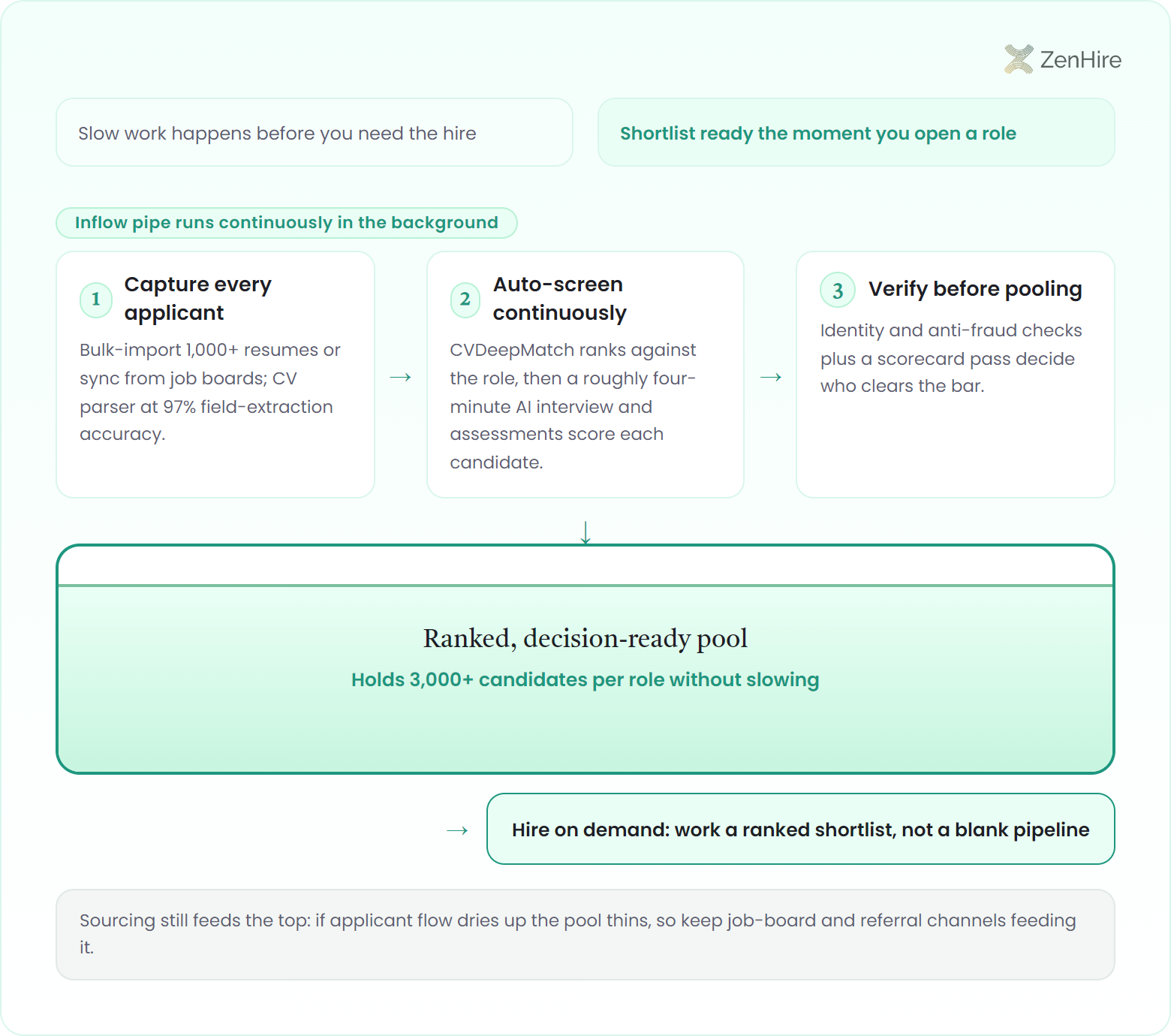
Vetting runs continuously in the background, so a qualified pool already exists when you open a role. Each applicant moves through CV matching, a short AI interview, skills assessment, and verification automatically, and the ones who clear the bar wait in a ranked pool until you need them. The same engine that powers ai candidate screening software does this front-end work the moment a resume lands, not weeks later.
Concrete example: a contact-center operator running constant agent intake lets every applicant self-screen around the clock; by the time a new account lands, hundreds of cleared candidates are already ranked and reachable. The honest edge case is sourcing, which this does not replace. The system speeds and stores screening, so if applicant flow at the top of the funnel dries up, the pool thins too. Keep your job-board and referral channels feeding it.
Built for the resume avalanche: the pipeline parses 1,000-plus resumes in a single bulk import and holds 3,000-plus candidates per role without slowing, so a peak campaign feeds the pool instead of breaking the screening step.
1. Capture every applicant
Bulk-import 1,000-plus resumes or sync from job boards; the CV parser structures each one on arrival at 97% field-extraction accuracy.
2. Auto-screen continuously
CVDeepMatch ranks against the role, then a roughly four-minute AI interview and assessments score each candidate.
3. Verify before pooling
Identity and anti-fraud checks plus a scorecard pass decide who clears the bar and enters the pool.
4. Hire on demand
When a role opens, you work a ranked, decision-ready shortlist instead of starting vetting from zero.
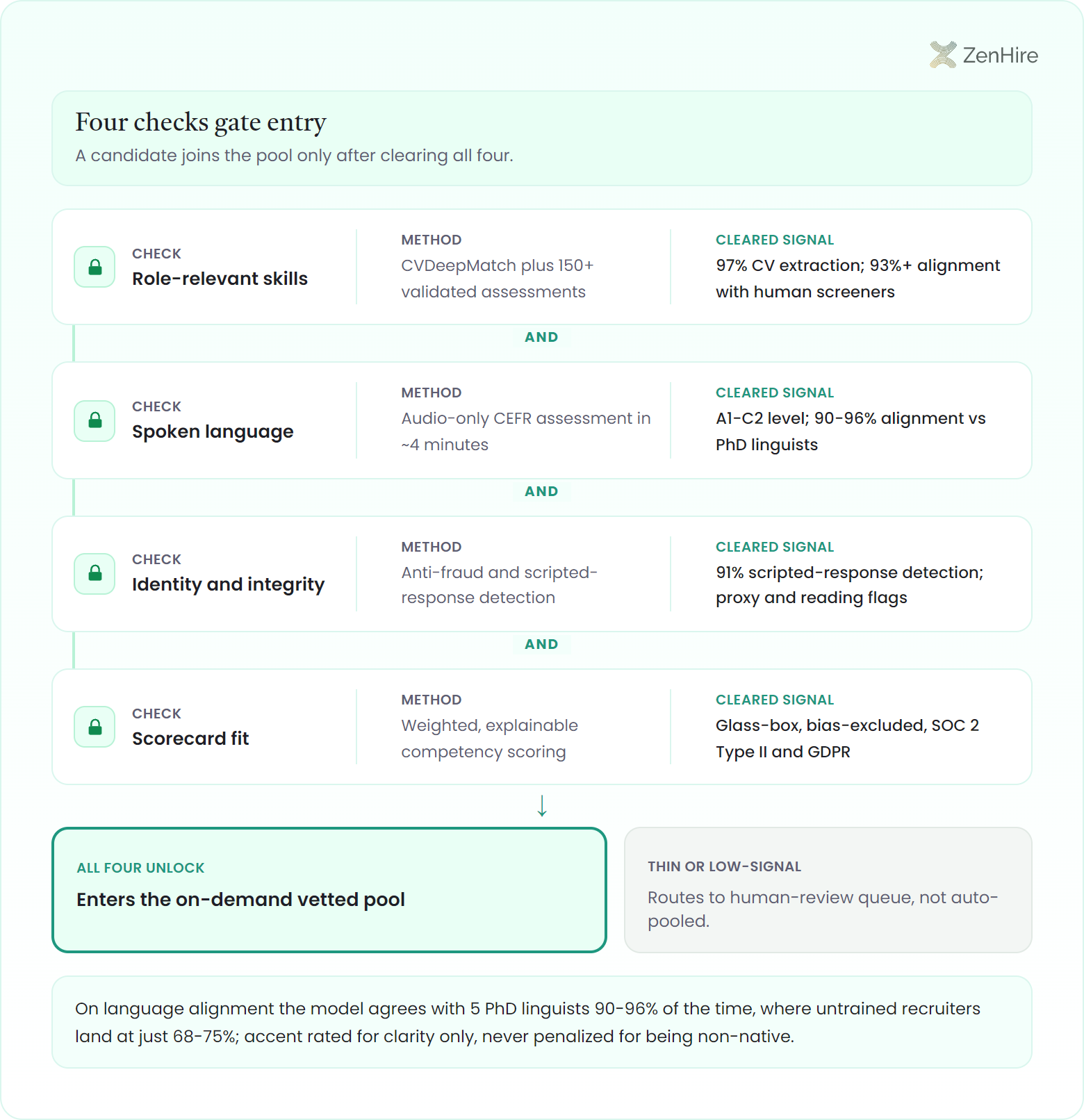
Four checks gate entry: role-relevant skills, spoken-language level, identity and integrity, and scorecard fit. A candidate only joins the on demand vetted candidates pool after clearing all four, so what you draw from is qualified rather than merely available.
Concrete example: for a customer-facing role you can require a B2 minimum on the CEFR scale, a passing assessment from the 150-plus validated test library, and a clean fraud signal; accent is rated for clarity only and never penalized for being non-native. The edge case worth flagging: a thin or sparsely worded resume gives the model little signal, so a borderline applicant is routed to a human-review queue rather than auto-pooled, keeping the bar honest. The spoken-language check runs on the same speech intelligence api that grades fluency, vocabulary, and pronunciation from audio alone.
On language alignment, the model agrees with the averaged judgment of 5 PhD linguists 90-96% of the time, where untrained human recruiters land at just 68-75%: a defensible bar for SLA-grade English, not a gut-feel phone screen.
| What ZenHire verifies | How it checks | Cleared signal |
|---|---|---|
| Role-relevant skills | CVDeepMatch plus 150+ validated assessments | 97% CV extraction; 93%+ alignment with human screeners |
| Spoken language | Audio-only CEFR assessment in ~4 minutes | A1-C2 level; 90-96% alignment vs PhD linguists |
| Identity and integrity | Anti-fraud and scripted-response detection | 91% scripted-response detection; proxy and reading flags |
| Scorecard fit | Weighted, explainable competency scoring | Glass-box, bias-excluded, SOC 2 Type II and GDPR |
Yes, because the slow work is already done; you open the ready to hire candidate pool, sort by score, and move people forward the same session. The shortlist is decision-ready on day one rather than something you build over the following two weeks.
Some argue an instant pool just means rushed, low-quality hires. The opposite holds here: every pooled candidate cleared the same four-gate vetting, with each score explainable and logged, so speed comes from front-loaded rigor, not from skipping it. Concrete example: when a peak ramp hits, you bulk-advance qualified candidates through stages at once and re-engage proven past applicants from the cross-role history in a click. This is the depth a high volume recruitment platform needs when an account win means standing up hundreds of agents in 60 to 90 days. The edge case is a brand-new role with no matching prior applicants; there the pool starts empty and you run normal intake first, then draw from it on the next opening.
Pre-screened candidates on demand are applicants already CV-matched, AI-interviewed, assessed, and identity-verified, held in a ready pool you draw from when a role opens. The vetting happens before you need the hire, so your shortlist is decision-ready instead of weeks away.
The ready to hire candidate pool stays accurate because every member cleared four explainable checks and the system logs each score. Cross-role history preserves a candidate's full record, and borderline or low-signal applicants are routed to human review rather than auto-added.
On demand vetted candidates carry a spoken-language grade before they ever reach the pool: the audio-only interview assigns an A1-to-C2 CEFR level in roughly four minutes and stores it on their record. Because accent is scored for clarity, not for sounding non-native, you can require a set threshold per role and trust that everyone in the pool already meets it.
Hiring from a pre-screened candidate pool is fair and auditable because scoring runs on a glass-box, audio-only model that excludes sensitive attributes and records every decision. ZenHire holds SOC 2 Type II and GDPR posture, so a fast hire stays a documented one.
The candidate pool keeps up with high-volume demand because the pipeline handles 3,000-plus candidates per role and 1,000-plus bulk resume imports without slowing. Bulk operations advance qualified candidates in batches, so a peak ramp draws from depth rather than starting over.
Free for Pre-screened candidate pool
A one-page checklist for building a ready-to-hire candidate pool: the four entry gates to set, the CEFR threshold to require per role, the fraud signals to flag, and how to keep every pooled decision auditable.


See how ZenHire keeps a pool of pre-screened candidates vetted and ranked so you hire on demand.