
What Is High-Volume Hiring?


· 8 min read
High-volume hiring is the practice of filling many similar, standardized roles quickly and repeatedly, measured by throughput rather than headcount: hundreds of contact-center agents, warehouse pickers, or seasonal retail staff screened in weeks. A contact center hiring 200 agents a quarter or a retailer staffing 5,000 seasonal seats both qualify; five bespoke executive searches do not. At this scale the screen you pick gets multiplied across the whole intake, and the numbers punish a lazy one: contact-center attrition runs 30-45% a year, roughly half of frontline leavers quit inside 90 days, and a validated screen stack sits around 0.6+ predictive validity while a resume glance sits near ~0.14 (r) — four-plus times the signal, replayed thousands of times.
What counts as high-volume hiring?
High-volume hiring counts as any process built to fill a large number of similar roles repeatedly and fast, measured by throughput rather than a single headcount target. The defining trait is not how many people you employ but how many near-identical hiring decisions you make in a compressed window: customer-service agents, warehouse pickers, seasonal retail staff, delivery drivers, or frontline restaurant crew.
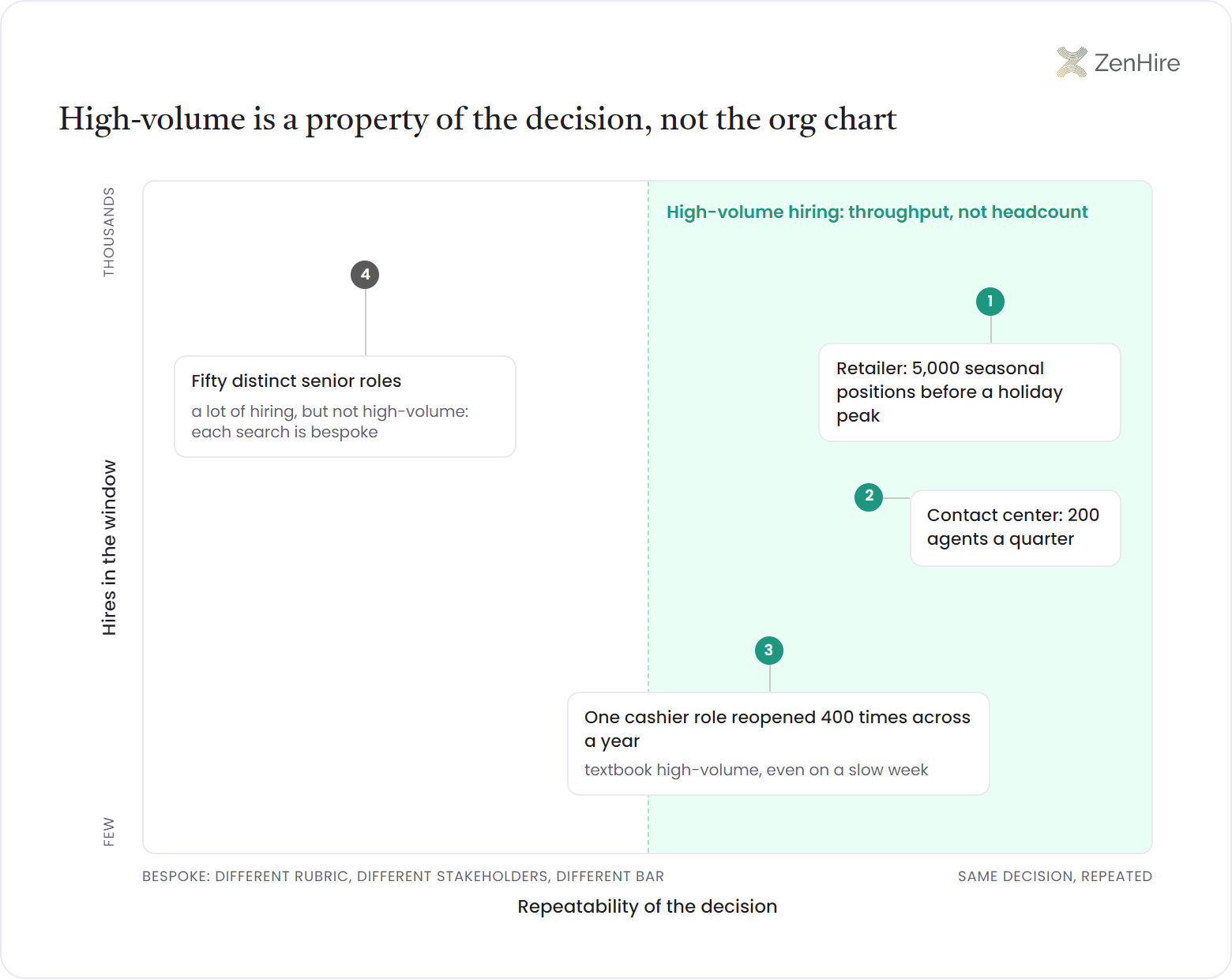
Mechanically, a role qualifies as high-volume when the funnel is wide, the roles are standardized, and the pace forces parallel evaluation instead of one careful search at a time. A contact center hiring 200 agents a quarter, a retailer staffing 5,000 seasonal positions before a holiday peak, or a BPO running continuous English screening all sit squarely in this category. The work is repeatable, the criteria are consistent across candidates, and the bottleneck is evaluation capacity, not sourcing creativity.
The edge case is the executive or specialist search that masquerades as volume. Filling fifty distinct senior roles is a lot of hiring, but each is bespoke (different rubric, different stakeholders, different bar), so it is not high-volume hiring even though the count is high. The opposite edge also holds: one cashier role you reopen 400 times across a year is textbook high-volume, even on a slow week. The signal is repeatability of the decision, not the size of the org chart.
Scale changes the economics. Contact-center attrition alone runs 30-45% a year (industry estimates), and roughly half of frontline leavers quit inside the first 90 days, before training pays back. At volume, a thin screen does not cost you one bad hire; it manufactures the same mistake across the whole intake, which is why high-volume hiring lives or dies on screening consistency.
- Repeatable, standardized roles: the same job description filled many times over
- Wide funnel, compressed timeline: far more applicants than any team can read by hand
- Evaluation is the bottleneck: not sourcing, not job posting, but consistent screening at pace
- High early-attrition exposure: frontline turnover concentrates in the first 90 days
How do you screen at scale in high-volume hiring without losing quality?
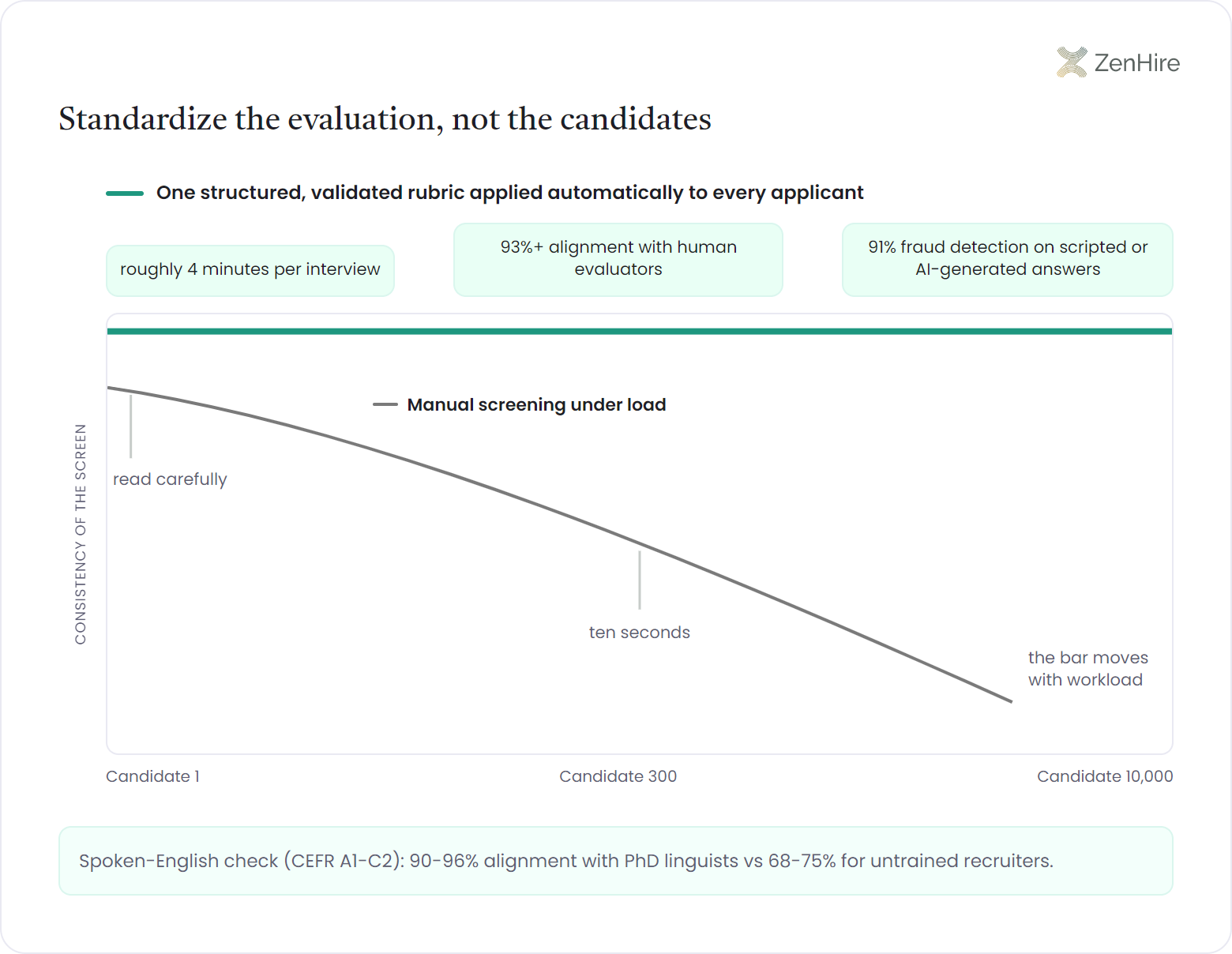
You screen at scale in high-volume hiring without losing quality by standardizing the evaluation, not the candidates, applying one structured, validated rubric automatically to every applicant so the bar never moves with workload. Quality decay happens when a busy human screener reads candidate one carefully and candidate three hundred in ten seconds; the fix is to remove that variance, not to hire more screeners.
The mechanism is structured, AI-assisted evaluation that scores communication, soft skills, reliability, and language the same way every time. A short asynchronous interview lets every applicant clear an identical bar regardless of when they applied or how busy the queue was. ZenHire's AI interview software reads multi-dimensional signals in roughly four minutes per candidate and lands 93%+ agreement with human evaluators — short enough to run across an entire seasonal intake, consistent enough that the evidence behind hire number ten and hire number ten thousand looks the same. Pair it with structured interview design and the same questions, scoring, and weighting hold across the whole flood.
A concrete example: a contact center hiring bilingual agents can route every applicant through a CEFR-aligned spoken-English check instead of a recruiter's gut-feel phone read. The audio-only assessment places each candidate on the A1-C2 scale in a few minutes, matching PhD linguists 90-96% of the time against 68-75% for untrained recruiters — so 'good enough English' stops depending on which interviewer took the call or how tired the shift was.
The edge case is volume that arrives in spikes: a seasonal hiring surge or a sudden new-client ramp. Manual screening fails exactly here, because the team cannot scale linearly with the applicant flood. Automated, consistent screening absorbs the spike without lowering the bar, and a fraud-detection layer (91% on scripted or AI-generated answers) keeps integrity intact when the funnel is too wide for anyone to eyeball every submission.
At volume the method you choose gets amplified, not averaged out. A plain resume review predicts on-the-job performance at about r = 0.14 and an unstructured interview at ~0.18; add structure (0.28), a skills test (0.45+), and a cognitive check (0.5+) and the stack clears 0.6 — over four times the signal. One hire, that gap is academic. Multiply it across a whole intake and it is the line between a clean cohort and a churn problem you funded yourself.
Which metrics matter most in high-volume hiring?
The metrics that matter most in high-volume hiring are time-to-fill, cost-per-hire, and 90-day retention read together, never one in isolation, because optimizing a single number almost always quietly breaks another. Cut time-to-fill by loosening the screen and you inflate 90-day attrition; chase the cheapest cost-per-hire and you usually pay it back in rehiring.
The mechanism is to treat the three as a balanced recruitment scorecard. Time-to-hire tells you whether the pipeline keeps up with demand, cost-per-hire tells you whether it is efficient, and 90-day retention tells you whether the speed and savings were real or borrowed against the future. Layer quality-of-hire on top so throughput is always read against whether those hires actually perform and stay, and segment everything by source, location, and role.
A concrete example: a retailer staffing for peak might hit a 12-day time-to-fill and a low cost-per-hire and call it a win, until the 90-day retention by hiring source shows one channel churning at twice the rate of another. The headline metrics looked healthy; the segmented view exposed where speed was bought with future turnover. That is the number that should redirect spend.
The edge case is the vanity funnel metric. Applications-per-opening or screening throughput feel like progress at volume, but a wider top of funnel with the same thin screen just produces more mis-hires faster. Volume metrics only mean something when paired with a quality outcome downstream, which is why retention, not raw applicant count, is the honest scoreboard for high-volume hiring.
| Metric | What it tells you at volume |
|---|---|
| Time-to-fill | Whether the pipeline keeps pace with demand and seat-vacancy cost |
| Cost-per-hire | Efficiency of the funnel, but cheap is a trap if retention drops |
| 90-day retention | Screening quality: did speed and savings hold up, or get borrowed? |
| Retention by source | Which channels deliver hires who stay, not just hires who start |
| Quality of hire | Whether throughput translated into people who perform |
When I watch teams scale hiring, the failure is almost never sourcing. It is the moment a recruiter who screened the first hundred candidates carefully starts skimming the next thousand because there are not enough hours in the day. That is not a discipline problem; it is a physics problem. You cannot hand-read your way through volume and keep the bar level. The whole point of doing this well is to make candidate ten thousand get exactly the same honest, structured evaluation as candidate one. Get that right, and 'fast' and 'fair' stop being a trade-off you have to apologize for.
Frequently asked questions
What is high-volume hiring in simple terms?+
High-volume hiring in simple terms is filling a large number of similar roles fast and repeatedly: mass hiring explained as throughput, not headcount. Think hundreds of customer-service agents, seasonal retail staff, or warehouse workers screened in weeks, where the same hiring decision is made over and over and consistency is the whole game.
How is high-volume hiring different from regular recruiting?+
High-volume hiring differs from regular recruiting in that the bottleneck is evaluation capacity, not finding candidates. Volume recruiting basics center on standardized roles, a wide funnel, and a compressed timeline, so the work shifts from bespoke search to applying one consistent bar across a flood of applicants without it slipping.
Does hiring at scale mean lowering the quality bar?+
Hiring at scale does not require lowering the quality bar; it requires standardizing it. Quality drops when manual screening gets thinner under load, not because volume is inherently incompatible with rigor. Structured, automated evaluation applies the same validated rubric to candidate one and candidate ten thousand alike, and that rubric carries roughly four times the predictive signal of a resume scan (0.6+ vs ~0.14).
How fast should high-volume hiring be?+
High-volume hiring should be as fast as the pipeline can go without 90-day attrition rising, since speed only counts if the hires stay. Track time-to-fill and 90-day retention together; a fast fill that churns inside three months is slower and costlier than a measured one, since replacing a frontline hire runs roughly $5,000-$20,000 (industry estimates).
What metrics matter most in high-volume hiring?+
The metrics that matter most in high-volume hiring are time-to-fill, cost-per-hire, and 90-day retention read together. Optimizing one alone usually breaks another, so segment all three by hiring source, location, and role, and layer quality-of-hire on top so throughput is always measured against people who actually perform and stay.
Free for high-volume hiring
The high-volume screening playbook
A practical guide to holding quality steady at scale: which signals to standardize, how to absorb seasonal spikes, and the metric trio that keeps speed honest.