
How Do You Reduce Employee Turnover?


· 5 min read
You reduce employee turnover by screening candidates for fit and reliability before the offer and supporting new hires through their first 90 days, because most early exits trace to hiring mismatch, not pay. Industry studies put roughly half of frontline leavers gone inside 90 days, before training pays back, and replacing one frontline worker costs $5,000-$20,000 (SHRM puts skilled roles at 50-200% of salary). The screen you use decides how much of that churn you can head off: a gut-feel interview forecasts who lasts at only ~0.18, but layer structured interviews with validated assessments and the tenure signal climbs past 0.6.
What causes employee turnover?
Employee turnover is caused mostly by hiring mismatch and a rough early experience: the wrong-fit hire and the unsupported first weeks, far more than pay alone. People who never fit the role, the pace, or the team leave fastest, and they leave before the investment in them pays back.
Pay and scheduling matter, but they explain the late, not the early, exits. The 90-day cliff is a screening problem: a candidate who looked fine on a resume could not actually carry the work. It is most acute in high-volume hiring, where the pressure to fill seats invites rushed, inconsistent screening.
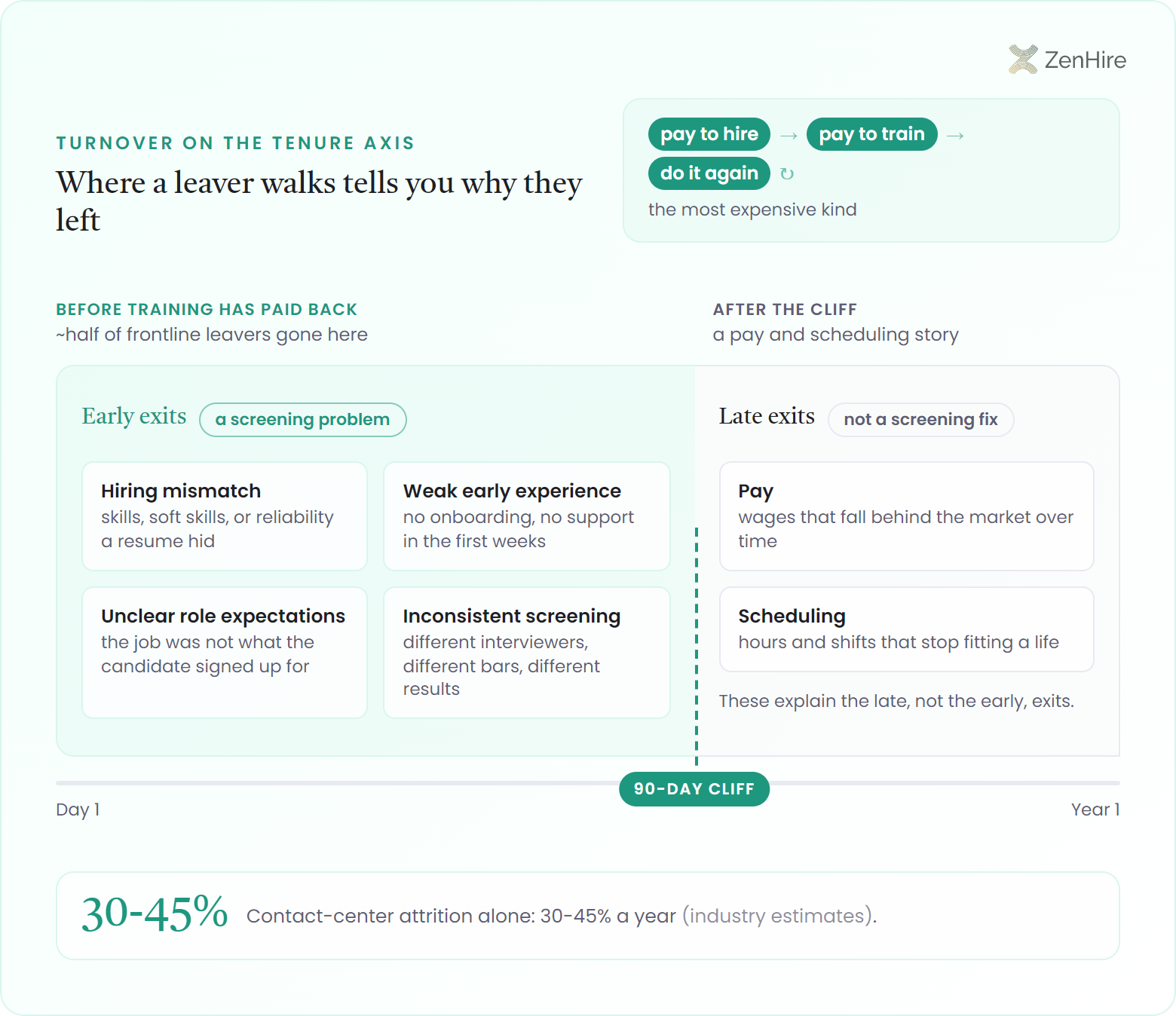
Roughly half of frontline hires who leave do so inside the first 90 days (before training has paid back), and contact-center attrition alone runs 30-45% a year (industry estimates). Early turnover is the most expensive kind: you pay to hire, pay to train, and pay to do it again.
- Hiring mismatch: skills, soft skills, or reliability that a resume hid
- Weak early experience: no onboarding, no support in the first weeks
- Unclear role expectations: the job was not what the candidate signed up for
- Inconsistent screening: different interviewers, different bars, different results
How do you hire to reduce employee turnover?
You hire to reduce turnover by evaluating fit and reliability consistently before the offer: structured interviews and assessments that predict tenure, not just qualifications. The aim is to catch the mismatch in screening, where it is cheap, instead of in week three, where it is not.
Structured, AI-assisted screening adds two things a busy hiring manager cannot: consistency and scale. Every candidate clears the same bar, scored the same way, so a strong communicator is not lost because they applied on a busy day. ZenHire's AI interview software reads communication, soft skills, and reliability signals in a few minutes, and the same evidence is there whether you hire ten people or ten thousand.
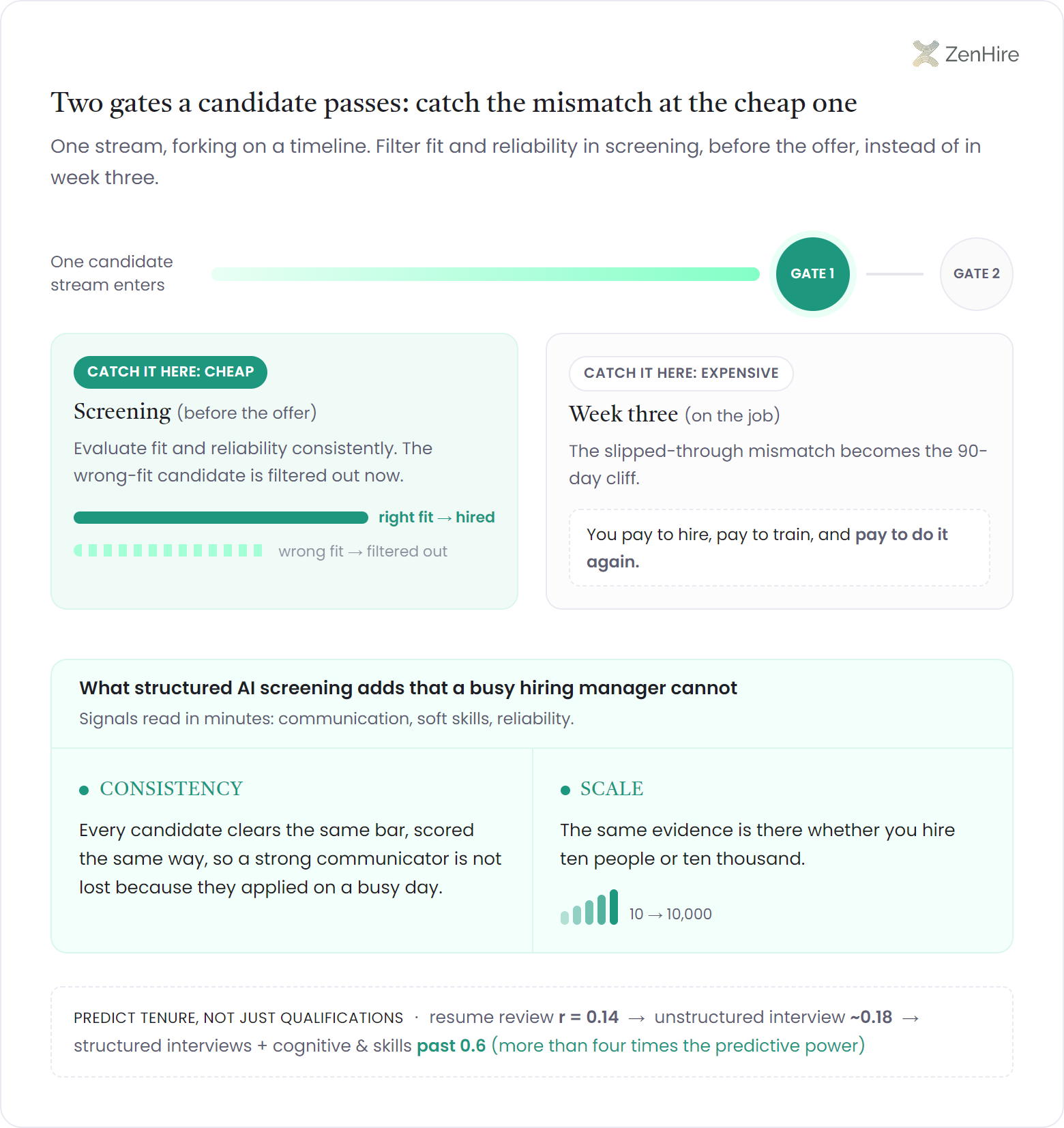
How you screen decides how many early exits you prevent: skim a resume and you forecast on-the-job performance at about r = 0.14; run an off-the-cuff interview and it barely moves to ~0.18. Stack structured interviews with cognitive and skills assessments and the tenure signal clears 0.6, more than quadrupling the predictive power a rushed screen gives you.
How do you measure a drop in employee turnover?
You measure a drop in turnover with 90-day and [annual turnover rates](/turnover/calculate-turnover-rate), segmented by role, location, and hiring source, so you can see which change actually moved retention, not just the headline number.
Track the leading indicator (90-day attrition) alongside the lagging one (annual turnover), and break both down by where the hire came from. If a sourcing channel or a screening change cuts 90-day quits, you will see it months before the annual rate moves. Pair it with quality-of-hire so retention is read against performance, not in isolation.
| Metric | What it tells you |
|---|---|
| 90-day attrition | Screening quality: are you hiring people who can do the job? |
| Annual turnover rate | Overall retention health, by role and location |
| Turnover by source | Which channels deliver hires who stay |
| Time to productivity | How long before a hire pays back the cost to replace them |
Everyone treats turnover as a retention problem: better perks, better managers, better pay. Those help at the margins, but I have watched the real leak sit at the front door: we hire someone we hope will work out, and on day one they do not. The cheapest retention program is an honest, consistent screen. Catch the mismatch before the offer and most of your 90-day churn simply never happens.
Frequently asked questions
What is the biggest cause of early employee turnover?+
The biggest cause of early employee turnover is hiring mismatch: a candidate who looked fine on paper but could not carry the role, pace, or team. It shows up as the 90-day cliff, where industry studies put roughly half of leavers gone before training pays back.
Can better hiring really reduce turnover?+
Better hiring is the most direct lever on early turnover, because most early exits are screening failures, not pay problems. Structured, consistent evaluation that predicts fit and reliability catches the mismatch before the offer, when it is cheap to fix.
How much does employee turnover cost?+
Employee turnover costs about $5,000-$20,000 to replace one frontline worker (industry estimates), and SHRM puts skilled-role replacement at 50-200% of annual salary once you count recruiting, training, and lost productivity.
What is a healthy employee turnover rate?+
A healthy turnover rate depends on the industry: frontline and contact-center roles run far higher (30-45% a year is common) than office roles. The more useful target is your own 90-day attrition trend, segmented by role and hiring source.
Free for reducing turnover
The 90-day retention checklist
A one-page checklist for cutting early turnover at the hire: what to screen for, the reliability signals to weight, and the first-90-days support that keeps new hires.