
Interview Analysis
Interview Analysis for Lecturers
Interview analysis for lecturers scores how a candidate actually performs the spoken, human parts of the job: communication, composure, and the role-specific skills a resume cannot show, all from a single short AI interview.
What does interview analysis reveal about a lecturer?
Interview analysis reveals how a lecturer actually performs the human side of the job: how a lecturer structures a complex topic into a talk a hall full of students can follow, fields a sharp question from the back without losing the thread, and holds attention across a long session without slipping into a monotone.
A resume lists where a lecturer has worked; it cannot show how they speak, react, and carry a real interaction. ZenHire's ai interview software runs a short, structured interview and scores the communication and soft-skill signals that predict on-the-job performance, turning a subjective gut-read into evidence you can compare candidate to candidate.
Which skills does interview analysis score for a lecturer?
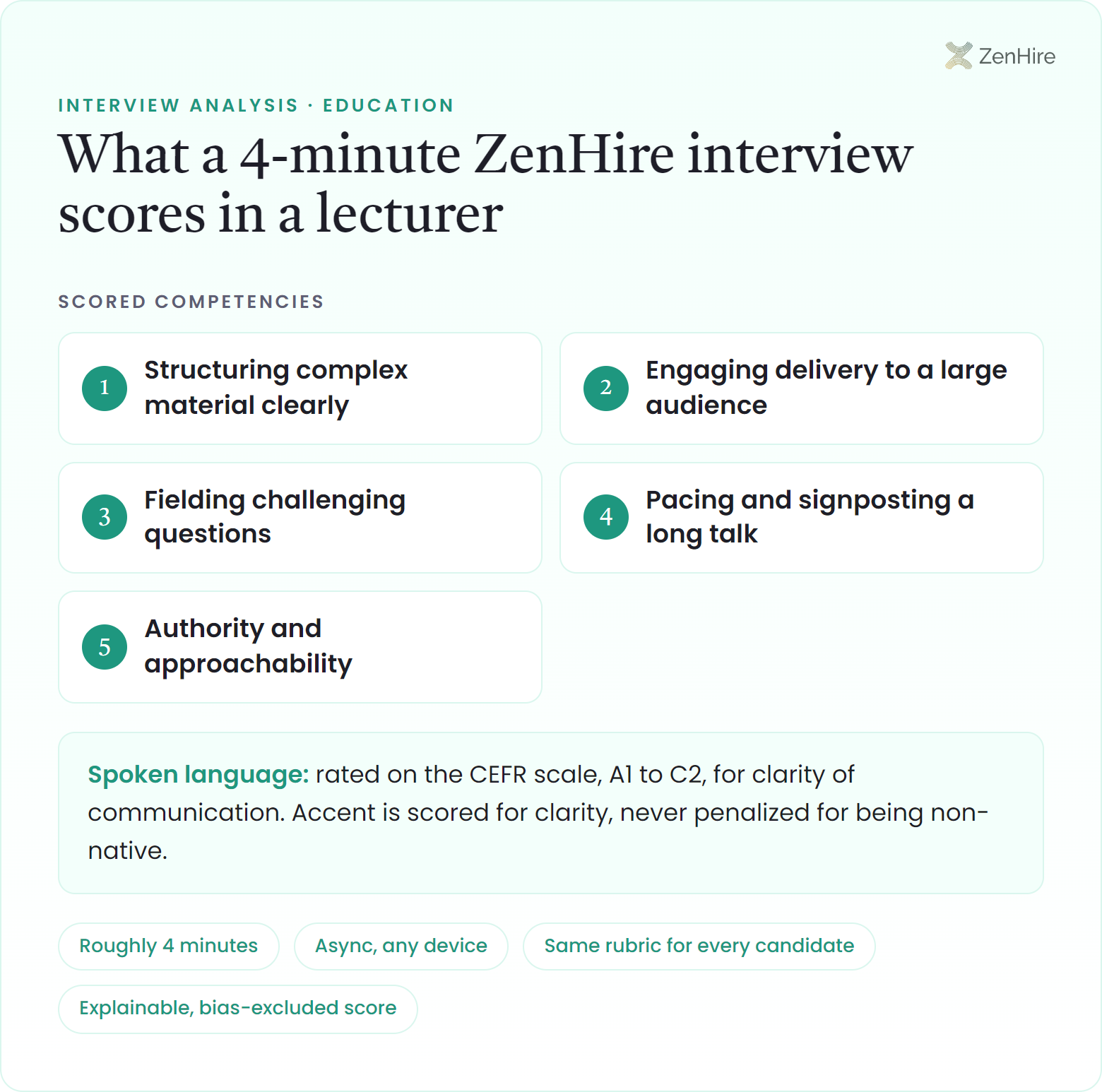
Interview analysis scores the specific competencies that predict a strong lecturer, not a generic template. For this role it weighs:
- Structuring complex material clearly
- Engaging delivery to a large audience
- Fielding challenging questions
- Pacing and signposting a long talk
- Authority and approachability
Each competency is scored on the same rubric for every candidate, so the bar a lecturer clears is consistent, and every score ships with the evidence behind it, so a hiring manager can audit it or override it with judgment.
How does language analysis rate a lecturer?
Language analysis rates a lecturer on clarity, fluency, and CEFR level (A1-C2): A lecturer is judged on spoken fluency and CEFR level, because a hall of students, many of them non-native speakers, has to follow the argument in real time, and accent is rated for clarity alone rather than penalized for being non-native.
The scoring is question-agnostic and reads real speech rather than a memorised answer, and it aligns 90-96% with a panel of PhD linguists where untrained recruiters land at 68-75%. Accent is rated for clarity only and never penalised for being non-native. See how English proficiency is assessed for the full CEFR breakdown.
How fast can you screen lecturer candidates with interview analysis?
You can screen lecturer candidates in minutes, not weeks: Async four-minute interviews let a department shortlist lecturer applicants fast, surfacing the strongest communicators before any panel or guest-lecture day is arranged.
Each interview runs about four minutes and is scored automatically, so a backlog that took days of phone screens becomes a ranked shortlist the same day. A single role can hold thousands of applicants without slowing down, which is why interview analysis fits high-volume hiring as well as a single careful hire.
Free for hiring lecturers
Get the lecturer screening scorecard
See exactly what interview analysis scores for lecturers: the rubric, the CEFR bar, and how to read the results. We will send it over.
FAQ
What does interview analysis measure for a lecturer?
Interview analysis measures how a lecturer communicates and performs the human side of the role (structuring complex material clearly, engaging delivery to a large audience, fielding challenging questions, and spoken language) from a short structured AI interview, with the evidence behind every score.
Is interview analysis for lecturer candidates fair?
Interview analysis for lecturer candidates is built to be fair: scoring is explainable and auditable, sensitive attributes are excluded by design, and accent is rated for clarity only, never penalised for being non-native.
How long does interview analysis take for lecturer candidates?
Interview analysis takes about four minutes per lecturer candidate. Interviews are async and scored automatically, so candidates complete them on their own time and you work a ranked shortlist instead of scheduling live screens.
Can interview analysis screen lecturer candidates at volume?
Interview analysis screens lecturer candidates at volume: a single role can hold thousands of applicants, all scored on the same rubric in bulk, so high-volume hiring clears before a recruiter opens the first profile.


Screen your next lecturer on evidence, not a gut-feel
See how ZenHire scores lecturers on the skills and language that predict performance, in about four minutes per candidate.