
Interview Analysis
Interview Analysis for Phlebotomists
Interview analysis for phlebotomists scores how a candidate actually performs the spoken, human parts of the job: communication, composure, and the role-specific skills a resume cannot show, all from a single short AI interview.
What does interview analysis reveal about a phlebotomist?
Interview analysis reveals how a phlebotomist actually performs the human side of the job: how a phlebotomist talks a needle-shy patient through a draw, keeps a steady reassuring tone while staying meticulous about labelling and order, and recovers gracefully from a difficult vein.
A resume lists where a phlebotomist has worked; it cannot show how they speak, react, and carry a real interaction. ZenHire's ai interview software runs a short, structured interview and scores the communication and soft-skill signals that predict on-the-job performance, turning a subjective gut-read into evidence you can compare candidate to candidate.
Which skills does interview analysis score for a phlebotomist?
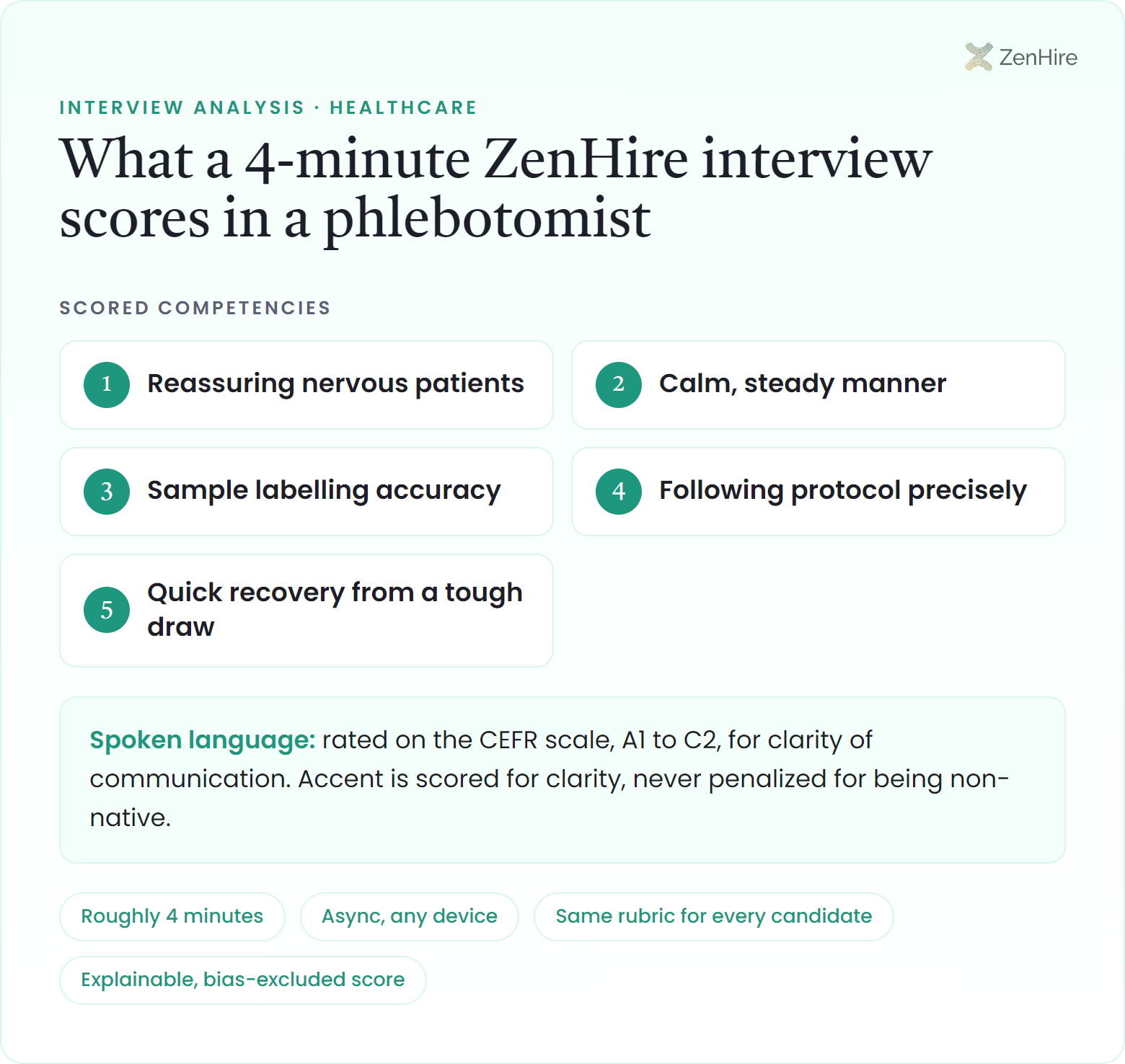
Interview analysis scores the specific competencies that predict a strong phlebotomist, not a generic template. For this role it weighs:
- Reassuring nervous patients
- Calm, steady manner
- Sample labelling accuracy
- Following protocol precisely
- Quick recovery from a tough draw
Each competency is scored on the same rubric for every candidate, so the bar a phlebotomist clears is consistent, and every score ships with the evidence behind it, so a hiring manager can audit it or override it with judgment.
How does language analysis rate a phlebotomist?
Language analysis rates a phlebotomist on clarity, fluency, and CEFR level (A1-C2): A phlebotomist needs the spoken clarity to confirm a patient's identity and explain what is about to happen, so language analysis rates CEFR level and pronunciation, and grades accent purely on whether the patient understands, not on sounding native.
The scoring is question-agnostic and reads real speech rather than a memorised answer, and it aligns 90-96% with a panel of PhD linguists where untrained recruiters land at 68-75%. Accent is rated for clarity only and never penalised for being non-native. See how English proficiency is assessed for the full CEFR breakdown.
How fast can you screen phlebotomist candidates with interview analysis?
You can screen phlebotomist candidates in minutes, not weeks: A four-minute async interview ranks a whole pool of phlebotomist applicants in bulk, useful when a lab or clinic is staffing several draw stations at once.
Each interview runs about four minutes and is scored automatically, so a backlog that took days of phone screens becomes a ranked shortlist the same day. A single role can hold thousands of applicants without slowing down, which is why interview analysis fits high-volume hiring as well as a single careful hire.
Free for hiring phlebotomists
Get the phlebotomist screening scorecard
See exactly what interview analysis scores for phlebotomists: the rubric, the CEFR bar, and how to read the results. We will send it over.
FAQ
What does interview analysis measure for a phlebotomist?
Interview analysis measures how a phlebotomist communicates and performs the human side of the role (reassuring nervous patients, calm, steady manner, sample labelling accuracy, and spoken language) from a short structured AI interview, with the evidence behind every score.
Is interview analysis for phlebotomist candidates fair?
Interview analysis for phlebotomist candidates is built to be fair: scoring is explainable and auditable, sensitive attributes are excluded by design, and accent is rated for clarity only, never penalised for being non-native.
How long does interview analysis take for phlebotomist candidates?
Interview analysis takes about four minutes per phlebotomist candidate. Interviews are async and scored automatically, so candidates complete them on their own time and you work a ranked shortlist instead of scheduling live screens.
Can interview analysis screen phlebotomist candidates at volume?
Interview analysis screens phlebotomist candidates at volume: a single role can hold thousands of applicants, all scored on the same rubric in bulk, so high-volume hiring clears before a recruiter opens the first profile.


Screen your next phlebotomist on evidence, not a gut-feel
See how ZenHire scores phlebotomists on the skills and language that predict performance, in about four minutes per candidate.