
What Is Quality of Hire and How Do You Measure It?


· 7 min read
Quality of hire is a composite measure of how well a new employee performs and how long they stay, and you measure it by combining ramp speed, performance rating, retention, and manager satisfaction. Which screen you ran caps how high that composite can go: judge candidates on a resume alone and you are working from a predictive validity of about r = 0.14, but stack a structured interview on top of validated assessments and the same decision carries past 0.6, roughly four times the signal to work with. Read the composite at 90 days and again at one year alongside cost-per-hire and turnover, since one frontline replacement lands somewhere between $5,000 and $20,000 and SHRM pegs skilled-role replacement at 50-200% of annual salary.
What is quality of hire?
Quality of hire is a composite measure of how well a new employee performs and how long they stay. It answers whether the people you hired actually did the job they were hired to do. It is the one recruiting metric that looks past the hiring event and judges the decision by its result, which is why it sits at the center of any serious hiring scorecard.
Mechanically, quality of hire blends a few signals into one read: how fast a hire reaches full productivity, their performance rating once ramped, whether they are still there at 90 days and a year, and how satisfied their manager is with the match. A concrete example: two contact-center cohorts hired the same month look identical on a time-to-hire dashboard, but one ramps to full proficiency in four months and stays, while the other churns at the 90-day cliff, and only quality of hire tells those two cohorts apart. The edge case to watch is the high performer who leaves early: strong output for ten weeks is not a quality hire if the role takes four to six months to reach full proficiency and you are already paying to replace them.
The quality of a hire is largely fixed before the first day on the job. Rank candidates on a resume review and you get roughly r = 0.14 of predictive signal; an unstructured interview barely moves it to ~0.18. Structure that interview and it climbs to ~0.28, and layering cognitive and skills assessments underneath pushes the combined read past 0.6, better than four times what the resume alone gave you.
- Performance: rating or output once the hire is fully ramped
- Retention: still in the role at 90 days and at one year
- Ramp speed: time to reach full productivity, often 4-6 months for frontline roles
- Manager satisfaction: whether the hire matched what the role actually needed
Which inputs make up quality of hire?
The inputs that make up quality of hire are the evaluation signals you collect before the offer plus the outcome signals you collect after the start date, and the pre-hire signals are the ones you can actually control. Skills and role fit, soft skills and communication, reliability, and (for voice-centric or offshore roles) language proficiency form the predictive front end; performance, retention, and ramp form the confirming back end.
The mechanism is that each pre-hire input carries its own predictive validity, so shifting weight toward the stronger inputs is what lifts quality. A cognitive assessment sits at 0.5+ and a skills test at 0.45+, both well clear of a CV scan, which is why a screen built on validated assessments quietly turns out better hires. A concrete example: for a customer-service role you might lean hard on spoken-English fluency and a short cognitive test, since those forecast on-the-job success more reliably than the years a resume lists, and ZenHire's CV DeepMatch checks whether a candidate actually used a skill or merely name-dropped it, so the input feeding the score is more honest to begin with. The edge case is over-indexing on one input: a standout test score paired with poor reliability still lands you a low-quality hire, which is exactly why you weight and track the composite rather than any single signal.
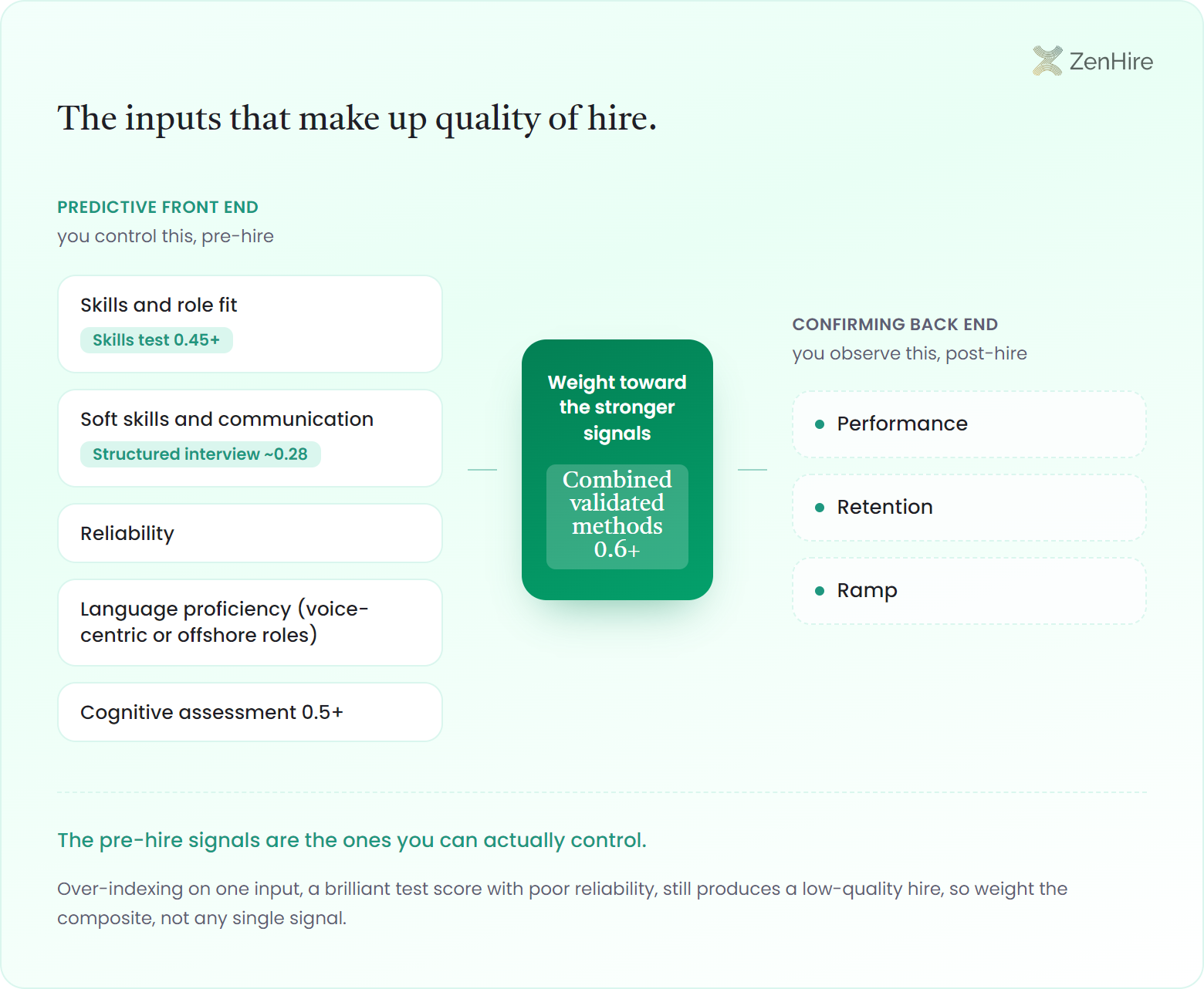
| Pre-hire input | Predictive validity | What it confirms after hire |
|---|---|---|
| Resume / CV scan | ~0.14 | Weak signal; baseline only |
| Unstructured interview | ~0.18 | Gut-feel, hard to confirm |
| Structured interview | ~0.28 | Consistent fit and communication |
| Skills test | 0.45+ | Can they do the actual work |
| Cognitive assessment | 0.5+ | Ramp speed and problem-solving |
| Combined validated methods | 0.6+ | Performance and retention together |
How do you tie quality of hire to business outcomes?
You tie quality of hire to business outcomes by reading it against the metrics it is supposed to move, cost-per-hire, time-to-productivity, and turnover, segmented by role, location, and hiring source. Quality of hire is only useful when it explains something you care about in dollars or output, so it should never live on a dashboard by itself.
The mechanism is correlation over time: raise quality-of-hire scores with a screening change and a few months later you should watch ramp shorten, 90-day turnover fall, and the all-in cost to fill-and-keep a seat come down with it. A concrete example: set quality against cost-per-hire and the arithmetic turns blunt fast, because one frontline replacement runs about $5,000-$20,000 (industry estimates) and SHRM puts skilled-role replacement at 50-200% of salary, so a modest quality lift that heads off a handful of mis-hires earns the screening back several times over. The edge case is the lag: quality of hire leads, but it confirms slowly, so grade a screening change on 90-day cohorts and trailing turnover by source rather than on next week's headline number.
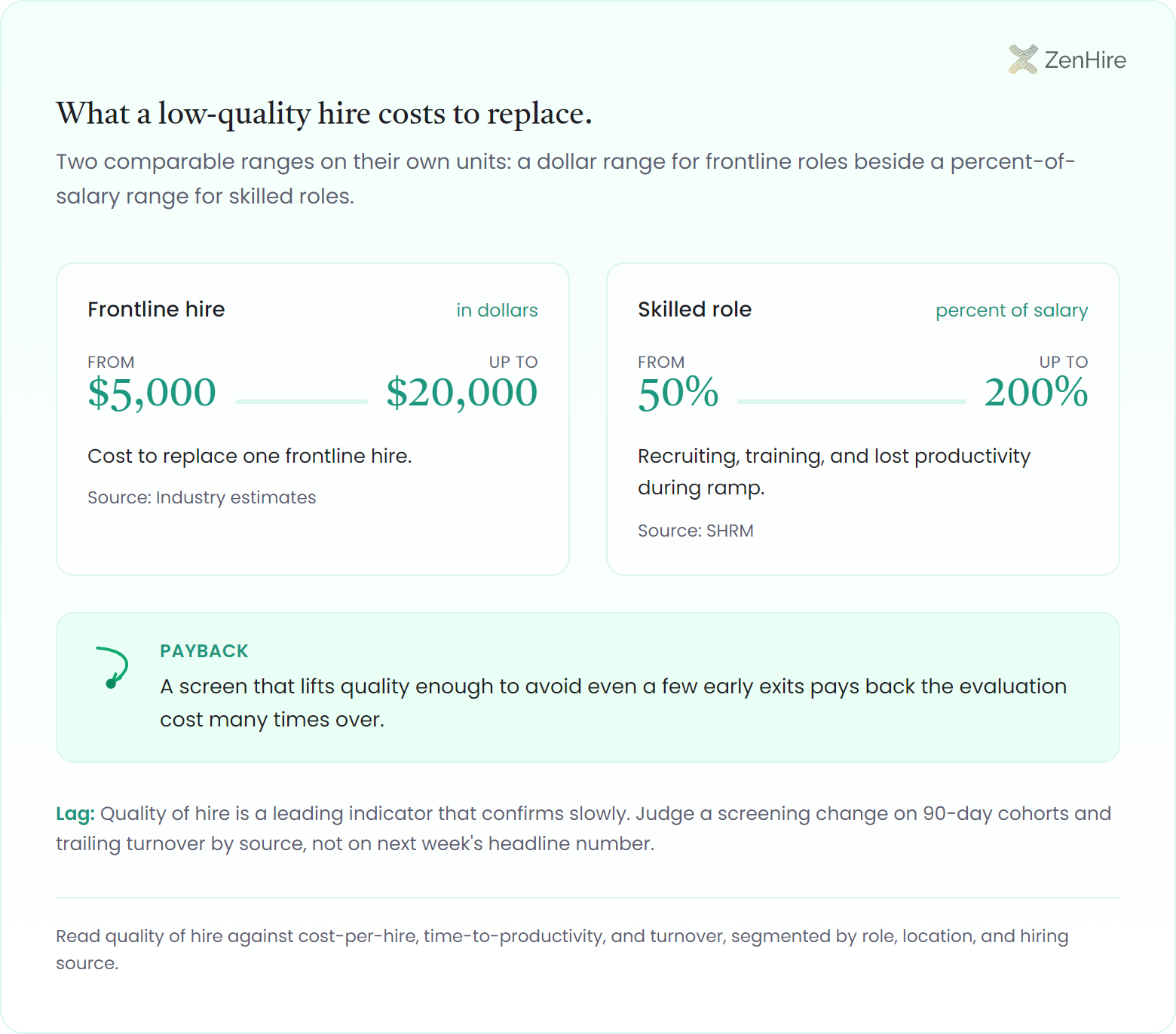
Keep quality of hire next to the numbers it actually moves. One frontline replacement costs roughly $5,000-$20,000 (industry estimates), and SHRM puts skilled-role replacement at 50-200% of annual salary, so a screen that lifts quality enough to spare even a couple of early exits has already paid for the evaluation several times over.
For years I watched teams celebrate a fast hire and a filled seat as if the job were done, and then quietly eat the cost three months later when the person could not do the work. Speed without quality is just a faster way to make an expensive mistake. The number I trust is not how quickly we filled the role, it is whether that hire is still there and performing at ninety days. Quality of hire is the only metric that holds screening accountable for what it promised, and it is decided long before the start date, at the screen, with honest, consistent evaluation, not at the offer.
Frequently asked questions
What is the simplest way to define quality of hire?+
The simplest definition of quality of hire is how well a new employee performs and how long they stay. It is a composite that blends performance rating, retention, ramp speed, and manager satisfaction into one read, so a fast hire who underperforms or quits early is not a high-quality hire.
How do you measure quality of hire?+
You measure quality of hire by combining performance, retention, ramp speed, and manager satisfaction into a single score, segmented by role, location, and hiring source. Track it against cost-per-hire and turnover so a screening change can be judged on 90-day cohorts rather than on the headline hiring number.
What is a good quality of hire metric to start with?+
A good quality-of-hire metric to start with is 90-day retention paired with a first performance rating. It is easy to collect, it reflects screening quality directly, and it moves months before annual turnover does, so it gives you an early read on whether a hiring change is working.
Why does screening method affect quality of hire so much?+
Screening method affects quality of hire because each method carries a known predictive validity that caps the outcome you can reach. Screen on a resume and you are anchored to roughly 0.14; pair a structured interview with validated assessments and you clear 0.6, about four times the signal, so the method largely decides the quality that follows.
How much does a low-quality hire cost?+
A low-quality frontline hire costs about $5,000-$20,000 to replace (industry estimates). For skilled roles SHRM puts the figure at 50-200% of annual salary once recruiting, training, and the productivity lost during ramp are all counted, which is why even a small lift in quality of hire returns the screening cost many times over.
Free for quality of hire
The quality-of-hire scorecard
A one-page template for scoring quality of hire: the four inputs to weight, how to segment by role and source, and the outcome metrics to read it against.