
How Do You Reduce Call Center Attrition?


· 7 min read
You reduce call center attrition by screening for spoken fluency, composure, and reliability before the offer, then supporting agents through their first 90 days. Contact-center attrition runs 30-45% a year against a ~22% cross-industry average, and about half of leavers quit inside 90 days, before the 4-6 month ramp to full proficiency pays back. Replacing one agent costs $5,000-$20,000 (industry estimates), so the cheapest fix is a consistent structured screen: combined validated methods predict performance at 0.6+ versus ~0.18 for unstructured interviews.
Why do call center agents leave within 90 days?
Call center agents leave within 90 days mostly because the hire was mismatched to the work, not because the job suddenly got worse. The agent who looked fine on a resume and sounded fine on a quick phone screen could not actually hold a clear conversation under pressure, handle back-to-back calls, or keep composure through an angry caller, and that gap surfaces in the first weeks, on the floor, where it is most expensive to discover.
The mechanism is simple: contact-center work is high-volume, high-stress, and verbal, so the traits that matter (spoken fluency, emotional steadiness, reliability) are exactly the ones a CV hides. BPO turnover causes cluster around this hidden mismatch far more than pay. A concrete example: a candidate passes a written English test and a friendly 10-minute screen, then washes out in week three because they freeze on live calls and their average handle time never improves. The edge case worth naming is the reverse: a strong, steady communicator who reads as 'quiet' on a rushed phone screen and gets cut, then thrives elsewhere; inconsistent screening loses keepers as readily as it admits mismatches. Early attrition is most acute in high-volume hiring, where the pressure to fill seats invites rushed, uneven evaluation.
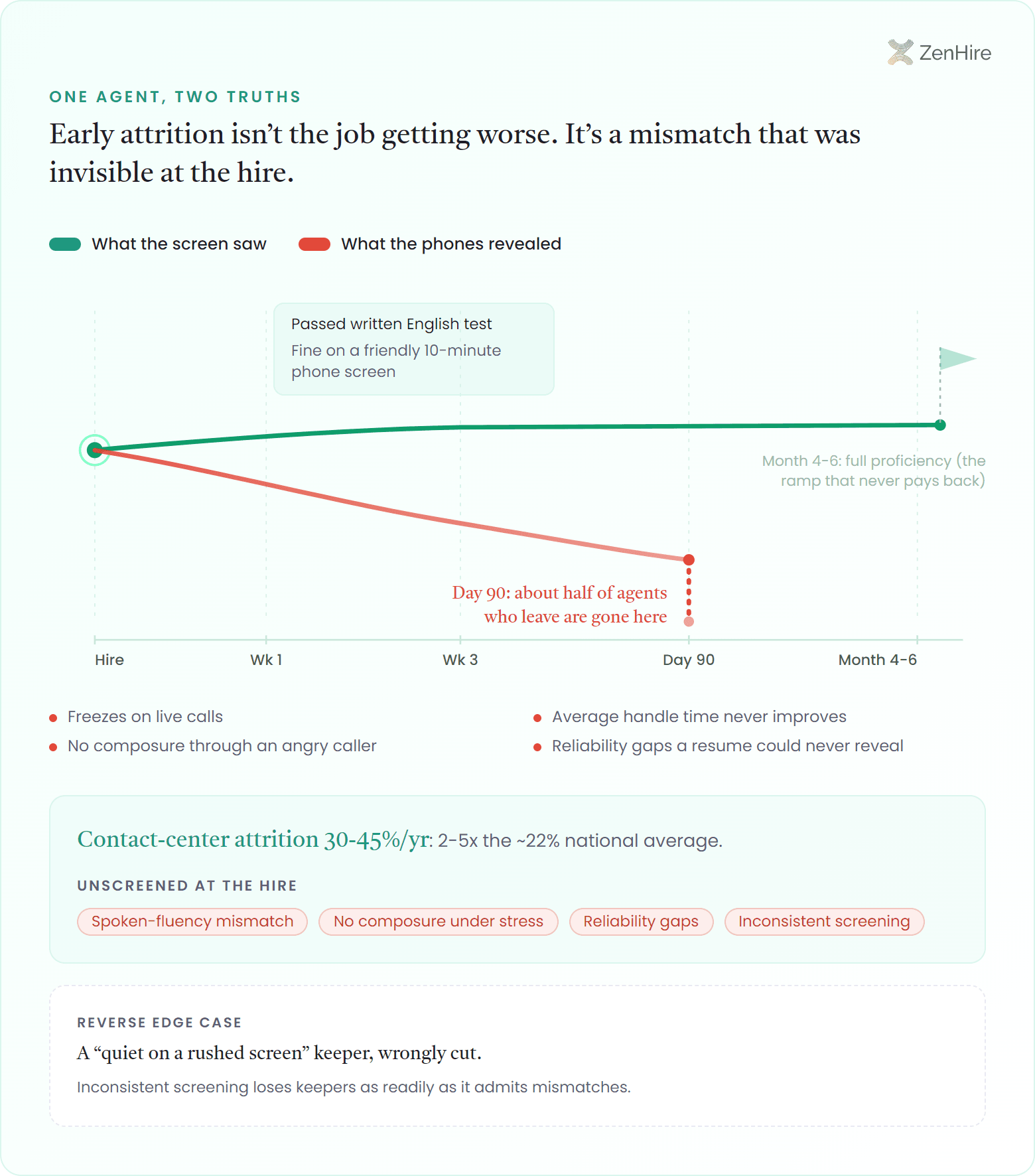
Contact-center attrition runs 30-45% a year (roughly 2-5x higher than the ~22% national average) and about half of agents who leave do so inside their first 90 days, before the 4-6 month ramp to full proficiency pays back (industry benchmarks). Early churn is the costliest kind: you pay to hire, pay to train, then pay to do it all again.
- Spoken-fluency mismatch: fine in writing, but cannot hold a clear call under pressure
- No composure under stress: back-to-back calls and angry callers were not screened for
- Reliability gaps: attendance and follow-through a resume could never reveal
- Inconsistent screening: different interviewers, different bars, different results
How do you hire call center agents who stay?
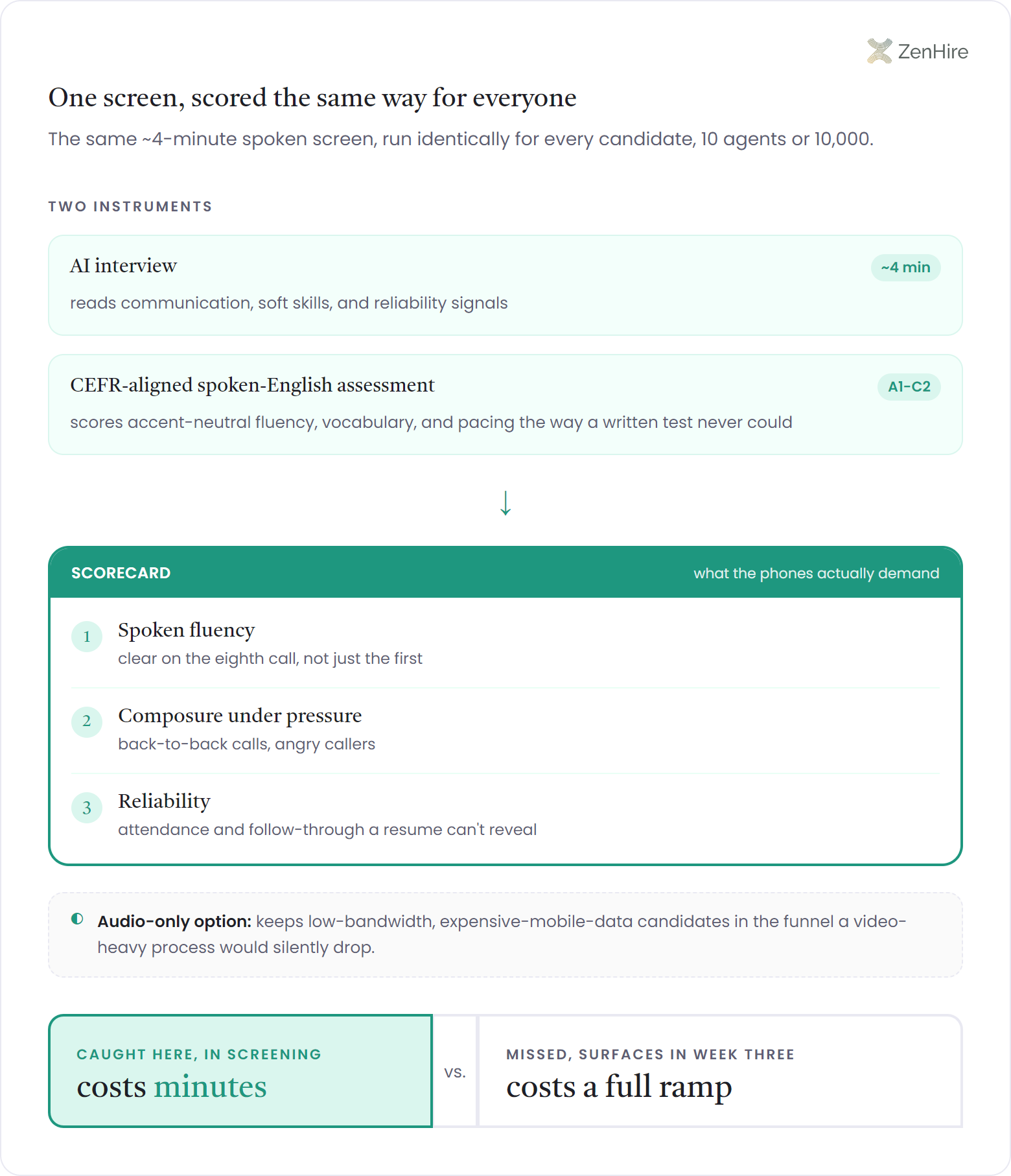
You hire call center agents who stay by evaluating spoken fluency, composure, and reliability consistently before the offer, not by reading resumes faster. The goal is to catch the mismatch in screening, where it costs minutes, instead of in week three, where it costs a full ramp. That means structured, scored evaluation of the things the phones actually demand, applied identically to every candidate so a strong communicator is never lost to a busy application day.
Structured, AI-assisted screening adds two things a busy hiring manager cannot: consistency and scale. Every candidate clears the same bar, scored the same way, whether you hire ten agents or ten thousand. ZenHire's AI interview software runs a roughly four-minute interview that reads communication, soft skills, and reliability signals, and its CEFR-aligned spoken-English assessment scores accent-neutral fluency, vocabulary, and pacing the way a written test never could. A concrete example: instead of one rushed phone screen per recruiter, every applicant completes the same short spoken assessment, and you shortlist on evidence, not on who happened to interview well that morning. The edge case to plan for is the low-bandwidth candidate in a market with expensive mobile data; an audio-only option keeps strong applicants in the funnel who a video-heavy process would silently drop. To lower agent attrition over time, you also want to lower agent attrition's hidden upstream driver: cost-per-hire waste from re-hiring the same mismatched profile.
| Screening method | Predicts on-the-job performance (r) |
|---|---|
| Resume review | ~0.14 |
| Unstructured interview | ~0.18 |
| Structured interview | ~0.28 |
| Cognitive / skills tests | 0.45-0.5+ |
| Combined validated methods | 0.6+ |
How does early support cut call center attrition?
Early support cuts call center attrition by carrying a good hire through the exact window where most quits happen: the first 90 days, before proficiency and confidence arrive. A well-screened agent still leaves if weeks one through twelve feel like sink-or-swim, so the support that matters is concrete: clear expectations set during hiring, a structured onboarding, fast feedback on live calls, and a manageable ramp instead of full quotas on day one.
The mechanism is that screening and support compound: the right hire plus a real first-90-days plan is what actually moves retention, not either alone. A concrete example: pairing a new agent with a buddy for shadowed calls and giving daily coaching for two weeks shortens the lonely stretch where doubt turns into a resignation. Candidate experience starts this earlier than most teams think: a warm, transparent candidate experience sets honest expectations so no one is blindsided by the pace of the floor. The edge case: support cannot rescue a fundamental mismatch. Coaching a candidate who genuinely cannot hold a call just delays an exit and burns goodwill, which is exactly why the screen has to come first. Track the result with a 90-day attrition metric segmented by hiring source, so you can see which change actually kept agents.
Two numbers frame the payback window: a new agent takes 4-6 months to reach full proficiency, yet about half of leavers quit inside 90 days, so the support that bridges those first weeks is, dollar for dollar, the highest-return retention move a contact center can make.
In contact-center hiring, everyone obsesses over the exit interview, and by then it is too late. I have watched centers burn a fortune re-hiring the same mismatch over and over because the screen was a written test and a friendly chat, neither of which is the job. The job is talking to a frustrated stranger, clearly, for the eighth hour in a row. So we measure that directly: a few minutes of real spoken assessment, scored the same way for everyone, accent-neutral by design. Get the front door right and most of your 90-day churn never starts. The phones are the truth; screen for them.
Frequently asked questions
What is the biggest cause of call center attrition?+
The biggest cause of call center attrition is a hiring mismatch on the verbal, high-pressure parts of the job: agents who pass a written test and a quick phone screen but cannot hold clear calls under stress. It shows up as the 90-day cliff, where industry studies put about half of leavers gone before the 4-6 month ramp pays back.
How do you lower agent attrition without raising pay?+
You lower agent attrition first by screening for spoken fluency, composure, and reliability before the offer, then by supporting the first 90 days. Pay matters for late exits, but most early churn is a screening failure; a structured, consistent spoken assessment catches the mismatch when it is cheap to fix, and a real onboarding plan carries good hires through the hardest weeks.
How much does call center attrition cost per agent?+
Replacing one call center agent costs about $5,000-$20,000 depending on role complexity (industry estimates), once you count recruiting, training, and the productivity lost during a 4-6 month ramp. SHRM puts general replacement cost at 50-200% of annual salary.
What is a normal call center attrition rate?+
A normal call center attrition rate is high, roughly 30-45% a year by global industry benchmarks, which is 2-5x the ~22% national average across industries. The more useful target than the headline number is your own 90-day attrition rate, segmented by role and hiring source.
Can spoken-English screening reduce BPO turnover?+
Yes: a short, CEFR-aligned spoken assessment reduces BPO turnover causes that written tests miss, because it scores real fluency and composure under pressure rather than reading or grammar alone. Scored consistently and accent-neutral by design, it predicts who can actually carry live calls, which is the gap behind most early exits.
Free for reducing call center attrition
The call center 90-day retention playbook
A one-page playbook for cutting agent attrition at the hire: the spoken-fluency and reliability signals to weight, the audio-only screen that keeps candidates in the funnel, and the first-90-days support that keeps them.