
The ZenHire recruitment API for ATS adds matching, parsing, scoring, and interview intelligence to the stack you already run: composable REST modules that return JSON, sync in real time, and ship under your own brand. No rip-and-replace.
{
  "candidate_id": "c_84213",
  "modules": {
    "cv_match": { "score": 87, "qualification": "qualified" },
    "resume_parse": { "fields": 24, "confidence": 0.96 },
    "candidate_score": { "competency_index": 81 },
    "speech": { "cefr": "C1", "fraud_signals": [] }
  },
  "synced_to_ats": true
}Because your system of record stores candidates well but rarely judges them. An AI layer reads, ranks, and scores applicants inside the tools your team already opens, without a migration.
Most platforms move tracking but not intelligence: they log every applicant, then leave a recruiter to read each resume by hand. The recruitment API closes that gap, scoring thousands per role before anyone opens a first page and writing the verdict straight back to the candidate record. On a single high-volume requisition the engine handles 3,000+ candidates per role and bulk imports of 1,000+ resumes without slowing down: default limits run at 500 requests per minute per client with 8 simultaneous processing runs, and anything beyond that queues cleanly with a 202 rather than an error, so a flood of applicants becomes a ranked queue rather than a backlog.
Some teams argue an AI layer is one vendor too many to maintain. In practice it removes work rather than adding it: a single REST contract sits beside your ATS, demands no model training, and most teams reach production in one to two weeks. Retries are safe by design: idempotency keys hold a 24-hour window, so a resubmitted call returns the same run instead of a duplicate. It pairs cleanly with an all-in-one ats when you want the full platform later, but never requires it. Where a record holds no machine-readable resume, such as a scanned image with no text layer, the API flags low confidence instead of guessing, so you never sync a score built on noise.
Public ZenHire benchmarks show teams reaching 7x more qualified matches, 36% lower time-to-hire, and 87% less manual screening once an AI layer reads the pipeline the recruiter cannot, closing the gap a tracking-only ATS leaves open.
| Without an AI layer | With the recruitment API |
|---|---|
| Recruiters read every resume by hand | Ranked shortlist returns before the first page is opened |
| Screening quality varies by reviewer | 93%+ alignment with human screeners on every role |
| Language and competency judged on a gut call | CEFR level and competency scores returned as JSON |
| Fraud caught late, if at all | Reading and proxy-speaker signals flagged on each call |
| Rip-and-replace to upgrade tooling | One REST endpoint, no migration, no retraining |
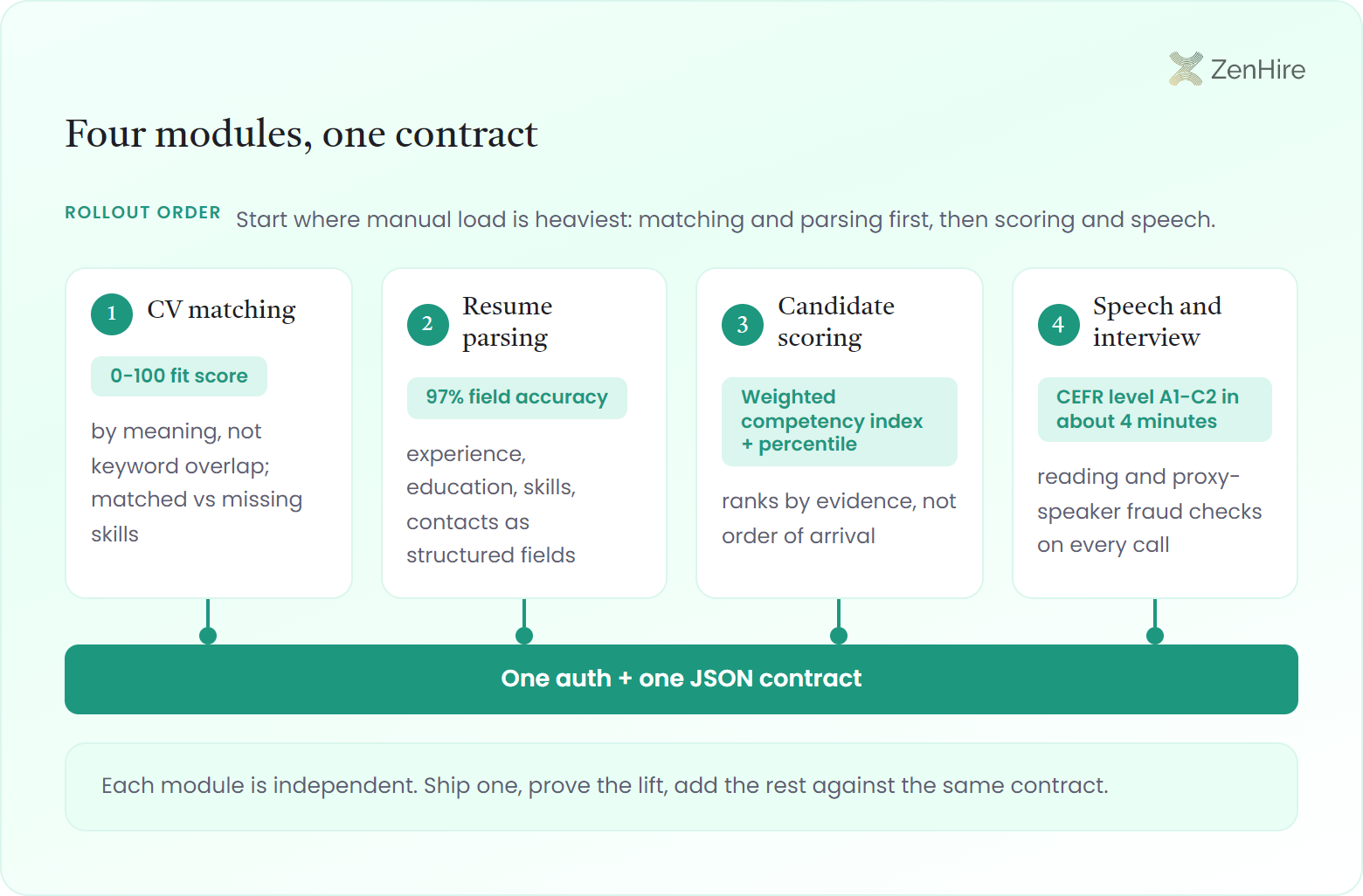
Start where the manual load is heaviest. For most high-volume teams that is screening, so the matching and resume parsing calls earn back their integration fastest, then scoring and speech follow.
Each module is independent: you can ship CV matching alone, prove the lift, and add candidate scoring or speech assessment later against the same auth and JSON contract. Run ids never expire, and every run accepts an optional externalId plus up to 50 metadata keys and 20 tags, all filterable on list endpoints, so each score stays traceable to the ATS record that produced it. Teams that begin with semantic cv matching usually layer in the speech analysis api once they need objective spoken-language proof for client-facing roles. Nothing forces an all-or-nothing rollout.
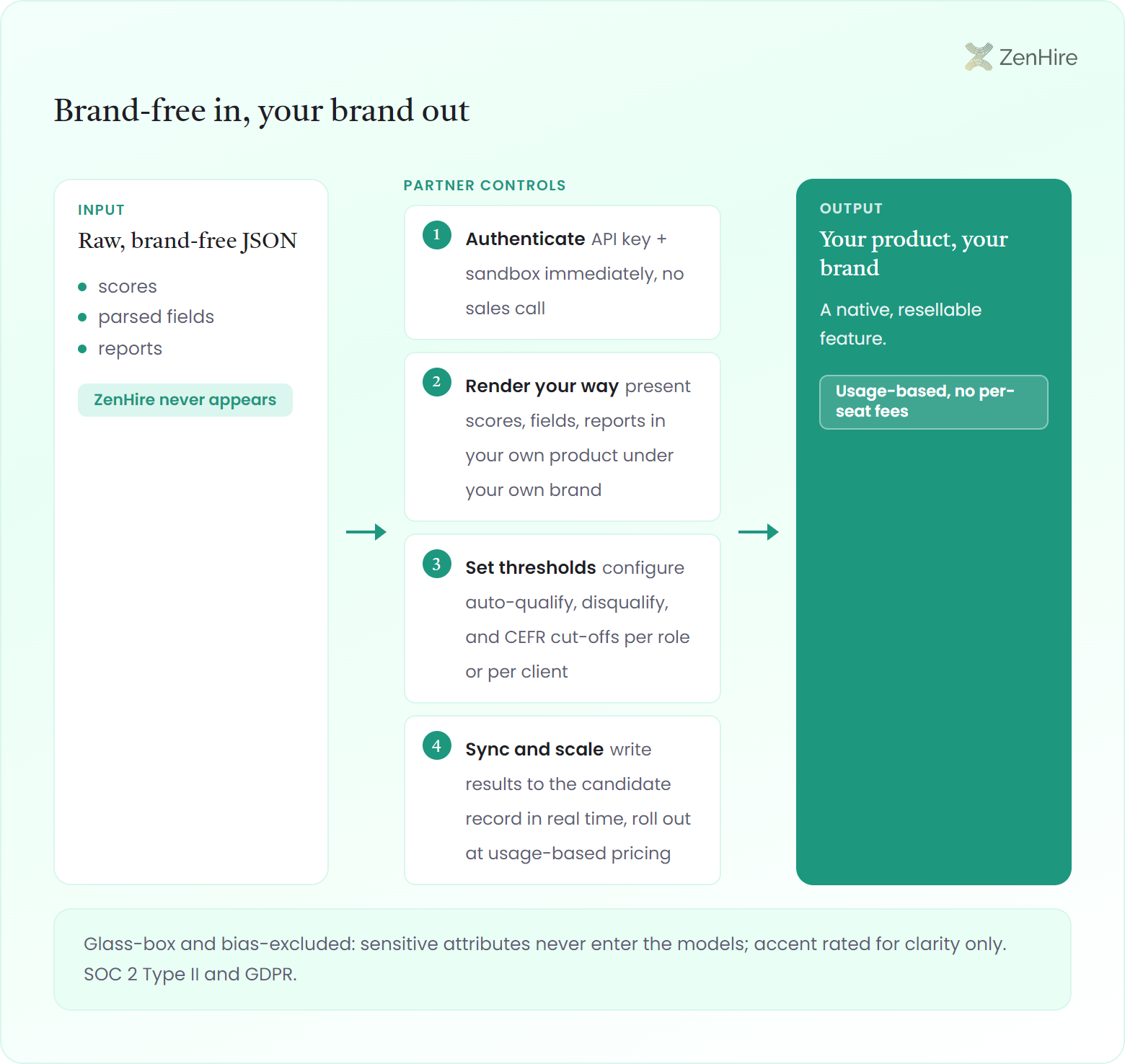
The API returns raw, brand-free JSON, so what your users see is entirely yours. You render the scores, fields, and reports inside your own UI under your own name; ZenHire never appears.
That makes the hiring intelligence API resellable: a platform or RPO can wrap the modules as a native feature of its product, set its own thresholds, and price its own way. The same modules power white-label ai recruiting for partners who resell hiring intelligence as their own product. Calls draw on one credit balance shared across every module, usage-based with no per-seat fees; the balance is checked before a run starts and failed runs are never charged, so cost tracks the volume you actually process.
Every score is glass-box and bias-excluded by design: sensitive attributes never enter the models, accent is rated for clarity only, and the platform holds SOC 2 Type II and GDPR, so partners can resell it into regulated, audit-heavy hiring.
1. Authenticate
Provision an API key and sandbox immediately, with no sales call, then build against the OpenAPI 3.1 spec with code examples in cURL, Python, Node.js, and Go.
2. Render your way
Take the JSON and present scores, parsed fields, and reports inside your own product, under your own brand.
3. Set thresholds
Configure auto-qualify, disqualify, and CEFR cut-offs per role or per client so the output fits each workflow.
4. Sync and scale
Write results back to the candidate record in real time, or receive them on HTTPS-only webhooks signed with Stripe-style HMAC-SHA256 and stripped of PII, then roll out across roles at usage-based pricing.
A recruitment API for ATS is an AI layer you call over REST to add matching, parsing, scoring, and interview intelligence to an applicant tracking system you already run. It augments your stack instead of replacing it: you send a candidate and a role, and it returns structured JSON you sync back to the record, with no migration and no model training.
The recruitment API does not replace your ATS or HRIS; it sits beside it. The system of record keeps storing candidates and stages, while the API supplies the judgment layer on top: fit scores, parsed fields, competency indices, and CEFR levels from a short AI interview, written back through real-time sync so enriched candidates appear where recruiters already work.
It is a hiring intelligence API because it evaluates candidates rather than filing them. Where an ATS records that an applicant exists, these modules score how well they fit, parse their resume at 97% accuracy, rank them by competency, and assess spoken language, aligning with human screeners more than 93% of the time and shipping the evidence behind every number.
The ai layer for ats stays explainable because every module returns the evidence behind its scores, and the speech engine uses glass-box, deterministic scoring rather than an opaque model. Sensitive attributes are architecturally excluded, accent is rated for clarity only and never penalized, and the platform holds SOC 2 Type II and GDPR, so each decision is auditable and you can override it.
You integrate the recruitment API against a single REST contract: get a key and sandbox immediately, call the modules you need, and read JSON back, with most teams live in one to two weeks. Pricing is usage-based per call with no per-seat fees, so cost scales with the volume you actually process rather than the size of your team.
Free for Recruitment API integration
A one-page quickstart for adding an AI layer to your ATS or HRIS: the endpoints, the JSON each module returns, the auth and sandbox flow, and a one-to-two-week go-live checklist.


Plug matching, scoring, and assessment into the stack you already run, and ship it under your own brand.