
How Do You Reduce Bias in Hiring?


· 9 min read
You reduce bias in hiring by standardizing evaluation and stripping the cues that leak demographic signal: same questions, same scoring scale, blind early screening, and auditable scorecards for every candidate. An unstructured interview predicts performance at just 0.18 and a resume scan at 0.14, while structured scored evaluation reaches 0.28 and combined validated methods exceed 0.6. ZenHire's audio-only language scoring aligns 90-96% with five PhD linguists, versus 68-75% for untrained recruiters, because it scores engineered neutral features instead of accent or gender-correlated pitch.
Where does bias in hiring enter the process?
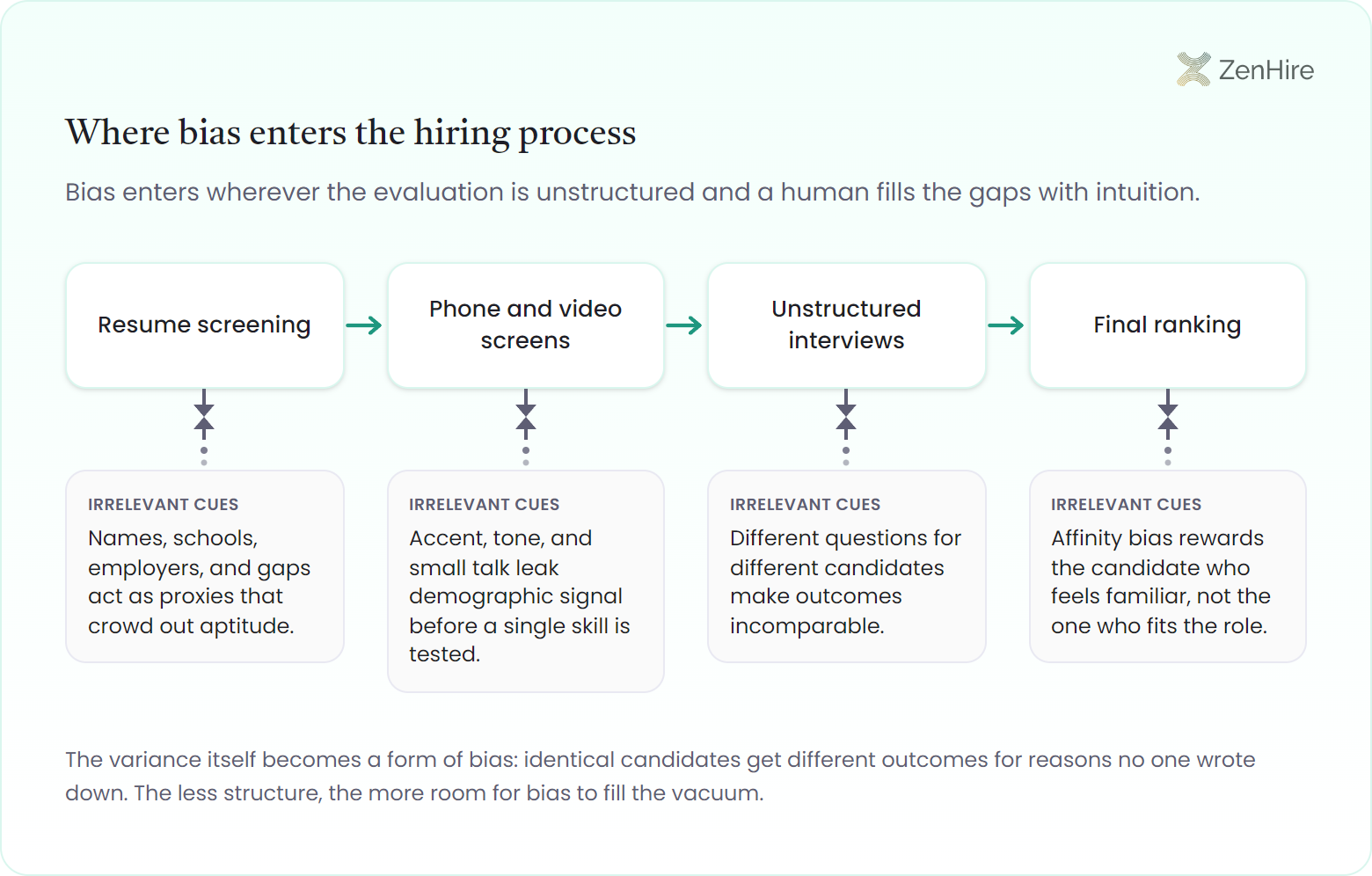
Bias in hiring enters the process wherever the evaluation is unstructured and a human is left to fill the gaps with intuition: the resume scan, the gut-feel phone screen, the unscripted interview, and the final ranking conversation. None of these stages is neutral by default. Each one lets signals that have nothing to do with the work, a candidate's name, the prestige of a school, an accent, a gap in dates, quietly tilt the decision.
The mechanism is consistency, or the lack of it. When two recruiters screen the same role to two different mental bars, or one recruiter screens differently on a busy Friday than on a quiet Monday, the variance itself becomes a form of bias: identical candidates get different outcomes for reasons no one wrote down. This is most acute in high-volume hiring, where the pressure to fill seats invites rushed, inconsistent screening and the same shortcut, lean on the familiar-looking candidate, repeats thousands of times.
A concrete example: a hiring manager reading a stack of 200 resumes for a contact-center role spends seconds on each and, without a rubric, anchors on proxies, a recognizable employer, a clean format, a name that is easy to pronounce. Two equally capable candidates get opposite verdicts because one had a tidier resume, not a better aptitude. The edge case worth flagging is that bias is not always against a group; it can be affinity bias for one, the interviewer who hires the candidate who reminds them of themselves. That feels like good judgment from the inside, which is exactly why it survives unexamined.
Method, not effort, decides how much bias creeps in. A plain resume review predicts on-the-job performance at only r = 0.14 and an unstructured interview at ~0.18, barely better, and wide open to irrelevant cues. A structured, consistently scored interview reaches ~0.28, and combining structured interviews with cognitive and skills assessments pushes the signal past 0.6. The less structure, the more room for bias to fill the vacuum.
- Resume screening: names, schools, employers, and gaps act as proxies that crowd out aptitude
- Phone and video screens: accent, tone, and small talk leak demographic signal before a single skill is tested
- Unstructured interviews: different questions for different candidates make outcomes incomparable
- Final ranking: affinity bias rewards the candidate who feels familiar, not the one who fits the role
How can AI reduce or worsen bias in hiring?
AI can reduce or worsen bias in hiring depending entirely on what it is trained on and whether it can explain itself: the same technology is a fairness tool or a bias amplifier based on its design, not its label. An AI trained to imitate a company's past hiring decisions learns the company's past bias and applies it at scale, faster and more confidently than any human ever could. That is the failure mode behind the high-profile AI-hiring discrimination cases, and pretending it cannot happen is how it happens.
Built the other way, AI becomes the most consistent screen you can run. The mechanism is twofold: first, it evaluates every candidate against the same rubric, so the variance that lets bias in disappears, so a strong communicator is not lost because they applied on a busy day. Second, a glass-box system that excludes demographic features and produces an auditable scorecard lets you inspect why a score was given and test the whole population for disparate impact, something an undocumented human screen can never offer. ZenHire's approach is to prefer explainable machine learning over black-box models so every score is reviewable, and to use structured interview scoring rather than opaque pattern-matching.
A concrete example: instead of judging spoken English by overall impression, where a regional accent quietly costs points, a fair system scores engineered, neutral features such as filler-word rate, vocabulary range, grammatical error types, and words per minute, and is built audio-only so no facial cue leaks race or gender. The edge case is accent and pitch: because deep-learning speech models can pick up gender-correlated pitch or penalize regional English, fairness requires actively inspecting and removing those signals, not assuming the model is neutral because it is a machine. AI does not remove bias by existing; it removes bias only when someone designs it to.
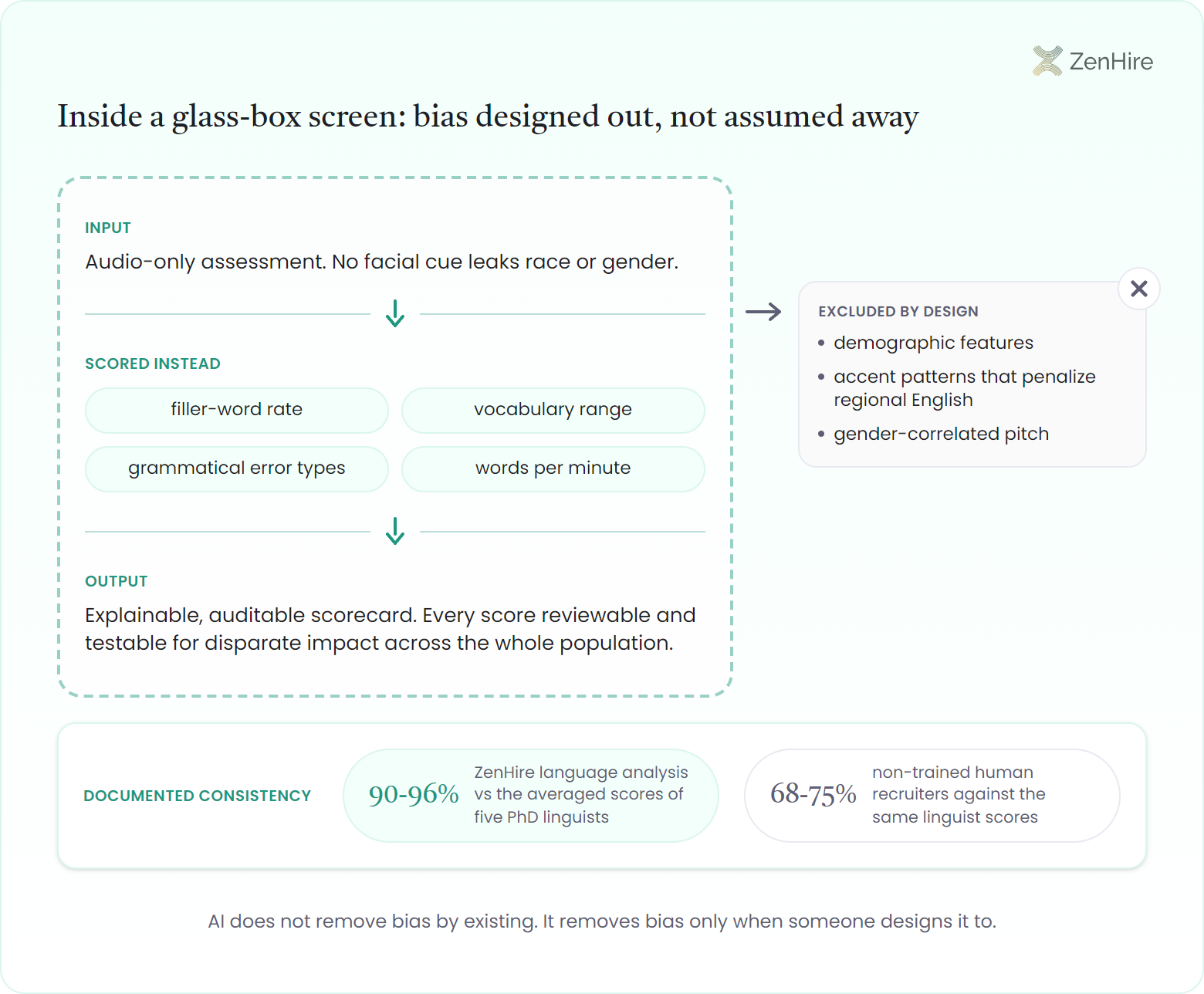
Done right, the audit trail is the point. ZenHire's language analysis aligns 90-96% with the averaged scores of five PhD linguists, while non-trained human recruiters reach only 68-75%, and it does so audio-only, on engineered features that exclude accent and gender-correlated pitch. CV extraction runs at 97% accuracy and job-description matching at 93%+ alignment with blind human review, so the consistency is documented rather than assumed.
Which practices reduce bias in hiring?
**The practices that reduce bias in hiring all share one trait: they replace inconsistent judgment with a structured, evidence-based, and auditable process. Define the rubric before you see candidates, score everyone the same way, remove the cues that leak demographic signal, and keep a record you can check. None of these is exotic; together they convert hiring from an opinion into a measurement.
Start by structuring the evaluation: the same questions, the same scoring scale, and the same evidence for every candidate, so two people are genuinely comparable. Then strip the irrelevant cues, blind early screening to names and demographic markers, and assess spoken ability on neutral language features rather than accent. Layer in validated assessments, because a skills test or cognitive measure predicts performance far better than a resume and is far harder to bias. Finally, make the whole thing accountable: keep explainable scorecards, run fairness audits, and let a human own the final call with the AI as a consistent baseline rather than the decider. These practices also lift candidate experience, because every applicant is judged on the same evidence and can be given the same honest feedback.
A concrete example: a BPO replaces its gut-feel phone screen with a four-minute, audio-only assessment scored on identical neutral features for all 5,000 monthly applicants, then has recruiters review the ranked shortlist with the scorecard in hand. Bias has fewer places to hide because every candidate cleared the same bar in the same way. The edge case is that fairness is not a one-time setup, models drift and roles change, so disparate-impact testing has to be continuous; a system that was fair last year is not automatically fair today. Bias reduction is a process you maintain, not a checkbox you tick.
| Practice | Why it reduces bias |
|---|---|
| Structured, scored evaluation | Same questions and scale for all; removes the variance bias fills |
| Blind early screening | Hides names and demographic proxies until skills are assessed |
| Neutral, audio-only language scoring | Judges engineered features, not accent or gender-correlated pitch |
| Validated assessments | Predicts performance at 0.45+ vs ~0.14 for a resume scan |
| Explainable, audited scorecards | Makes decisions reviewable and testable for disparate impact |
People assume AI is the bias risk in hiring. I see it the other way. The most biased system I have ever seen is a tired human reading the 180th resume of the day with no rubric; they cannot tell you why one candidate moved forward and another did not, because the reason was a feeling. The honest fix is not to trust the machine blindly; it is to make the machine show its work. Exclude the demographic cues, score everyone the same way, and keep a log you can audit. AI should measure, and a person should decide, but the measuring has to be the part you can actually inspect, because the bias you cannot see is the one you can never fix.
Frequently asked questions
What is the most effective way to reduce bias in hiring?+
The most effective way to reduce bias in hiring is to standardize the evaluation: ask every candidate the same questions, score them on the same scale, and remove the cues that leak demographic signal. Consistency is the lever, because most bias enters through unstructured judgment, where an unstructured interview predicts performance at only ~0.18 versus 0.6+ for combined validated methods.
Does AI make hiring more or less biased?+
AI makes hiring less biased only when it is designed for fairness, and more biased when it is not. A model trained to imitate biased past decisions repeats them at scale, while a glass-box system that excludes demographic features, scores everyone the same way, and produces an auditable record can catch bias a human screen never documents.
How do you reduce bias in language and accent assessment?+
You reduce bias in language assessment by scoring engineered, neutral features rather than overall impression: filler-word rate, vocabulary range, grammatical error types, and words per minute, assessed audio-only so no facial cue leaks race or gender. The system must also actively exclude accent patterns that penalize regional English and pitch tonality correlated with gender, since these can otherwise slip in unnoticed.
Can removing bias hurt the quality of hires?+
No, removing bias improves quality, because bias and accuracy point the same way. The cues that introduce bias, names, schools, accents, are weak predictors of performance, so cutting them out and replacing them with validated assessments raises predictive validity from around 0.14 for a resume scan to 0.45+ for skills tests and beyond.
Is bias reduction a one-time fix?+
No, bias reduction is an ongoing process, not a one-time fix. Models drift, roles change, and candidate pools shift, so fairness requires continuous disparate-impact testing and regular audits. A process that was fair last year is not automatically fair today, which is why explainable, auditable scoring matters more than any single setup step.
Free for reducing hiring bias
The bias-audit checklist for hiring
A one-page checklist for finding and removing bias at each stage: which cues to blind, how to structure scoring, what to exclude from language assessment, and the fairness metrics to track over time.