
What Is Candidate Experience?


· 8 min read
Candidate experience is how applicants perceive and feel about every touchpoint of your hiring process, from the job ad and application form to each interview, the waits between stages, and the final decision. Candidates value three things most: clarity, speed, and feedback, and most reputational damage happens in the silent gaps, not the interviews. The stakes are concrete: SHRM prices replacing one hire at 50-200% of annual salary, and the structured screening that feels fairest to candidates also predicts best, 0.6+ validity versus ~0.18 for gut-feel interviews.
What is candidate experience?
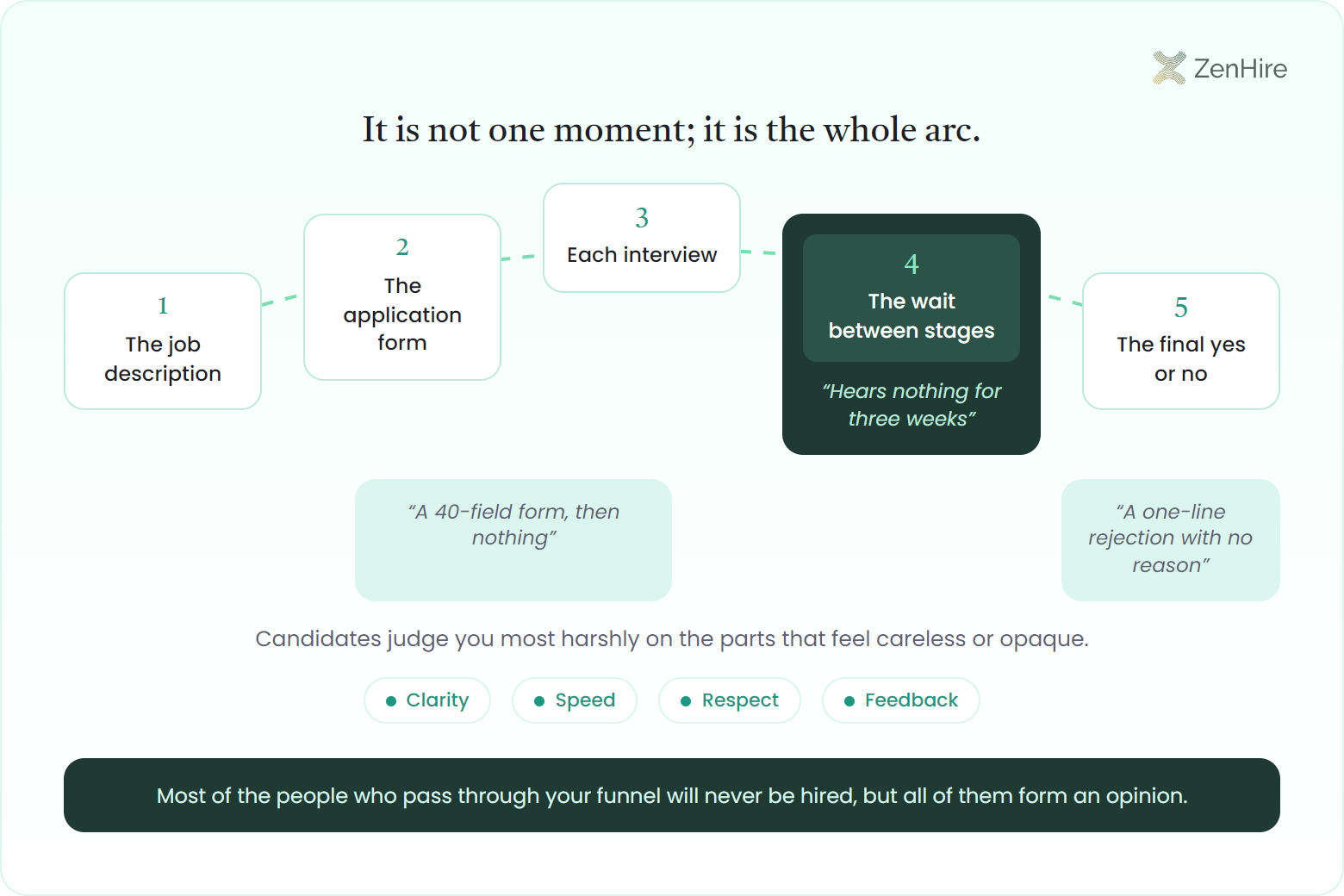
Candidate experience is how an applicant perceives and feels about your organization across every touchpoint of the hiring journey: the job description, the application form, each interview, the wait between stages, and the final yes or no. It is not one moment; it is the whole arc, and candidates judge you most harshly on the parts that feel careless or opaque.
The mechanism is simple: people generalize. A candidate who fills out a 40-field form, hears nothing for three weeks, then gets a one-line rejection with no reason concludes that this is how your company treats people. They cannot see your roadmap or your culture deck, so the hiring process becomes their entire evidence base. That is why a clean, communicative process matters even for candidates you reject. Most of the people who pass through your funnel will never be hired, but all of them form an opinion. Strong recruitment treats every applicant as someone who will remember how they were handled.
Consider a concrete example: two companies post the same role at the same pay. Company A confirms the application within an hour, sets expectations for timing, runs a short structured assessment, and sends every candidate a result with a reason. Company B leaves applicants guessing for a month and ghosts the ones it rejects. Same job, same salary, but Company A wins more accepted offers and a better reputation. The edge case worth flagging is the over-correction: a process so padded with warm touches that it becomes slow and bloated is its own bad experience. Candidates do not want more steps; they want clarity, respect, and a decision.
Candidate experience is not soft. The methods that make a process feel fair to applicants are the same ones that predict performance for you: an unstructured, gut-feel interview predicts on-the-job success at only ~0.18, while a structured interview reaches ~0.28 and a validated combination of structured interview plus assessments passes 0.6+. Consistency is both kinder and sharper.
- Clarity: a job ad that says what the role actually is, and a process that tells candidates what happens next
- Speed: fast confirmation, fast stages, and a decision before strong candidates take another offer
- Respect: a short, accessible process that does not waste applicants' time or punish those on slow connections
- Feedback: a reason for the decision, even a brief one, so candidates leave knowing where they stood
Why does candidate experience affect hiring and brand?
Candidate experience affects hiring and brand because the people moving through your funnel are also your future hires, referrers, reviewers, and customers, and they act on how you made them feel. A strong experience raises offer-acceptance rates and referral volume; a weak one leaks talent at the top of the recruitment funnel and follows you onto public review sites where the next applicant reads it before they apply.
The hiring half of the mechanism is competition for the best candidates. Strong applicants hold multiple options, so the company that is clear, fast, and respectful converts more of them into accepted offers, while a slow or silent process loses them to a faster rival before the final round. The brand half compounds over time: a candidate who had a good experience tells peers and may come back for a future role, while a candidate who was ghosted leaves a review that costs you applicants you will never even see. In high-volume hiring, where one role can draw thousands of applicants, the reputational stakes are multiplied by sheer numbers.
A concrete example: a contact-center operator filling hundreds of seats sees that drop-off, not interview performance, is its real bottleneck. When the screening step is a 30-minute video assessment, most applicants abandon it; when it is a short, low-bandwidth assessment that respects their time and data, far more finish, and the funnel fills without lowering the bar. The edge case to watch is that experience cannot rescue a fundamentally weak offer. If pay, schedule, or the role itself are uncompetitive, a delightful process only postpones the no; experience amplifies a viable offer, it does not manufacture one.
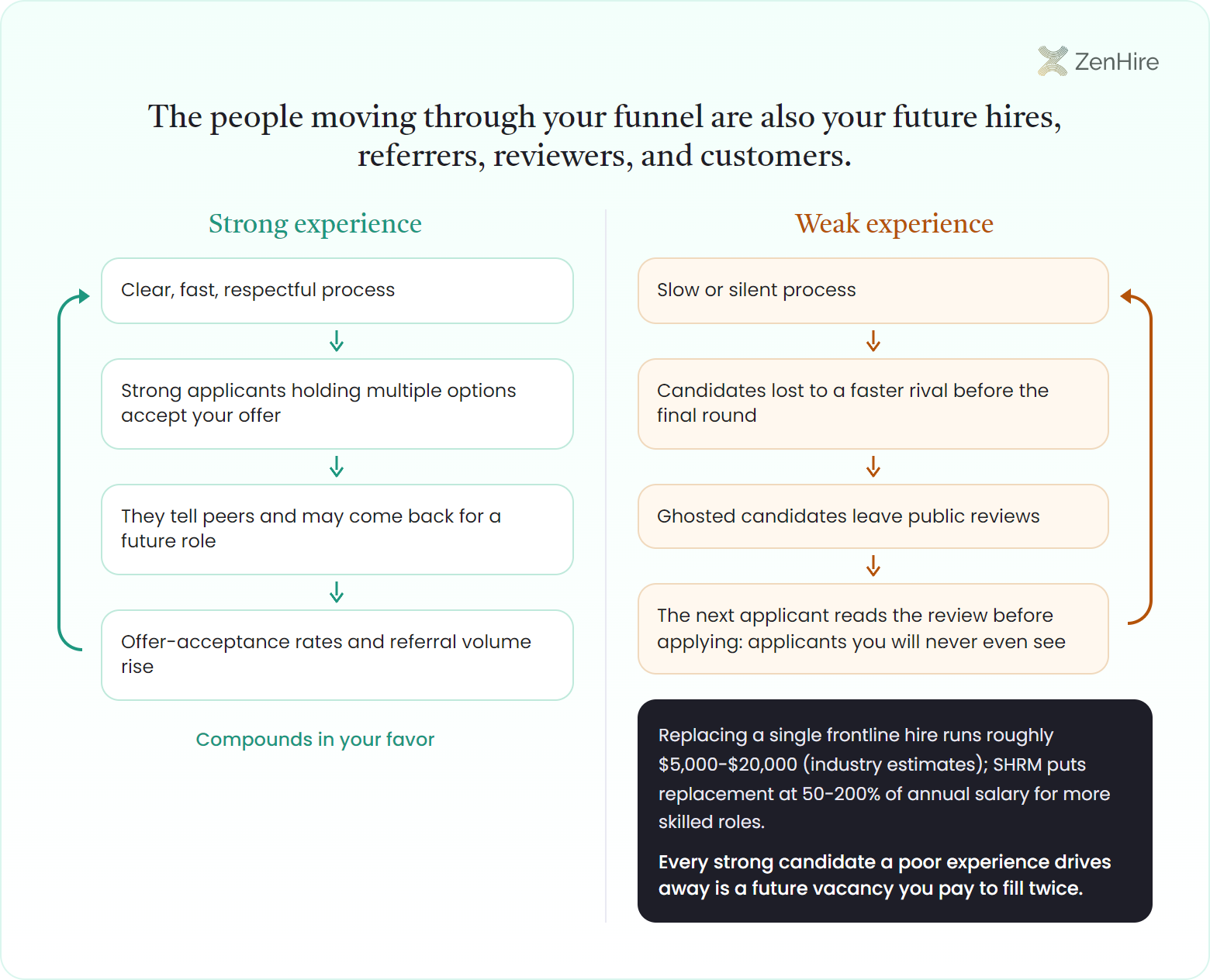
The funnel math is unforgiving in volume hiring. Replacing a single frontline hire runs roughly $5,000-$20,000 (industry estimates), and SHRM puts replacement at 50-200% of annual salary for more skilled roles. Every strong candidate a poor experience drives away is a future vacancy you pay to fill twice, a reason candidate experience belongs in your cost-per-hire math, not just your HR brand deck.
How do you improve candidate experience at scale?
You improve candidate experience at scale by making the process clear, fast, consistent, and feedback-rich for every applicant, not just the finalists, and by using automation to deliver those four things at a volume humans cannot match by hand. The goal is not more human touches per candidate; it is the same high standard applied to the ten-thousandth applicant as to the first.
The mechanism is leverage. A recruiter can write a warm, personalized rejection to ten people; they cannot to ten thousand, so at volume the choice is usually between a templated silence and a system that does it consistently. Structured, AI-assisted screening closes that gap: every candidate clears the same bar, scored the same way, fast, and each one can receive individualized feedback built from their own results regardless of outcome. ZenHire's AI interview software reads communication and reliability signals in about four minutes and returns a result quickly, which removes the dead air that does most of the reputational damage. Pairing that with a structured interview for finalists keeps the human stages consistent too.
A concrete example: instead of a long, video-heavy assessment that strands candidates on slow connections, an audio-only option lets someone complete screening on a basic phone in minutes, then receive a personalized summary of how they did. The edge case is fairness and trust: automation done badly feels like being judged by a black box. The fix is transparency: explainable scores, demographic factors excluded, and a human who can review and override, so speed never comes at the cost of the respect that defines a good experience in the first place.
| Improvement | What it fixes for candidates |
|---|---|
| Instant application confirmation | Removes the did it even send? anxiety at the very first step |
| Short, low-bandwidth screening | Cuts drop-off and respects time and data, especially on mobile |
| Fast, consistent scoring | Shrinks the silent wait that does the most brand damage |
| Personalized feedback for all | Turns a rejection into a brand-positive touchpoint, not a dead end |
Most companies think candidate experience means sending a nicer rejection email. To me it is something more honest: do you respect the person's time and tell them the truth about where they stood? For years that was impossible at scale, because you simply could not give ten thousand people a real answer, so you gave them silence. That silence is what people remember, and it is what they post online. The thing I am proudest of is that we made fairness affordable in bulk: every candidate gets the same fast, consistent shot and a real piece of feedback built from their own results, win or lose. A good process is not a courtesy you extend to the lucky few. It is the cheapest, most durable brand investment a hiring team has.
Frequently asked questions
What does candidate experience mean in recruitment?+
Candidate experience means how applicants perceive and feel about your hiring process from start to finish: the job ad, the application, the interviews, the waiting, and the final decision. It is the cumulative impression a person walks away with, and it forms whether or not they are hired.
Why is candidate experience so important?+
Candidate experience is important because the people in your funnel are also your future hires, referrers, and customers, and they act on how you treated them. A strong experience lifts offer-acceptance and referral rates; a weak one leaks talent and lands on public review sites where your next applicant reads it first.
How do you measure candidate experience?+
You measure candidate experience with drop-off rates, time-to-decision, offer-acceptance rates, and direct candidate feedback or NPS surveys. Drop-off at a specific step usually points to friction there, while a slow time-to-decision is the most common source of negative reviews and lost finalists.
Does a faster, automated process hurt candidate experience?+
A faster, automated process improves candidate experience when it is done transparently, because the dead air and inconsistency that frustrate applicants are exactly what automation removes. The risk is a black-box feel, so explainable scoring, excluded demographic factors, and a human who can override keep speed from costing trust.
How can you improve candidate experience at high volume?+
You improve candidate experience at high volume by making the process clear, fast, and feedback-rich for every applicant, using automation to scale those standards. Short, low-bandwidth screening cuts drop-off, fast scoring removes the silent wait, and personalized feedback for all turns even a rejection into a brand-positive touchpoint.
Free for improving candidate experience
The candidate-experience scorecard
A one-page audit of your hiring funnel: where applicants drop off, where the silence hurts most, and the four fixes that improve experience and [quality of hire](/metrics/quality-of-hire) at the same time.