
What Is Recruitment Fraud and How Do You Prevent It?


· 9 min read
Recruitment fraud is deliberate candidate deception, fake credentials, proxy interviews, or AI-scripted answers, used to pass a hiring screen for a job the person cannot do, and you prevent it with structured, verified evaluation. It clusters into three hiring fraud types, credential, identity, and answer fraud, and each one preys on a screen that trusts its inputs: a resume read at face value forecasts real performance at just r = 0.14, and a freeform interview at only 0.18, so neither can tell a rehearsed faker from a genuine fit. Tightening the interview into a scored, repeatable format lifts that signal to ~0.28, and ZenHire adds a fraud layer on top through interview analysis, catching proxy voices, mid-test screen exits, and duplicate CVs while flagging scripted or AI-written answers at about 91% accuracy.
What are the common types of recruitment fraud?
The common types of recruitment fraud fall into three families: credential fraud, identity fraud, and answer fraud, and most real cases mix more than one. Credential fraud fakes what is on paper: invented job titles, an inflated or fictitious degree, a friend posing as a former manager for the reference call. Identity fraud fakes who is actually being evaluated: a proxy who sits the interview or completes the skills test while a weaker candidate takes the job. Answer fraud fakes the responses themselves: AI-generated or pre-scripted replies pasted into an assessment, or a hidden tool feeding answers in real time.
A concrete example ties them together. A candidate submits a resume listing three years of bilingual contact-center experience (credential fraud), has a fluent friend complete the spoken-English assessment (identity fraud), and pastes a polished, AI-written answer into the written portion (answer fraud). On paper the file is flawless. In the role, the person cannot hold a customer call. This is why fraud is most damaging in high-volume hiring, where the pressure to fill seats rewards a clean-looking file over a verified one.
The edge case worth naming: not every embellishment is fraud. A candidate who rounds a job's end date or frames a side project generously is exaggerating, not defrauding. The line is intent to deceive a specific check: a proxy interview is fraud; an optimistic self-summary is not. Treating every rough edge as fraud burns trust and pushes good candidates away, which is why ethical hiring draws the line at deliberate deception, not imperfection.
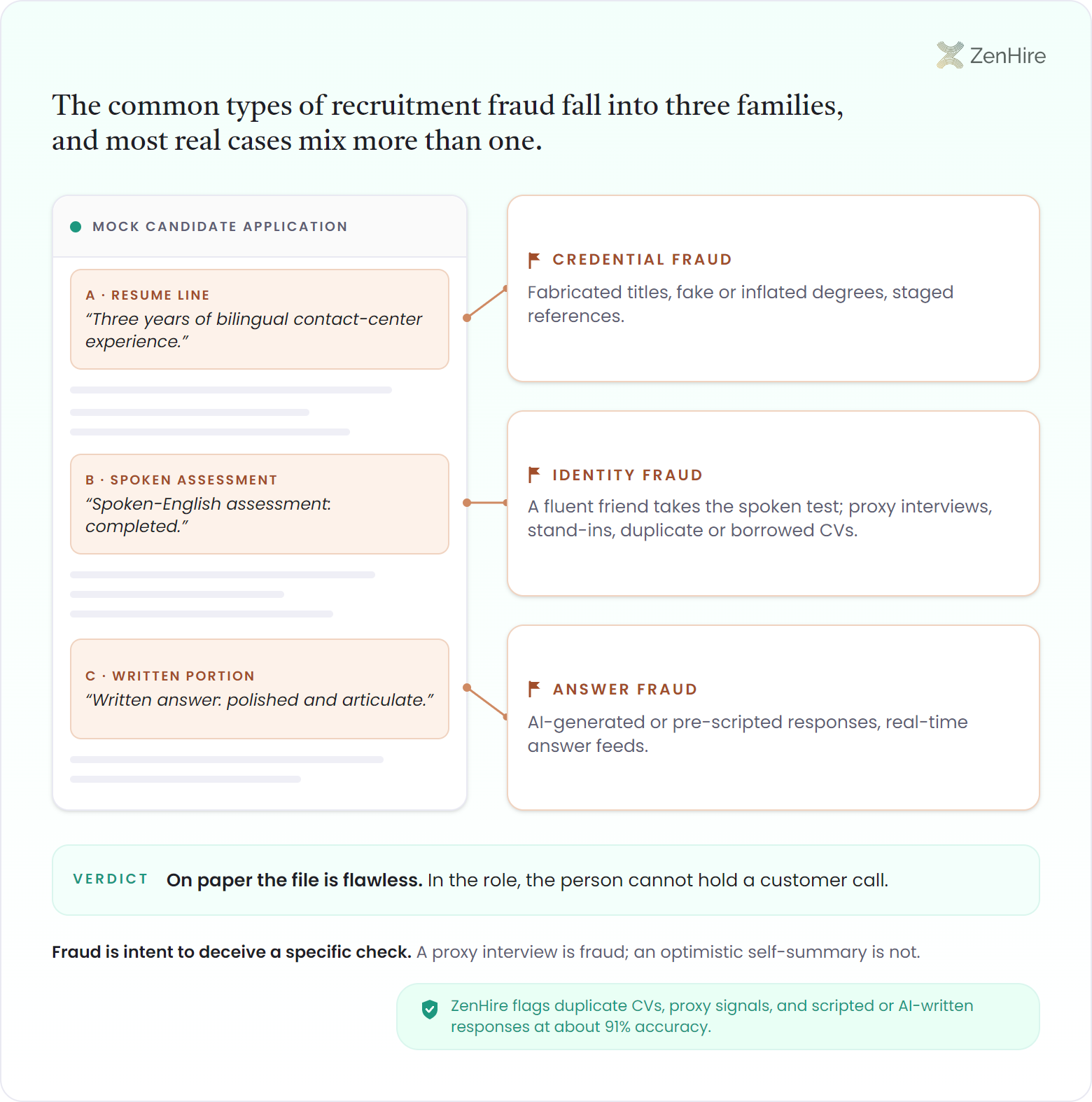
These map to detectable signals. ZenHire's anti-fraud layer flags duplicate CV submissions, AI-generated and scripted answers, and proxy-interview signals such as multiple voices or mid-assessment screen exits, and it detects scripted or AI-written responses at about 91% accuracy, turning a trust problem into a measurement problem.
- Credential fraud: fabricated titles, fake or inflated degrees, staged references
- Identity fraud: proxy interviews, a stand-in completing the test, duplicate or borrowed CVs
- Answer fraud: AI-generated or pre-scripted responses, real-time answer feeds
- Capability fraud: a genuine person who simply cannot do the work they claimed they could
How does recruitment fraud slip through hiring?
Recruitment fraud slips through hiring because most screening is trust-based and inconsistent: it asks whether a story sounds right, not whether it can be verified. The numbers expose how little that judgment is worth: a freeform interview tracks on-the-job performance at just r = 0.18, and a resume scan at ~0.14, both barely above chance. A signal that faint has no way to pull the rehearsed impostor apart from the honest hire, since either can hold a room for half an hour. Fraud never has to beat a strong screen; it only has to find a soft one.
Here is the mechanism in practice. A faker prepares for the predictable parts of a loose process, such as the standard questions, the surface-level reference call, and the resume keywords an ATS rewards, and clears each because each check trusts the input it is given. A different interviewer on a busy day applies a different bar, so there is no consistent baseline to deviate from and nothing to flag. The deception is not clever; the screen is simply too low-resolution to catch it. Fix the format, and the resolution climbs: a structured interview that asks every candidate the same questions and scores them the same way pushes predictive validity up to ~0.28, and that consistency is exactly what makes an impostor's answers stick out.
The edge case is the inverse failure: false positives. A nervous but honest candidate, or a strong speaker with a regional accent, can trip crude fraud filters and get rejected for being real. That is its own ethical failure, one that overlaps directly with the work of reducing bias in hiring, and it is why detection has to be calibrated, not maximally suspicious. The fix is not more suspicion but more structure: signals tied to behavior and consistency rather than to how polished or accented someone sounds.
Read the fraud problem as a validity gap. A resume review lands near r = 0.14 and a freeform interview near ~0.18, the two methods a faker can rehearse for; a structured interview climbs to ~0.28, and stacking it with cognitive and skills tests drives the combined signal past 0.6, the range no scripted answer survives. Every point of validity you add is a soft spot the impostor loses.
How do you prevent recruitment fraud?
You prevent recruitment fraud by replacing trust with structure and verification: the same questions scored the same way, behavioral signals that catch scripted or proxy answers, and an auditable record of every decision. Structure removes the soft spots a faker prepares for: when every candidate clears an identical, consistently scored bar, the rehearsed answer and the real one are no longer interchangeable. Verification adds a second layer, checking that the person being evaluated is the person who shows up, and that the answers are theirs.
A concrete example: instead of a freeform call, a candidate completes a short, structured, audio-based assessment scored on engineered, neutral features: pacing, filler-word rate, vocabulary range, consistency of response. A proxy or a fed answer shows up as a mismatch in those behavioral signals, while a CEFR-aligned spoken check confirms real spoken ability rather than a friend's. ZenHire's English proficiency assessment aligns 90-96% with five PhD linguists (versus 68-75% for untrained human recruiters), so the verification itself is more reliable than the gut-feel it replaces. The anti-fraud signals layer on top through the anti-fraud system.
The edge case to design for is the arms race: as candidates adopt better AI tools, single-point checks decay. The durable defense is layered and explainable: multiple independent signals (identity, consistency, scripted-response detection) plus a human-review queue for genuine edge cases, all on a SOC 2 and GDPR posture so the audit trail holds up. A glass-box system you can inspect beats a black box you have to trust, because the goal is not to win one round of detection but to keep the screen honest as the fakery evolves.
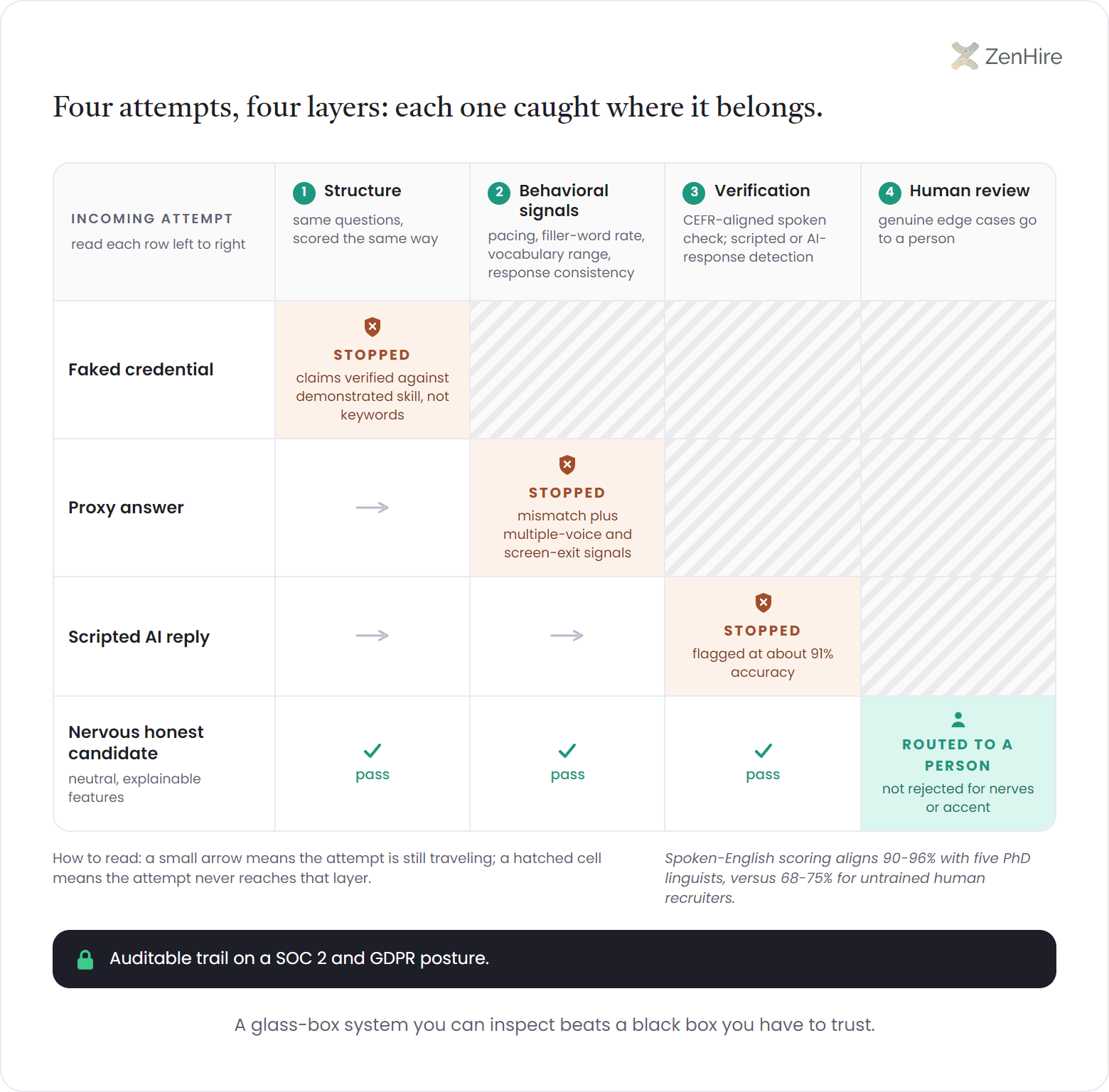
| Fraud type | How it slips through | How structure prevents it |
|---|---|---|
| Credential fraud | Resume trusted at face value | Verify claims against demonstrated skill, not keywords |
| Identity / proxy | Different interviewer, no baseline | Same scored assessment; multiple-voice and screen-exit signals |
| Answer fraud | Polished AI or scripted reply | ~91% scripted / AI-response detection plus behavioral metadata |
| False positive | Nerves or accent tripped a crude filter | Neutral, explainable features and a human-review queue |
People ask me how we catch cheaters, and I think that frames it wrong. We are not trying to win a cat-and-mouse game against candidates. We are trying to make honesty the easy path. Most fraud is a rational response to a screen that rewards the right keywords and the right polish over real ability. Build an evaluation that actually measures the work, score every person the same way, and keep the decision auditable, and the incentive to fake mostly disappears, because there is no soft spot left to game. The win is not a higher catch rate. It is a process where faking it stops being worth the effort.
Frequently asked questions
What is recruitment fraud, in simple terms?+
Recruitment fraud is any deliberate deception a candidate uses to pass your hiring screen for a job they cannot actually do: a fabricated resume, a proxy who sits the interview, or AI-written answers. The fraud targets the evaluation, not the work, so the cost shows up after the hire when the person cannot perform.
What are the most common hiring fraud types?+
The most common hiring fraud types are credential fraud, identity fraud, and answer fraud. Credential fraud fakes the resume, degrees, or references; identity fraud uses a proxy to sit the interview or test; answer fraud submits AI-generated or scripted responses. Most real cases combine two or three.
How is interview fraud detected?+
Interview fraud is detected through structure plus behavioral signals, not gut feel. Identical, consistently scored questions create a baseline, and signals such as multiple voices, mid-assessment screen exits, and scripted or AI-generated patterns flag anomalies. A structured AI interview captures those signals on every candidate, and ZenHire detects scripted and AI responses at about 91%.
Can fraud detection unfairly reject honest candidates?+
It can, if the detection is crude, which is why fairness matters as much as strictness. Nerves or a regional accent can trip a blunt filter. Audio-only, demographically neutral features plus a human-review queue catch deliberate deception without penalizing honest candidates for being real.
Does AI make recruitment fraud worse?+
AI raises the volume and polish of fraud, but it also raises the defense. Generative tools make scripted answers easy, yet layered, explainable detection (identity, consistency, and scripted-response signals on a SOC 2 and GDPR posture) closes the gap faster than any single check a faker can prepare for.
Free for preventing recruitment fraud
The recruitment-fraud prevention checklist
A one-page checklist for closing the gaps fraud exploits: which claims to verify, the proxy and scripted-answer signals to watch, and how to keep detection fair to honest candidates.