
How Do You Reduce Time to Hire?


· 7 min read
You reduce time to hire by removing waiting, not by deciding faster: locate where candidates stall with time-in-stage tracking, automate screening and scheduling, and verify the drop stage by stage. Hiring teams using AI report roughly 62% faster processes at about 59% lower cost, and most calendar days sit in the application-to-screen and screen-to-interview gaps, not in evaluation. ZenHire's roughly 4-minute structured AI interview screens an entire applicant pool in parallel, turning a 1,200-resume, eight-day manual queue into a ranked shortlist by the next morning.
Where is time to hire lost across the funnel?
Time to hire is lost in the gaps between stages, not inside the stages themselves. They are the days a resume waits to be read, the candidate waits for a callback, and the interview waits to be scheduled. The work of evaluating a person takes minutes; the waiting around it takes weeks. If you map your recruitment funnel as time-in-stage rather than total days, the dead zones jump out immediately.
The slowest stretch in high-volume hiring is almost always the top of the funnel: a single coordinator reading hundreds of resumes by hand and trying to book first-round screens. That is a serial bottleneck: every candidate queues behind the last one, so volume directly inflates the wait. This is why high-volume hiring breaks down differently from low-volume hiring, where the delay usually sits in getting busy senior interviewers to agree on a calendar slot.
A concrete example: a contact-center team posts 80 openings and gets 1,200 applicants. One recruiter screening 30 resumes a day needs eight working days just to reach the bottom of the pile, by which point the strongest applicants, who apply to several employers at once, have already accepted elsewhere. The edge case is the reverse problem: a niche skilled-trades role where applications trickle in slowly, so the bottleneck is not the queue but the back-and-forth of scheduling around a hiring manager who travels. Same metric, opposite cause, and the fix has to match the cause.
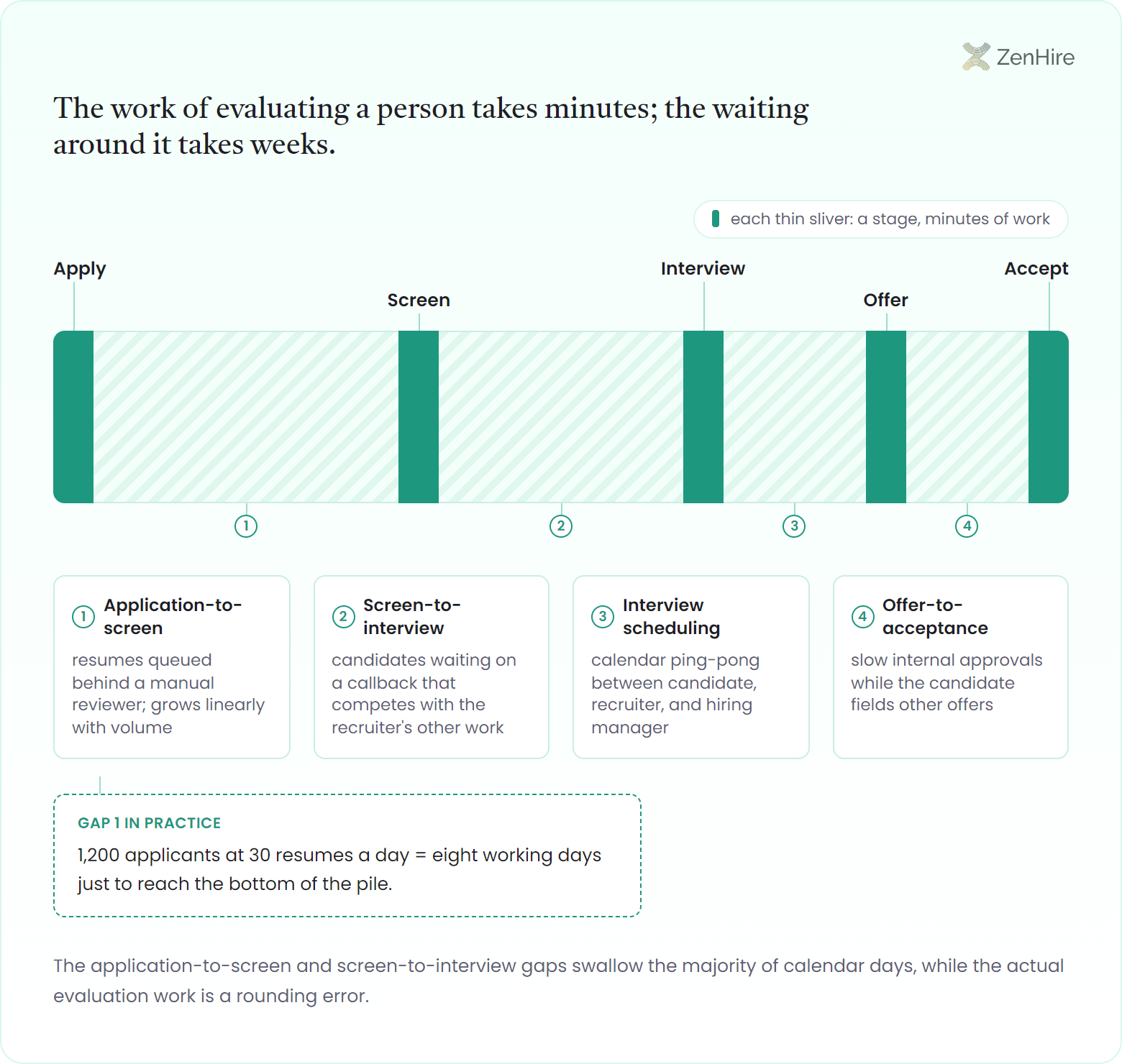
Map your funnel by time-in-stage and the pattern is consistent: the application-to-screen and screen-to-interview gaps swallow the majority of calendar days, while the actual evaluation work is a rounding error. You cannot fix a number you have not located, so measure where the days go before you try to cut them.
- Application-to-screen: resumes queued behind a manual reviewer; grows linearly with volume
- Screen-to-interview: candidates waiting on a callback that competes with the recruiter's other work
- Interview scheduling: calendar ping-pong between candidate, recruiter, and hiring manager
- Offer-to-acceptance: slow internal approvals while the candidate fields other offers
Which steps can you automate to reduce time to hire?
You automate the high-volume, low-judgment steps (resume screening, first-round assessment, and scheduling) to reduce time to hire without touching the decisions that should stay human. These are exactly the serial bottlenecks from the funnel map: tasks that scale badly when one person does them in sequence but run in parallel the moment a machine handles them.
The mechanism is parallelism. A manual reviewer processes one resume at a time; an automated screen evaluates every applicant the same way at once, so a 1,200-person pile becomes a ranked shortlist in hours instead of days. ZenHire's AI interview software runs a roughly four-minute structured interview that scores communication, soft skills, and reliability signals, and pairs with CV DeepMatch to read whether a candidate actually used a skill rather than just listing it. Self-scheduling links then let candidates book their own slots, which deletes the calendar ping-pong entirely.
A concrete example: replace the eight-day manual screen above with an automated first round, and every one of the 1,200 applicants is screened and ranked by the next morning, so the recruiter spends their day interviewing the top of a vetted list, not reading the bottom of an unsorted one. The edge case to watch is over-automation: pushing borderline or flagged candidates straight to rejection. The right design keeps a structured interview and a human-review queue for edge cases, so speed never quietly becomes a quality cut.
| Funnel step | Manual reality | What automation changes |
|---|---|---|
| Resume screening | One reviewer, one resume at a time | Every applicant ranked in parallel, same bar for all |
| First-round screen | Phone tag across days | ~4-min structured AI interview, scored consistently |
| Scheduling | Calendar ping-pong | Candidate self-booking, no coordinator in the loop |
| Shortlisting | Subjective, undocumented | Ranked, auditable scorecards a manager can act on |
How do you measure a drop in time to hire?
You measure a drop in time to hire by tracking time-in-stage before and after, not just the headline total, so you can prove which change moved the number and confirm you did not buy speed by sacrificing quality. An aggregate number that fell from 30 days to 18 is encouraging, but it does not tell you whether the win came from screening, scheduling, or a one-off lucky month.
Instrument each gap separately and compare the same stage across periods. If you automated screening, the application-to-screen days should collapse while the later stages hold steady; that is your causal evidence. Read the headline time to hire alongside quality of hire and 90-day retention, because a faster funnel that ships worse hires is not a win, it is a deferred cost. Watching cost per hire at the same time confirms the speed came from removing waiting, not from spending your way around it.
A concrete example: a team cuts time to hire from 28 to 15 days and, by segmenting, sees the entire 13-day gain sitting in the application-to-screen stage: clean proof the automated first round did the work. The edge case is a misleading drop: time to hire falls only because the applicant pool shrank, not because the process got faster. Always read the metric against pipeline volume and acceptance rate so a smaller, weaker funnel does not masquerade as an efficiency win.
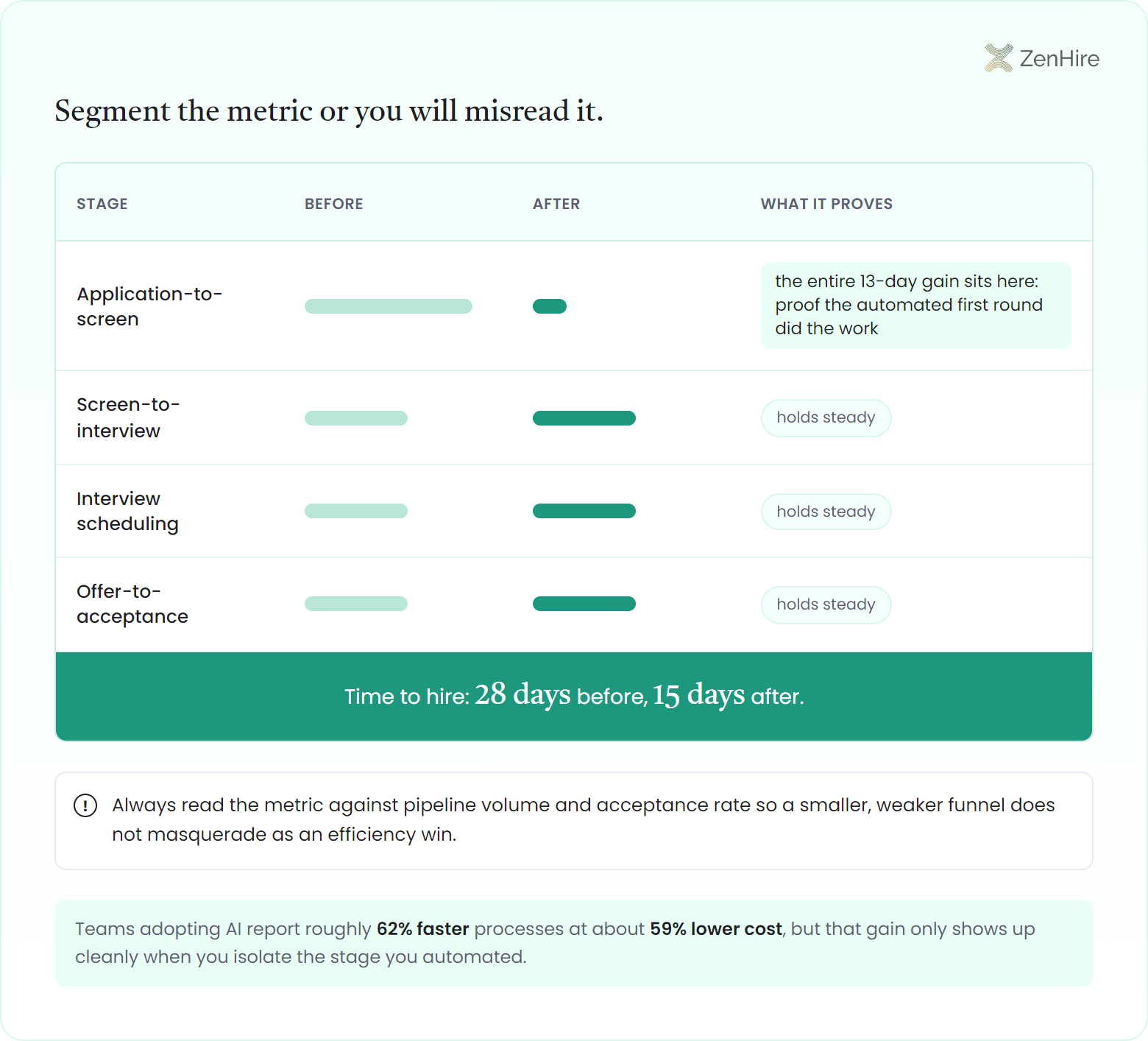
Segment the metric or you will misread it. Industry research finds that hiring teams adopting AI report roughly 62% faster processes at about 59% lower cost, but that gain only shows up cleanly when you isolate the stage you automated. A faster total with no stage-level evidence is a coincidence you cannot repeat.
When people ask me how to speed up hiring, they expect me to say work faster. It is the opposite. Almost none of your time to hire is work; it is candidates sitting in a queue while a human gets to them one by one. We did not make recruiters type faster; we removed the line. The first structured screen now happens for everyone at once, in minutes, and the recruiter walks in to a ranked shortlist. The time you save is the time nobody was ever actually using; it was just waiting.
Frequently asked questions
What is the biggest cause of a slow time to hire?+
The biggest cause of a slow time to hire is manual screening at the top of the funnel: a single reviewer reading resumes and booking screens one at a time, so candidates queue and the wait grows with volume. The evaluation itself is fast; the waiting in line is what stretches the calendar.
How can you speed up the hiring process without lowering quality?+
You speed up the hiring process by automating waiting, not deciding: parallel resume ranking, a short structured first round, and candidate self-scheduling. Keep a structured interview and a human-review queue for edge cases, so the saved time comes from removing dead time, not from skipping evaluation.
How much faster can automation make hiring?+
Industry research finds teams using AI in hiring report roughly 62% faster processes at about 59% lower cost. The gain concentrates in the top-of-funnel stages where one person was screening sequentially, because automation evaluates every applicant in parallel instead of in a queue.
How do you shorten time to hire in high-volume hiring specifically?+
You shorten time to hire in high-volume hiring by parallelizing the first round, since the bottleneck is the queue, not the decision. An automated screen ranks the whole applicant pool at once, and a roughly four-minute structured interview turns days of manual review into an overnight shortlist.
What metrics confirm time to hire actually dropped?+
Time-in-stage, segmented before and after, confirms a real drop: the gain should sit in the stage you changed while the others hold steady. Read it alongside quality of hire, 90-day retention, and pipeline volume so a smaller or weaker funnel does not masquerade as a speed win.
Free for reducing time to hire
The time-to-hire teardown worksheet
A one-page worksheet to map your funnel by time-in-stage, spot the bottleneck that is eating your calendar days, and pick the one automation that moves it most.