
What Are the Stages of the Recruitment Funnel?


· 9 min read
The stages of the recruitment funnel are awareness, application, screening, interview, offer, and accept, six filters in series where the final hire yield is every stage's conversion rate multiplied together. A single high-volume role can pull 2,000-5,000 applications yet convert around 0.5% into hires, and the funnel leaks worst at screening, where volume outruns reviewer time. That middle filter also carries the weakest signal: the resume it runs on tracks eventual performance at only r = 0.14 and a quick unstructured screen at 0.18, whereas stages that combine structured, validated methods clear 0.6.
What are the stages of the recruitment funnel?
The stages of the recruitment funnel are awareness, application, screening, interview, offer, and accept: six handoffs that take a wide pool of potential candidates and narrow it to a single hire. Each stage filters the pool further, which is why it is drawn as a funnel: many enter at the top, few reach the bottom.
The mechanism is conversion. At every stage a percentage of candidates move forward and the rest fall away, so the size of your final hire pool is the product of all those rates multiplied together. A funnel that converts 10% at each of three stages does not lose 30% of candidates; it loses 99.9%, because the rates compound. Understanding the hiring funnel stages this way is the difference between guessing and managing: you stop treating recruiting as one opaque step and start treating it as a measurable sequence, the same way a strong talent acquisition strategy treats the whole hiring system.
A concrete example: a single contact-center requisition draws 3,000 applications (application stage), 600 clear an English and reliability screen (screening), 90 are interviewed (interview), 20 receive offers (offer), and 15 accept and start (accept). That is a 0.5% application-to-hire rate, normal for high-volume roles, and invisible unless you count it. The edge case worth naming: some roles invert the funnel. For a rare niche engineer, awareness is the bottleneck and screening is trivial, so the same six stages need completely different effort weighting.
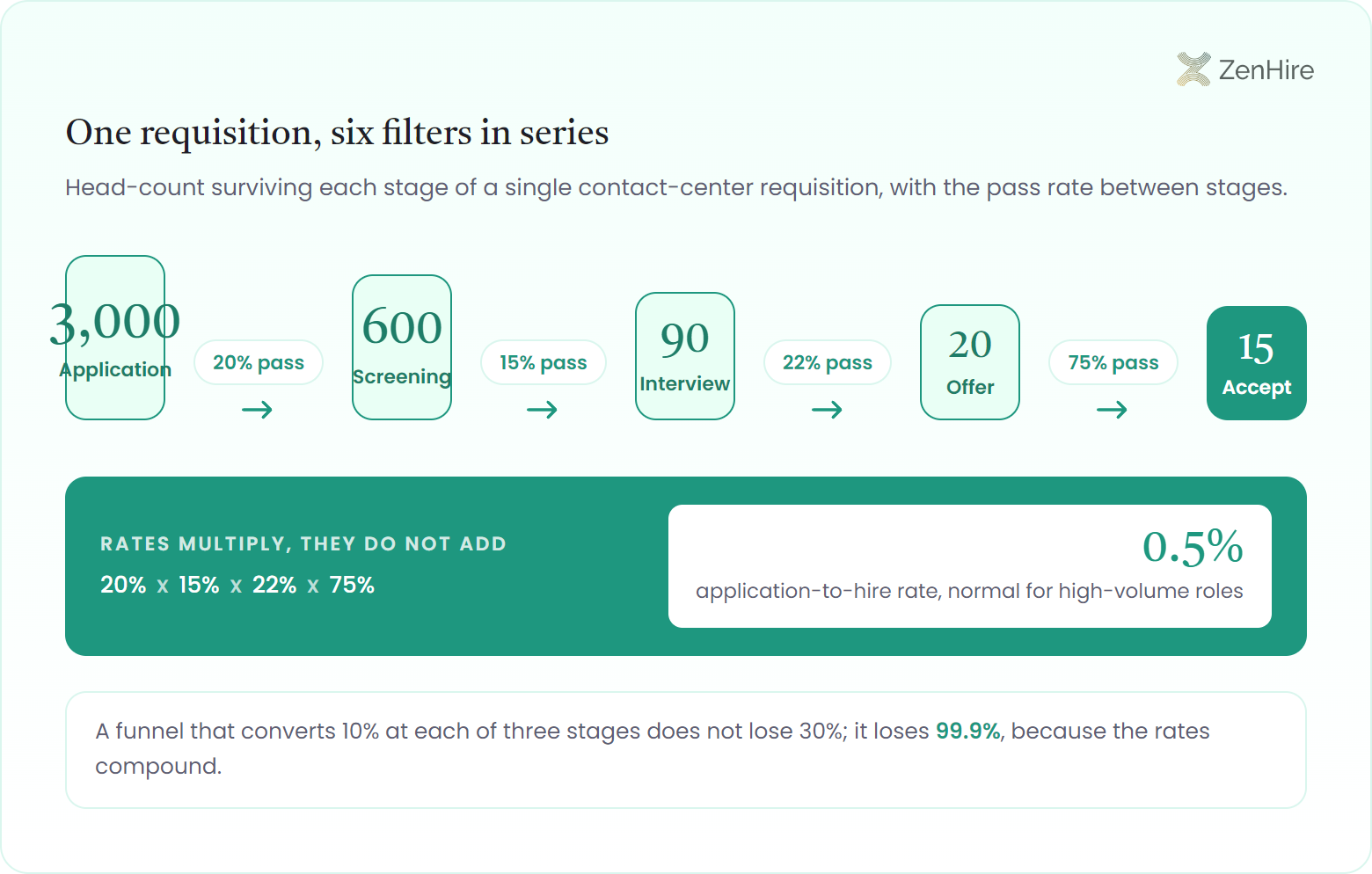
Conversion compounds, so funnels are unforgiving: at high volume a single role can attract 2,000-5,000 applications, yet only a handful become hires. The funnel is not one filter; it is six filters in series, and the final yield is every stage's pass rate multiplied together.
| Funnel stage | What happens | Primary signal |
|---|---|---|
| Awareness | Candidate learns the role exists | Reach, source mix, employer brand |
| Application | Candidate applies | Apply-start rate, drop-off on the form |
| Screening | You filter applicants to a shortlist | Screen-pass rate, false negatives |
| Interview | You assess shortlisted candidates | Interview-to-offer rate, no-shows |
| Offer | You extend an offer | Offer rate, time from interview to offer |
| Accept | Candidate accepts and starts | Offer-accept rate, early renege |
Where does the recruitment funnel leak most?
The recruitment funnel leaks most at screening, where the gap between volume and reviewer time is largest. This is the stage with the worst ratio of candidates-in to attention-available, so it is where good people get buried and where the cost of a wrong call is highest. The leak is not random attrition; it is two specific failures: false negatives, where a strong candidate is rejected by a rushed scan, and false positives, where a weak candidate slips through to consume interview slots.
The mechanism behind the leak is inconsistency under load. When one role pulls thousands of applications, a reviewer cannot apply the same bar to candidate 2,000 as to candidate 2, so the screen becomes a function of who applied early and who happened to use the right keywords. The instrument compounds it: the resume this stage sorts on lines up with actual performance at roughly 0.14, and the unstructured phone screen that follows only reaches about 0.18, so even a careful manual pass is filtering on a faint signal. The other heavy leak sits at the very bottom, where slow offers cost you accepts, which is why time-to-hire belongs on the same dashboard as conversion rates.
A concrete example: a team screening 3,000 applicants manually spends review time on the first few hundred and rubber-stamps the rest, so a candidate with the right reliability and communication profile who applied on day nine never gets a fair read. The edge case: a funnel can also leak at the top from over-screening. If your application form is a 40-minute ordeal, your best passive candidates abandon it before they ever enter the funnel, and you mistake a self-inflicted candidate experience leak for a small market.
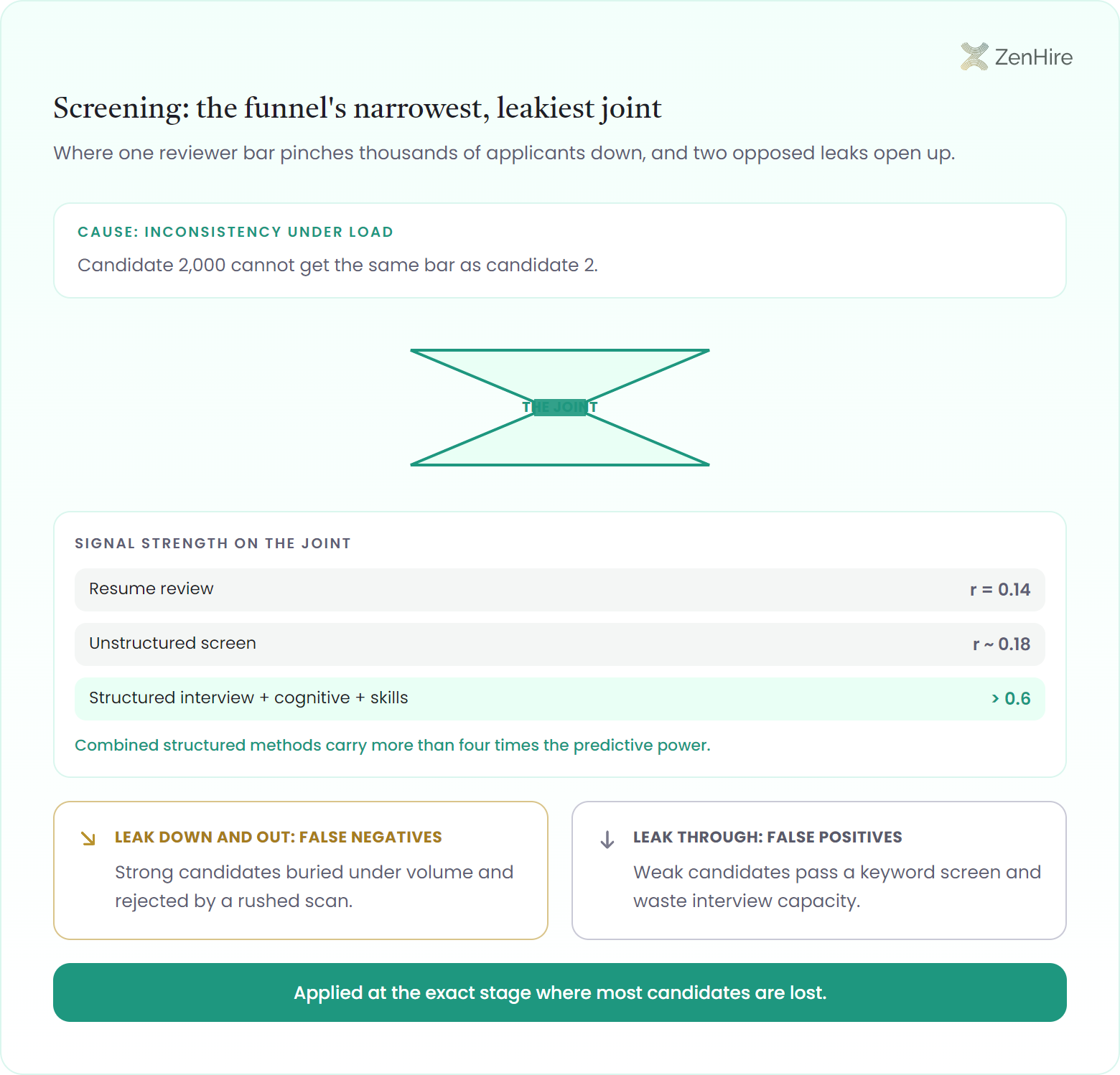
Screening is the funnel's narrowest, leakiest joint, and it usually runs on its weakest instrument: a plain resume review tracks performance at about r = 0.14 and an unstructured screen at ~0.18, while rebuilding the same stage from structured interviews, cognitive, and skills assessment pushes the signal past 0.6, more than four times the predictive power, at the exact point where most candidates are lost.
- Screening leak (false negatives): strong candidates buried under volume and rejected by a rushed scan
- Screening leak (false positives): weak candidates pass a keyword screen and waste interview capacity
- Offer-stage leak: slow decisions let competing offers arrive while the candidate waits
- Top-of-funnel leak: an over-long application form drives off your best passive candidates
How do you optimize each recruitment funnel stage?
You optimize each recruitment funnel stage by measuring its conversion rate, finding the stage that loses the most qualified candidates, and fixing that one before touching any other. Funnel math means the worst stage caps the whole pipeline, so widening the top while the middle leaks just creates more rejected applicants and more wasted reviewer hours. Recruitment funnel optimization is sequential triage, not a general push.
The mechanism is leverage. Because the stages multiply, a 10-point improvement at your weakest stage moves the final hire count far more than a 10-point gain at a healthy one, and the weakest stage in high-volume hiring is almost always screening. The highest-leverage move is to make screening consistent and predictive at scale, so every candidate clears the same bar scored the same way regardless of when they applied. That is exactly what a structured interview does for judgment, and what an AI interview does for the volume that swamps this stage: ZenHire gives every applicant in the queue the same roughly four-minute assessment of communication, soft skills, language, and reliability, agreeing with human evaluators 93%+ of the time and pulling CV data at 97% accuracy, so which candidates advance no longer depends on where they landed in the reviewer's day. Track the result with the same recruitment metrics you would use to manage any pipeline.
A concrete example: a team that fixes screening before the interview stage sees interview-to-offer rates rise on their own, because interviewers are finally meeting pre-qualified candidates instead of a random sample. The edge case to respect: optimizing a stage can move the leak, not remove it. If you triple screen-pass quality but keep a five-day gap before the interview, you will simply lose those better candidates at the offer stage instead, so re-measure the whole funnel after every change, never just the stage you touched.
| Stage | Optimization lever | Metric to watch |
|---|---|---|
| Application | Shorten the form; mobile-first apply | Apply-start vs. apply-complete rate |
| Screening | Consistent, structured, AI-assisted scoring at scale | Screen-pass rate and false-negative rate |
| Interview | Structured rubric; same questions, same scale | Interview-to-offer conversion |
| Offer | Compress time from interview to offer | Days-to-offer; offer-accept rate |
| Accept | Fast, warm follow-up; clear expectations | Accept rate; 90-day early renege |
When I started building an AI recruiter, I assumed in-house teams needed help everywhere in the funnel. They do not. Almost every team I talk to has a perfectly fine top and bottom and a broken middle: thousands of applicants meeting a few human hours of attention. That is not a motivation problem you can manage your way out of; it is an arithmetic problem. The honest fix is to make the screening stage as consistent as the rest of your funnel, so candidate number 3,000 gets read with the same care as candidate number three. Get that one joint right and the stages below it quietly start working.
Frequently asked questions
What are the main stages of the recruitment funnel?+
The main stages of the recruitment funnel are awareness, application, screening, interview, offer, and accept. A wide pool enters at the awareness and application stages, screening filters it to a shortlist, interviews assess the shortlist, and the final two stages convert a candidate into a started hire.
Where does the recruitment funnel leak the most?+
The recruitment funnel leaks most at the screening stage, where the gap between application volume and reviewer time is widest. A single role can draw 2,000-5,000 applications, so strong candidates get buried (false negatives) while weak ones slip through (false positives) and waste interview capacity.
How do you optimize the recruitment funnel?+
You optimize the recruitment funnel by measuring the conversion rate at each stage and fixing your weakest stage first. Because the stages multiply, the worst stage caps the whole pipeline, so a consistent, predictive screen usually delivers more hires than widening the top of the funnel.
What is a good conversion rate for a recruitment funnel?+
A good conversion rate depends on the role and the stage, so your own trend matters more than any benchmark. High-volume frontline roles often run well under 1% application-to-hire, while specialist roles convert far higher because awareness, not screening, is the bottleneck. Track each stage separately and watch its direction over time.
How is the recruitment funnel different from the hiring pipeline?+
The recruitment funnel is the conversion view and the pipeline is the inventory view of the same process. The funnel measures the rate at which candidates move between stages, while a talent pipeline is the warm pool of pre-assessed people you can draw from, which feeds the top of the funnel when a role opens.
Free for recruitment funnel optimization
The recruitment funnel diagnostic
A one-page worksheet to map your six funnel stages, calculate the conversion rate at each, and pinpoint the single leak that is capping your hires, before you spend a dollar widening the top.