
How Do You Lower Your Recruitment Costs?


· 8 min read
You lower your recruitment costs by fixing the three biggest funnel leaks: hidden recruiter labor, rework from inconsistent screening, and agency placement fees, not by trimming job-ad spend. Teams adopting AI-assisted screening report roughly 59% lower cost per cycle and 62% faster hiring, while agency placement fees run 15-25% of first-year salary, about $12,000 on a $60,000 role. A manual first pass on 4,000 applications burns roughly 400 recruiter hours, and replacing one mis-hire costs 50-200% of salary (SHRM).
Where do recruitment costs leak in your funnel?
Recruitment costs leak in your funnel wherever a human has to touch a candidate who was never going to be hired, and that is most of the top of the funnel. For every role you fill, your team reads hundreds of resumes, runs dozens of first-round screens, and schedules interviews for people who drop out, fail later, or were never a fit. That labor is invisible on the budget but it is the largest real cost of recruiting.
The second leak is rework. When screening is inconsistent, strong candidates get rejected on a busy day and weak ones advance, so you pay to interview, re-open, and re-screen the same role. The third is the agency line, where a single placement can cost a fifth of the hire's annual salary. Map these against your cost per hire and the picture inverts: the cheap-looking job ad is rarely the expensive part.
A concrete example: a contact-center team filling 200 seats a quarter receives roughly 4,000 applications. If a recruiter spends six minutes per resume on a manual first pass, that is 400 hours of loaded labor before a single interview happens: money that never appears as a recruiting cost but absolutely is one. This is the defining strain of high-volume hiring, where the labor leak scales with every open seat. The edge case is the senior or niche role, where volume is low but each agency placement or each week the seat stays open carries a much larger per-unit cost, so the leak shifts from labor to time-to-fill.
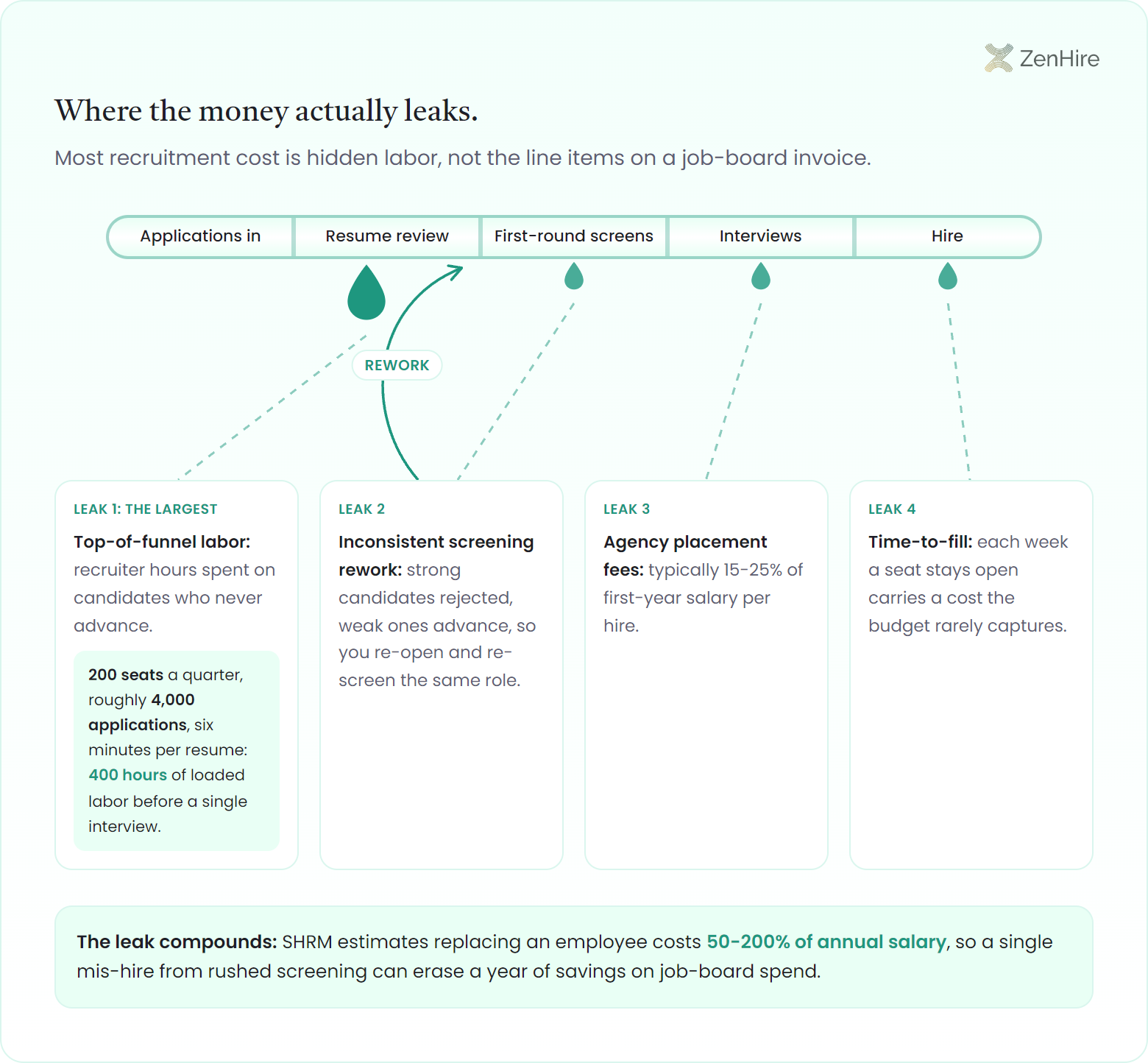
The leak compounds: SHRM estimates that replacing an employee costs 50-200% of their annual salary once you count recruiting, training, and lost productivity. That means a single mis-hire from rushed, inconsistent screening can erase a year of careful savings on job-board spend.
- Top-of-funnel labor: recruiter hours reading resumes and running first-round screens for candidates who never advance
- Inconsistent screening: rework when strong candidates are rejected and weak ones advance, so you re-open and re-interview
- Agency placement fees: typically 15-25% of first-year salary per hire
- Slow time-to-fill: every week a revenue-generating seat sits empty is a cost the budget rarely captures
How does automation lower recruitment costs?
Automation lowers recruitment costs by removing the repetitive screening labor that dominates the funnel, so the same team can evaluate far more candidates at the same cost. Instead of a recruiter reading every resume and running every first-round call, an AI recruiter reads communication, skills, and reliability signals consistently, at the same standard for the tenth candidate and the ten-thousandth. The cost that falls is the hidden labor cost, which is the biggest one.
The mechanism is leverage on the most expensive minutes in your process. ZenHire's AI interview software runs a structured assessment in about four minutes per candidate and returns a scored, comparable result, while CV DeepMatch extracts and ranks resumes at 97% extraction accuracy with 93%+ alignment to human evaluators. A recruiter then reviews a ranked shortlist and decision-ready summaries instead of a stack of raw resumes, at a fraction of the time and a fraction of the cost.
A concrete example: that same 4,000-application contact-center funnel, screened automatically, turns 400 hours of manual first-pass labor into a review of a pre-ranked shortlist, so the recruiter spends their time on the candidates who can actually do the job. The edge case worth naming is over-automation: if you let a tool auto-reject without a human review queue, you risk discarding strong, non-obvious candidates and paying for it later in re-opened roles. The savings are real precisely because structured interviews and a glass-box, auditable score keep a human accountable for the final call.
Industry research finds that around 70% of hiring teams expect to use AI by 2025, and teams that adopt it report roughly 62% faster hiring and 59% lower cost per cycle. The driver is simple: AI screening removes the repetitive labor that made high-volume recruiting expensive in the first place.
| Funnel stage | Manual cost driver | What automation changes |
|---|---|---|
| Resume review | Recruiter hours per application | Ranked shortlist instead of a raw stack |
| First-round screen | A live call for every candidate | A ~4-min structured assessment, scored consistently |
| Calibration | Different bar per interviewer | One glass-box rubric every candidate clears |
| Shortlisting | Reading every transcript | Decision-ready summaries for a human to review |
How do you lower recruitment costs by reducing agency reliance?
You lower recruitment costs by reducing agency reliance when you bring the evaluation in-house so you can confidently fill more roles directly, instead of paying a 15-25% placement fee for someone else to screen for you. Agencies are not the enemy (they are useful for hard, scarce, or confidential roles), but using them as a default for high-volume hiring is the most expensive habit in recruiting, because the fee scales with every single hire.
The mechanism is capability, not willpower. Most teams lean on agencies because they cannot screen at volume to a consistent quality bar on their own. Once an in-house funnel can evaluate candidates reliably and at scale, with consistent assessments, fraud detection, and auditable scores, the reason to pay a placement fee (or an RPO retainer) for routine roles disappears. That is the structural lever behind cheaper recruiting: you reduce reliance by removing the gap the agency was filling. ZenHire's anti-fraud system catches scripted and AI-generated answers at around 91% detection, which is exactly the assurance teams used to outsource to a vendor.
A concrete example: on a role paying $60,000, an agency placement at 20% costs about $12,000. Fill twenty such roles a year through an in-house funnel instead and the avoided fees dwarf the cost of running the screening yourself. The edge case is the genuinely hard hire: a rare skill set, a senior leadership search, or a market you do not operate in. There, the agency fee can still be the cheapest path to a quality hire, and the right move is selective use: agencies for the few, an automated funnel for the many. Pair this with disciplined tracking of time to hire so you can see direct hires getting faster as the in-house funnel matures.
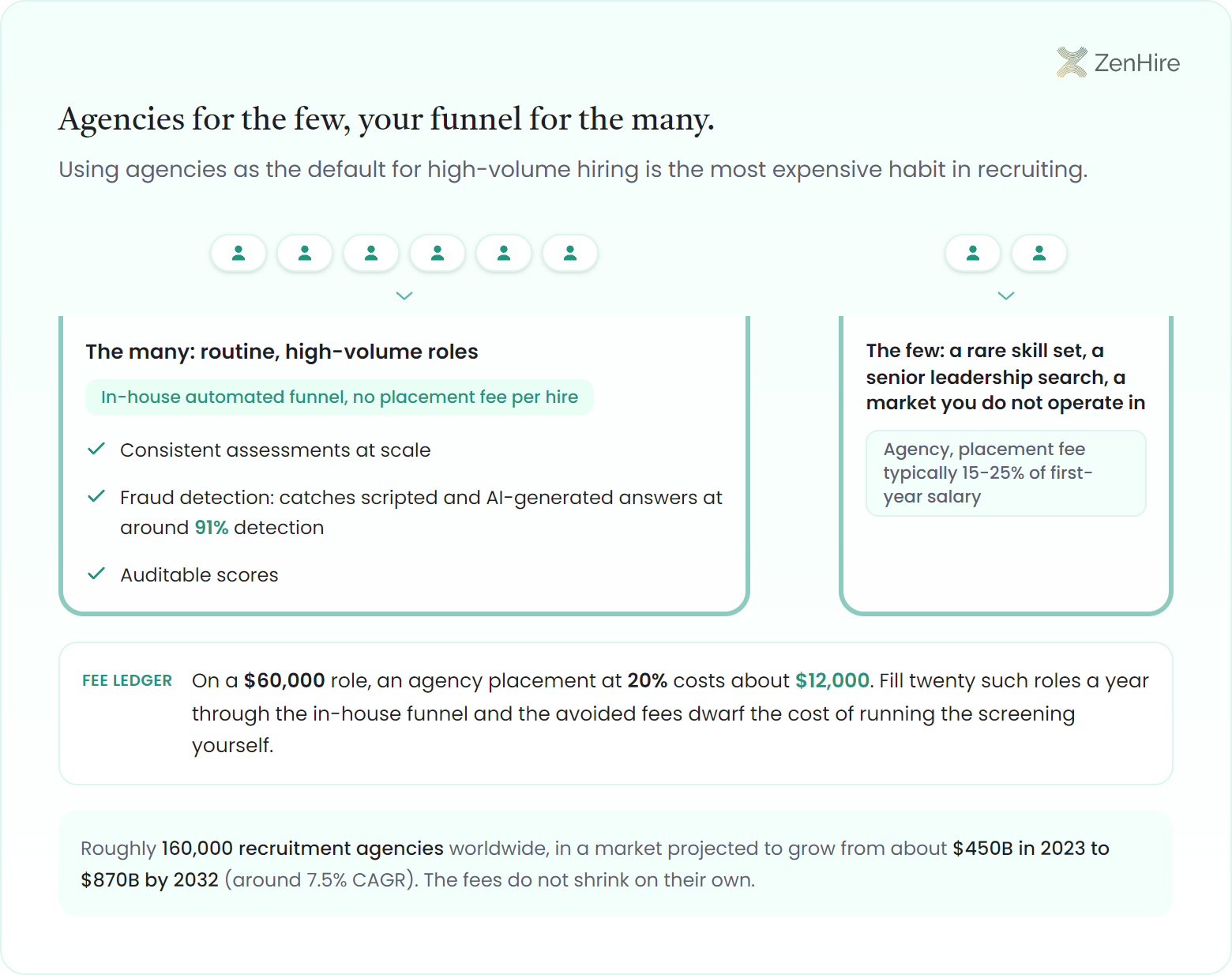
There are roughly 160,000 recruitment agencies worldwide serving a market projected to grow from about $450B in 2023 to $870B by 2032 (~7.5% CAGR). The agency model is not shrinking, which is exactly why a team that can screen at volume in-house keeps more of its hiring budget instead of routing it to placement fees.
When founders ask me how to cut recruiting cost, they almost always point at the wrong line item: the job ads, the tooling, the per-seat licenses. The real money is in the hours nobody invoices: a recruiter reading the four-thousandth resume that was never going to make it, or a 20% agency fee paid because the team could not screen at volume themselves. We did not build ZenHire to make hiring cheap by cutting corners. We built it to remove the repetitive labor and the outsourced screening that made hiring expensive in the first place, so the money you save comes from doing the work better, not from doing less of it.
Frequently asked questions
What is the fastest way to lower recruitment costs?+
The fastest way to lower recruitment costs is to automate early-stage screening and reduce agency reliance, because both attack the largest costs, hidden recruiter labor and 15-25% placement fees, rather than the small line items like job-board spend. Industry research links AI-assisted hiring to roughly 59% lower cost per cycle.
Does cheaper recruiting mean lower-quality hires?+
Cheaper recruiting does not have to mean lower quality. Done right, it raises quality while cutting cost. The expensive mistake is weak screening, since a mis-hire costs 50-200% of salary to replace (SHRM). Consistent, structured evaluation catches mismatches early, so you reduce hiring costs and improve quality of hire at the same time.
How much do recruitment agencies cost?+
Recruitment agencies typically charge a placement fee of 15-25% of the hire's first-year salary. On a $60,000 role that is roughly $9,000-$15,000 per hire. Agencies are worth it for rare or senior roles, but using them as the default for high-volume hiring is the most expensive habit in recruiting.
Can automation really reduce hiring costs without hurting candidates?+
Automation reduces hiring costs and can improve the [candidate experience](/candidate-experience) at the same time. Structured AI screening gives every applicant the same fair, fast evaluation and frees recruiters for human follow-up, while a glass-box, auditable score keeps a person accountable for the final decision. The savings come from removing repetitive labor, not from cutting candidates short.
How do I measure whether my recruitment costs actually went down?+
You measure it with cost per hire, segmented by stage and source, so you can see which change moved the number. Track recruiter hours per hire and agency fees as a share of total spend alongside time to hire, and the effect of automating screening or reducing agency reliance shows up directly.
Free for lowering recruitment costs
The recruitment cost leak audit
A one-page worksheet for finding where your hiring budget actually goes: the hidden labor at the top of the funnel, the rework from inconsistent screening, and the agency fees you could bring in-house.