
What Is a Recruitment Operating System (Recruitment OS)?


· 7 min read
A Recruitment Operating System (Recruitment OS) is a single AI-native platform that runs every hiring stage on one shared candidate record: sourcing, screening, interviewing, assessment, and shortlisting, replacing stitched-together point tools. Because every stage writes to the same record, the signal compounds instead of leaking: resumes parse at 97% field-extraction accuracy, a structured interview carries a predictive validity near 0.28 against roughly 0.18 for an unstructured one, and those scores feed straight into a ranked, evidence-backed shortlist rather than a fresh export. Stack matching, interviews, and validated assessments on that one record and the combined read clears 0.6, well above the 0.14 a resume scan alone earns, whereas five stitched point tools leave six handoffs for a strong candidate to slip through.
What is a Recruitment Operating System?
A Recruitment Operating System is a single AI-native platform that runs every hiring stage: sourcing, parsing, matching, interviewing, and assessment, all on one candidate record, the way a computer's operating system coordinates everything on the machine.
The defining trait is that the intelligence is built in, not added on. Because matching, interviewing, and scoring share one data model, a signal captured at screening still informs the final shortlist; nothing is lost in a handoff between vendors. In practice it behaves less like a filing cabinet and more like an AI recruiter working the pipeline for you.
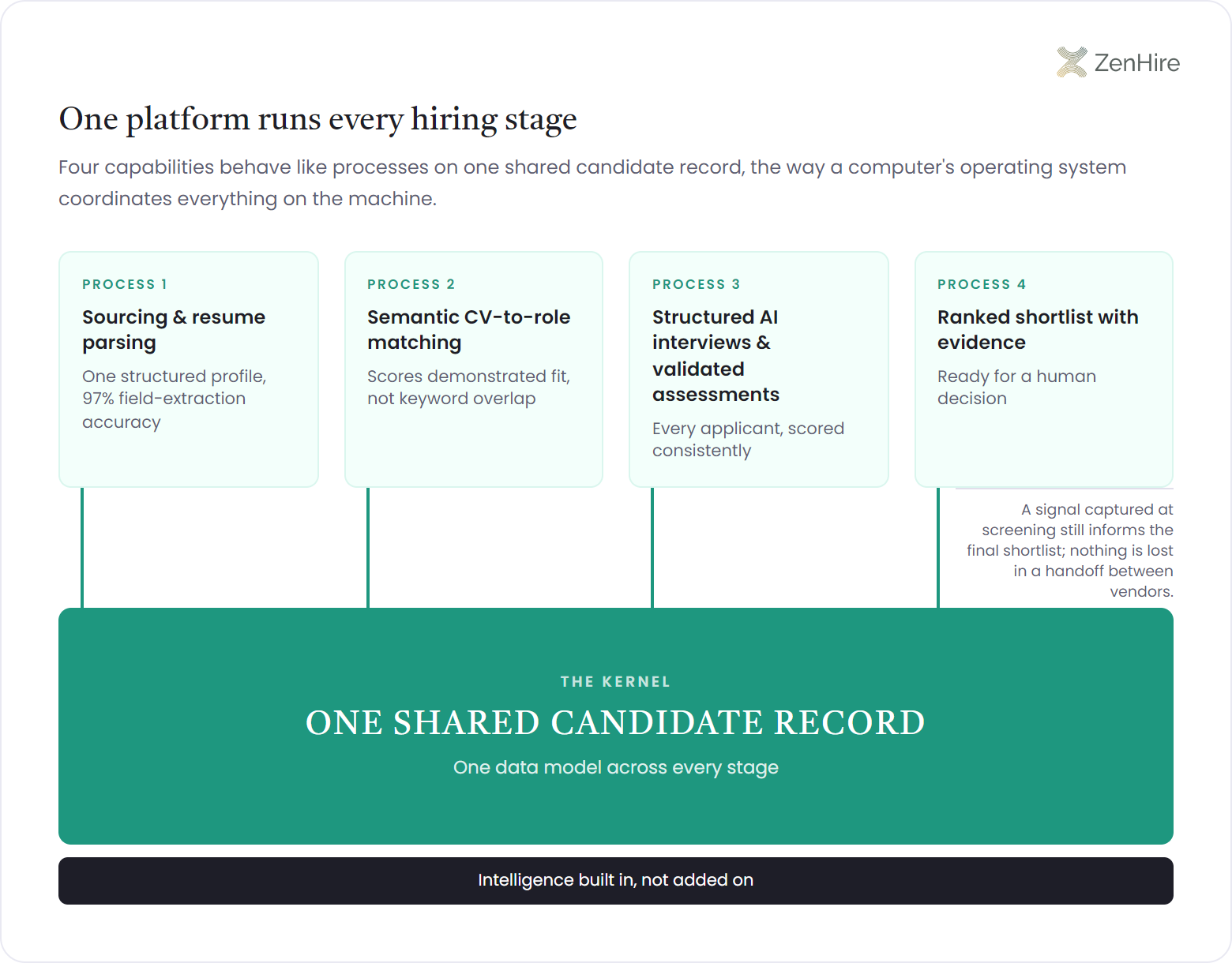
- Sourcing and resume parsing into one structured profile, at 97% field-extraction accuracy
- Semantic CV-to-role matching that scores demonstrated fit, not keyword overlap; see AI candidate matching
- Structured AI interviews and validated assessments on every applicant, scored consistently
- A ranked shortlist with the evidence behind each score, ready for a human decision
How does a Recruitment Operating System differ from point tools?
A Recruitment Operating System differs from point tools by owning every stage on one data model, so a screening signal still counts at the shortlist, instead of dying in the gap between a sourcing tool, an assessment vendor, and a video-interview product.
Some teams prefer best-of-breed point tools and assume an all-in-one must be shallower. The opposite tends to hold in hiring: because the system keeps one candidate record across stages, it can weigh an interview answer against an assessment result the way an experienced recruiter would, something disconnected tools cannot do without manual reconciliation. (Where a human still wins is its own question; see AI recruiter vs human recruiter.)
Roughly half of frontline hires who leave do so inside the first 90 days, before training has paid back, and replacing one can run $5,000 to $20,000 (industry estimates). A pipeline that loses strong candidates between disconnected tools quietly compounds that bill.
| Point tools | Recruitment OS | |
|---|---|---|
| Coverage | One stage each | Every stage, end to end |
| Data | Re-entered, siloed per tool | One shared candidate record |
| Decision | Pieced together by hand | Ranked shortlist with evidence |
| Failure mode | Candidates lost between tools | Seamless handoff between stages |
Stitched point tools vs a traditional ATS vs a Recruitment OS: who actually does the work?
The difference is not which logo runs each stage; it is whether anything in the stack actually evaluates a candidate, or just stores and moves them. Stitched point tools cover individual stages but leave you reconciling exports by hand; a traditional ATS is a system of record that tracks applicants without judging them; a Recruitment OS runs every capability on one record and returns a decision, not just a pipeline.
Read the matrix down each column. Most stacks can technically *do* every row, whether by buying another tool or paying an agency, but only the right-hand column does them on a single shared candidate record, so a signal captured at screening still counts at the shortlist. That continuity is the whole point: selection research rates a structured interview around 0.28 against roughly 0.18 for an unstructured one, and layering methods lifts the combined read past 0.6, but a number is only worth capturing if it lands where the next stage can read it, not in the third of three disconnected dashboards.
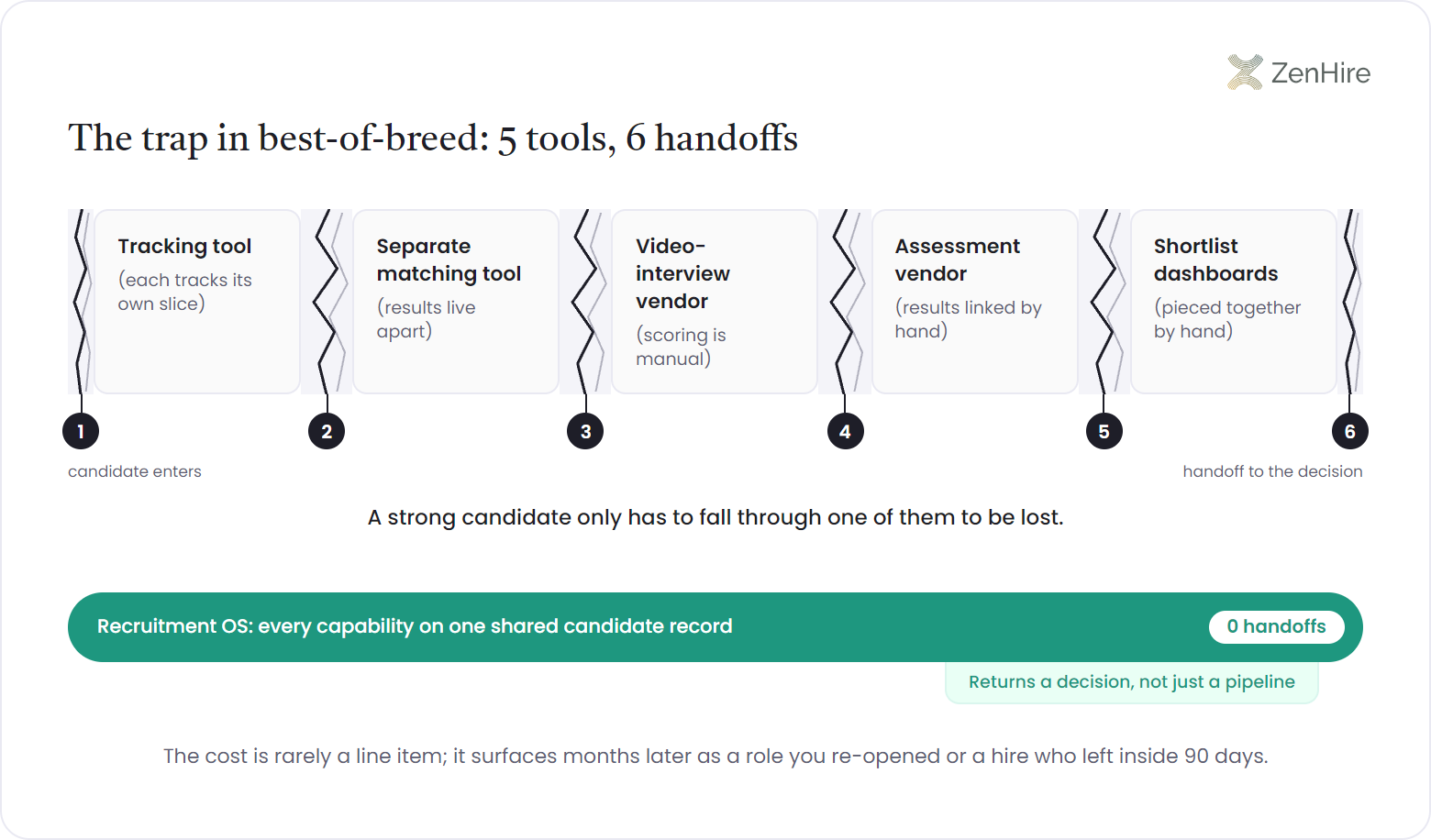
The trap in "best-of-breed": five excellent point tools still produce six handoffs, and a strong candidate only has to fall through one of them to be lost. The cost of that gap is rarely a line item; it surfaces months later as a role you re-opened or a hire who left inside 90 days.
| Capability | Stitched point tools | Traditional ATS | Recruitment OS |
|---|---|---|---|
| Track applicants | Each tool tracks its own slice; you reconcile by export | Yes, this is its core job | Yes, on one shared record across every stage |
| Evaluate fit | Add a separate matching tool; results live apart | No; stores resumes, does not judge them | Semantic CV-to-role matching, scored, not keyword overlap |
| Run interviews | Bolt on a video-interview vendor; scoring is manual | No; schedules at best, evaluates nothing | Structured AI interviews on every applicant, scored consistently |
| Run assessments | Buy an assessment vendor; link results by hand | No native assessment layer | Validated assessments built in, on the same record |
| Shortlist with evidence | Pieced together across dashboards | A list ordered by date or status, not merit | Ranked shortlist with the evidence behind each score |
| Single source of truth | No; data re-entered and siloed per tool | Partial: record of applicants, not of evaluation | Yes, one candidate data model end to end |
Why is a Recruitment Operating System more future-proof?
A Recruitment Operating System is more future-proof because its intelligence is native, not bolted on: when evaluation methods improve, every stage benefits at once, on the same data model.
It also keeps decisions explainable and auditable as scrutiny of AI hiring grows: each score ships with its evidence, which matters as regulation tightens. The honest position is not that AI will run hiring unattended, but that AI should measure while a person decides, and a Recruitment OS is built around exactly that split. For where that is heading, see the future of recruitment.
Why one record beats a stack: on its own a resume scan predicts on-the-job performance at only about r = 0.14; a Recruitment OS keeps the structured interview, cognitive, and skills scores on the same candidate profile, and that assembled signal clears 0.6, over four times what the resume managed by itself. The math only works when the scores live together instead of scattered across vendor exports.
I did not build ZenHire to add another tool to the pile. I watched teams lose strong people in the gaps between a sourcing tool, an assessment vendor, and a video product, so I became convinced the unit of progress is the whole hiring job, run on one record. A Recruitment OS is that conviction made concrete: measure everything consistently, keep a human on every decision, and stop letting the seams decide who you hire.
Frequently asked questions
Is a Recruitment OS the same as an ATS?+
A Recruitment OS is not the same as an ATS. An ATS tracks and stores applicants but does not evaluate them; it answers "where is this candidate in the process," not "how good a fit are they." A Recruitment OS adds the intelligence layer, AI matching, interviews, and assessments, that judges the pipeline and returns a ranked, evidence-backed shortlist. It can run standalone or sit on top of your existing all-in-one ATS.
What does a Recruitment OS include?+
A Recruitment OS includes sourcing and resume parsing, semantic CV-to-role matching, structured AI interviews, validated assessments, and a ranked shortlist with the evidence behind each score, all on one candidate data model.
Do you still need a recruiter with a Recruitment OS?+
You still benefit from a recruiter with a Recruitment OS, but their work shifts. The system handles repetitive screening so people focus on judgment, candidate relationships, and closing: AI measures, humans decide.
Is candidate data in a Recruitment OS handled responsibly?+
A responsible Recruitment OS keeps decisions explainable and auditable, excludes sensitive attributes from scoring, and maintains a compliance posture such as GDPR and SOC 2 Type II. The goal is fairer, more consistent evaluation than informal manual screening.
Free for Recruitment OS evaluation
The Recruitment OS buyer's checklist
A one-page checklist for evaluating an AI-native hiring system: the questions to ask, the red flags to avoid, and what "explainable" should actually mean.