
AI Recruiter vs Human Recruiter: Where Each Wins


· 13 min read
In the AI recruiter vs human recruiter matchup, the AI recruiter wins speed, scale, consistency, cost, and bias control, while the human recruiter wins senior judgment, relationships, and closing. Put the two side by side on the one thing hiring is meant to predict, and the gap is stark: a hand-read resume forecasts on-the-job performance at only about 0.14, whereas the AI recruiter's structured, combined methods push that signal past 0.6, all while it parses thousands of applicants overnight at near-97% CV-extraction accuracy. ZenHire's scoring tracks human screeners at 93%+, and AI-enabled hiring lands about 62% faster and 59% cheaper, which is why the winning setup is not one column but both stapled together: AI measures, humans decide.
Where does an AI recruiter beat a human recruiter?
An AI recruiter beats a human recruiter on every task that is repeatable, high-volume, and rule-based: it grades the thousandth applicant exactly as carefully as the first, never tires, and never skims a CV because it is Friday at 5pm.
The mechanism is consistency at scale. A person can read a few dozen resumes an hour before fatigue dulls their attention; an AI recruiter parses thousands overnight with CV extraction near 97% accuracy, runs a structured roughly four-minute interview on each, and scores spoken language on a CEFR scale. Because the rubric is fixed, candidate 900 and candidate 9 face the same questions and the same scoring, which is the foundation of fairness. It also excludes sensitive attributes from scoring and keeps an explainable, glass-box record of why each score landed, so bias control is architectural rather than a good intention. If that mechanics interests you, see what an ai recruiter does end to end.
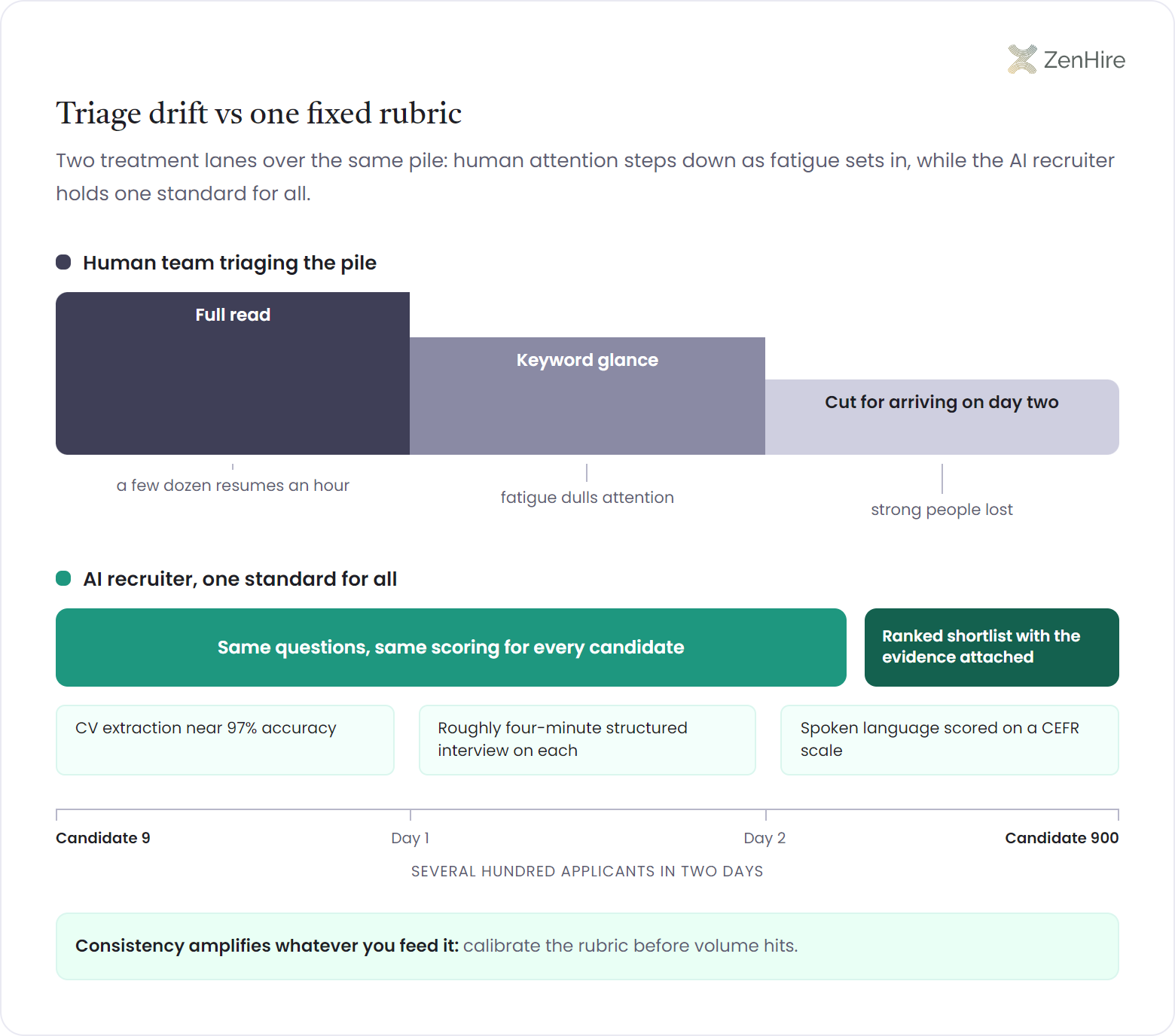
Concretely, picture a contact-center role that draws several hundred applicants in two days, the everyday reality of high-volume hiring. A human team triaging that pile drifts: early candidates get a full read, later ones get a keyword glance, and strong people get cut for arriving on day two. The machine vs recruiter gap shows here plainly, because the AI recruiter applies one standard to all several hundred and hands back a ranked shortlist with the evidence attached. This is also where semantic cv-to-role matching beyond keywords earns its keep, surfacing candidates whose real experience a keyword filter would have buried.
The edge case worth naming: speed and consistency are only virtues when the rubric is right. If the scorecard encodes a flawed definition of the job, the AI recruiter applies that flaw uniformly and at scale, which is worse than a human's scattered error. Consistency amplifies whatever you feed it, so a person has to calibrate the rubric before volume hits.
Why hand the front end to the machine at all: because the human's default screening tool is the weakest predictor in the kit. A CV review predicts on-the-job performance at about r = 0.14 and an unstructured chat at ~0.18, a structured interview lifts that to ~0.28, and stacking structured methods carries it past 0.6, over four times what reading a resume by hand can tell you. Recruiters are voting with their workflows already: by 2025 industry research has roughly 70% of hiring teams leaning on AI in some form, and the AI-run version of that front end comes in about 62% faster and 59% cheaper per hire.
- Speed: parses and interviews thousands of candidates overnight instead of over weeks.
- Scale: absorbs a spike of hundreds of applicants without dropping its standard.
- Consistency: every candidate faces the same questions and the same scoring rubric.
- Bias control: excludes sensitive attributes, keeps explainable scores, audits each decision.
- Cost: a fixed per-candidate cost that does not climb with volume the way recruiter hours do.
Where does a human recruiter still beat an AI recruiter?
A human recruiter still beats an AI recruiter wherever the decision is senior, ambiguous, or relational: judgment on a vague role, trust built over a call, and the art of closing a reluctant star are not measurement problems.
The mechanism is context and persuasion. A recruiter reads what a transcript cannot: that a candidate is undersold by their resume, that a hiring manager's stated requirement is not the real one, that a competing offer can be beaten with growth rather than salary. They negotiate, they sell the mission, and they hold a relationship across months until the timing is right. In the ai vs human hiring split, this is the half that resists automation, because it leans on tacit signals, trust, and accountability that a model cannot own.
Concretely, picture a single senior leadership hire where three finalists are all genuinely excellent on paper and in assessment. The scores cluster; the decision now turns on chemistry with the founding team, appetite for risk, and who can be persuaded to leave a comfortable job. A person makes that call and personally closes the candidate, because no ranking resolves a tie when the differentiator is human fit rather than a measurable gap. When you are building a leadership team as a founder, this is the part you should guard most jealously.
The edge case that cuts the other way: human judgment is also where bias hides. Undocumented gut feel can smuggle in more bias than an audited model, so the human edge is real only when the recruiter is doing genuine senior judgment, not informal screening that a consistent system would handle more fairly. The win is in the nuanced decisions, not in re-reading resumes by hand.
- Senior and executive hires where scores cluster and chemistry decides the tie.
- Ambiguous roles with no stable definition of success to score against.
- Relationships and trust built and held over weeks or months.
- Negotiation and closing: persuading a great candidate to actually say yes.
- Selling the role and the mission in a way a transcript never can.
How do you combine an AI recruiter and a human recruiter?
You combine an AI recruiter and a human recruiter by splitting the work along one line: let software measure every applicant the same way, and let people decide on the handful that matter. That division of labor is the entire model, and it compresses to one rule: AI measures, humans decide.
The mechanism is a single pipeline with a clean handoff. The AI recruiter sources, parses, interviews, and assesses the full field, then ranks it and surfaces the evidence behind each score. The recruiter starts where judgment begins, opening a shortlist of ten with transcripts and signals attached instead of a queue of 400 resumes. They spend their hours on the finalists, the hiring managers, and the close. The order matters because of what it does to the pool: a resume on its own sits near 0.14 in predictive validity, and the AI-run structured layer lifts the field it draws from past 0.6 before a person ever weighs in, so the human is deciding among genuinely better-vetted finalists rather than sifting raw applicants. This is the spine of a done-for-you hiring pipeline, and the wider model behind a single AI-native recruitment operating system.
Use this decision rule. If a task is repeatable, high-volume, and benefits from one consistent standard, route it to the AI recruiter. If it is senior, ambiguous, relational, or about persuasion, route it to a person. Most roles need both, in that order: measure first, decide last.
Concretely, picture a team hiring fifty frontline agents and one operations lead in the same quarter. The fifty flow through the AI recruiter end to end, which is where the time and cost savings live, given that replacing a mis-hired frontline worker can run roughly $5,000 to $20,000 and about half of frontline leavers go within their first 90 days, before training has paid back, which is why hiring for fit is the cheapest way to reduce employee turnover. The one lead gets the full human treatment from the shortlist onward. Same pipeline, two depths of human involvement matched to the stakes.
Some argue this hybrid just adds a layer of AI output for recruiters to second-guess, so it creates work rather than saving it. In practice it removes work: reviewing a ranked shortlist with evidence takes a fraction of the time of reading every resume and watching every interview, and the recruiter keeps the override. The system is a consistent baseline and a starting point, not a verdict, which is exactly why a person stays accountable for the final call.
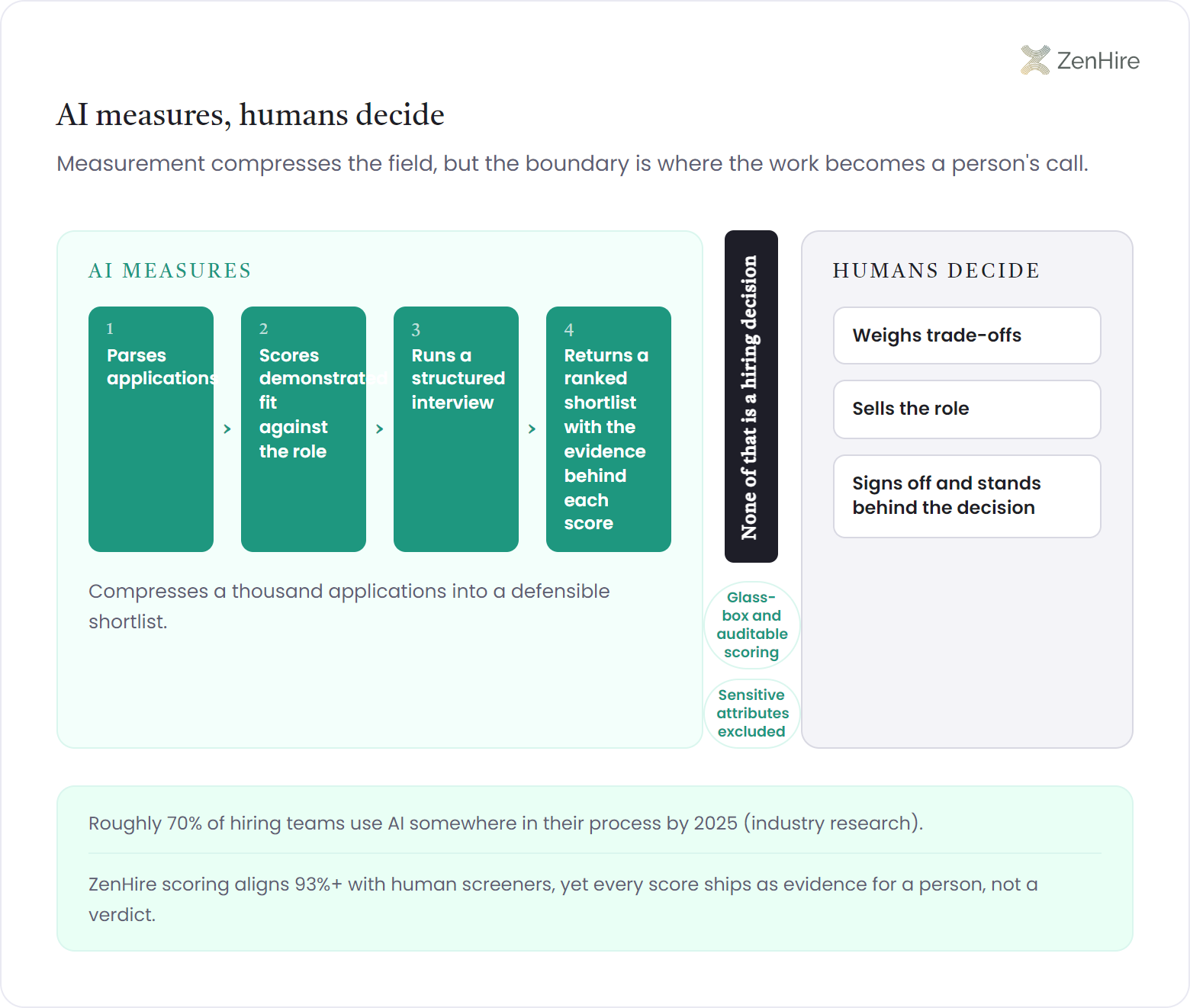
On a structured assessment, ZenHire's scoring aligns 93%+ with human screeners and its language analysis lands 90-96% with five PhD linguists, where untrained recruiters reach only 68-75%. The point is not that the machine is smarter; it is that the machine is consistent, so the human can spend judgment where judgment actually changes the outcome.
| Axis | AI recruiter | Human recruiter |
|---|---|---|
| Speed | Thousands screened overnight | Dozens of CVs per hour |
| Scale | Absorbs spikes without drift | Quality degrades under volume |
| Consistency | One fixed rubric for everyone | Varies by mood, time, fatigue |
| Bias control | Sensitive attributes excluded, audited | Gut feel can hide bias |
| Cost | Fixed per candidate | Hours that scale with volume |
| Senior judgment | Clusters, cannot break a tie | Reads chemistry and risk |
| Relationships | No trust or rapport | Builds and holds them over months |
| Negotiation | Cannot persuade or close | Sells the role, closes the offer |
Which side wins on each dimension of hiring?
Score it dimension by dimension and the pattern is unambiguous: the AI recruiter wins consistency, scale and speed, bias control, and cost, while the human recruiter wins judgment and empathy or closing, and the combined model wins overall, because it claims both columns instead of trading one for the other. No single side sweeps the board, which is exactly why the head-to-head ends in a handoff rather than a knockout.
Read the table below as a referee's card, not a leaderboard. Each row names a dimension, calls the winner, and says why in one line. The decisive row is the last one, and it is the reason neither column sweeps: no single selection method carries a hire on its own. A resume read by hand predicts on-the-job performance at about r = 0.14 and an unstructured interview at ~0.18; a structured interview reaches ~0.28, and only when structured methods are combined does the signal climb past 0.6. That ceiling is exactly why the AI recruiter owns measurement and the human owns the call: neither wins the row alone, but the pair clears it. Stack them and you get more than either column scores alone.
The practical reading: route the four machine-favored dimensions to the AI recruiter by default, keep the two human-favored dimensions firmly with a person, and treat the bottom row as the actual recommendation. A team that does this measures every applicant the same way and still lets a human break the ties that scores cannot, using the hybrid pipeline the whole comparison points toward.
How to use the card: if a dimension is repeatable and benefits from one standard, it belongs to the machine; if it turns on context, trust, or persuasion, it belongs to a person. The bottom row is the whole point: you are not picking a winner between the columns, you are stapling them together so the machine carries the volume and the human carries the judgment.
| Dimension | Winner | Why it wins |
|---|---|---|
| Consistency | AI recruiter | One fixed rubric grades candidate 9 and candidate 900 identically; CV field-extraction lands near 97% accuracy with no fatigue or drift. |
| Scale and speed | AI recruiter | Runs a roughly four-minute structured interview on thousands overnight and absorbs spikes of hundreds of applicants without lowering its standard. |
| Judgment | Human recruiter | When finalists cluster on every score, a person reads risk appetite, manager fit, and the real shape of an ambiguous role, a tie no ranking can break. |
| Empathy and closing | Human recruiter | Trust, rapport, and persuading a reluctant star to say yes are relational acts a transcript cannot perform; the human sells the mission and closes the offer. |
| Bias control | AI recruiter | Sensitive attributes are architecturally excluded and every score is an explainable, auditable glass-box record, fairness you can measure, not assume. |
| Cost | AI recruiter | A fixed cost per candidate that does not climb with volume, versus recruiter hours that scale linearly with every extra applicant in the pile. |
| Overall | Combined model | AI measures the full field; the human decides the few that matter. Industry research shows combined structured methods predict performance past 0.6, beating either side alone. |
The question I get asked is always "AI or humans?" and I think it is the wrong question. I have never once tried to build a machine that replaces a recruiter. I have tried to build one that stops wasting them. When a recruiter spends their week reading the four-hundredth resume instead of closing the one candidate who could change a team, that is not a human winning, that is a human being misused. My conviction is simple: let the machine carry the volume so a person can carry the judgment, and never let it be the other way around.
Frequently asked questions
Who is better, an AI recruiter or a human recruiter?+
Neither an AI recruiter nor a human recruiter is better outright, because they win on different axes. The AI recruiter wins on speed, scale, consistency, cost, and bias control; the human recruiter wins on senior judgment, relationships, and closing. The strongest setup runs both in one pipeline rather than picking a winner.
What is the real difference in ai vs human hiring?+
The real difference in ai vs human hiring is what each side is good at, not who replaces whom. AI hiring measures every candidate against a fixed rubric at scale with auditable scores; human hiring supplies context, persuasion, and accountability for the final decision. AI measures, humans decide.
Does the machine vs recruiter choice mean recruiters lose their jobs?+
The machine vs recruiter framing does not mean recruiters lose their jobs; it moves their work up the value chain. The AI recruiter absorbs repetitive screening, and people shift to relationships, calibration, and closing the finalists. For the longer view, see whether ai will replace recruiters.
When should you trust an AI recruiter over a human recruiter?+
You should trust an AI recruiter over a human recruiter when the work is high-volume, repeatable, and benefits from one consistent standard, for example, screening hundreds of frontline applicants. Reserve the human recruiter for senior, ambiguous, or relational hires where chemistry and negotiation decide the outcome.
Is an AI recruiter less fair than a human recruiter?+
An AI recruiter is not inherently less fair than a human recruiter, and a well-built one is often fairer. It excludes sensitive attributes from scoring, keeps explainable glass-box records, and maintains a SOC 2 and GDPR posture, whereas undocumented human screening can hide more bias than an audited system. The honest position is that fairness should be measured statistically, not assumed.
Free for ai-human work split
The AI-vs-human work-split worksheet
A one-page worksheet to sort your hiring tasks into two columns (what to hand the AI recruiter and what to keep for a human) so you know exactly where the handoff should sit in your pipeline.