
What Is an AI Recruiter, and What Can It Do?


· 12 min read
An AI recruiter is software that runs the repeatable hiring stages on its own: sourcing, parsing, matching by meaning, interviewing, assessing, and ranking candidates into an evidence-backed shortlist a human decides on. Where a person tires, it holds its accuracy: it pulls fields off a CV at roughly 97%, places spoken English on the CEFR A1-C2 scale within 90-96% of what PhD linguist panels agree on, and catches scripted or AI-generated answers about 91% of the time. Because it runs a structured interview plus validated assessments on everyone who applies, the predictive signal climbs from the 0.14 a bare resume gives you to past 0.6, and that is the mechanism behind ZenHire's 87% drop in manual screening and 36% faster time-to-hire.
What does an AI recruiter do end to end?
An AI recruiter carries a candidate from first contact to a decision-ready shortlist, automating each repeatable step so the only manual work left is judgment. One system handles the flow that today spans a separate sourcing tool, an assessment vendor, and a video-interview product.
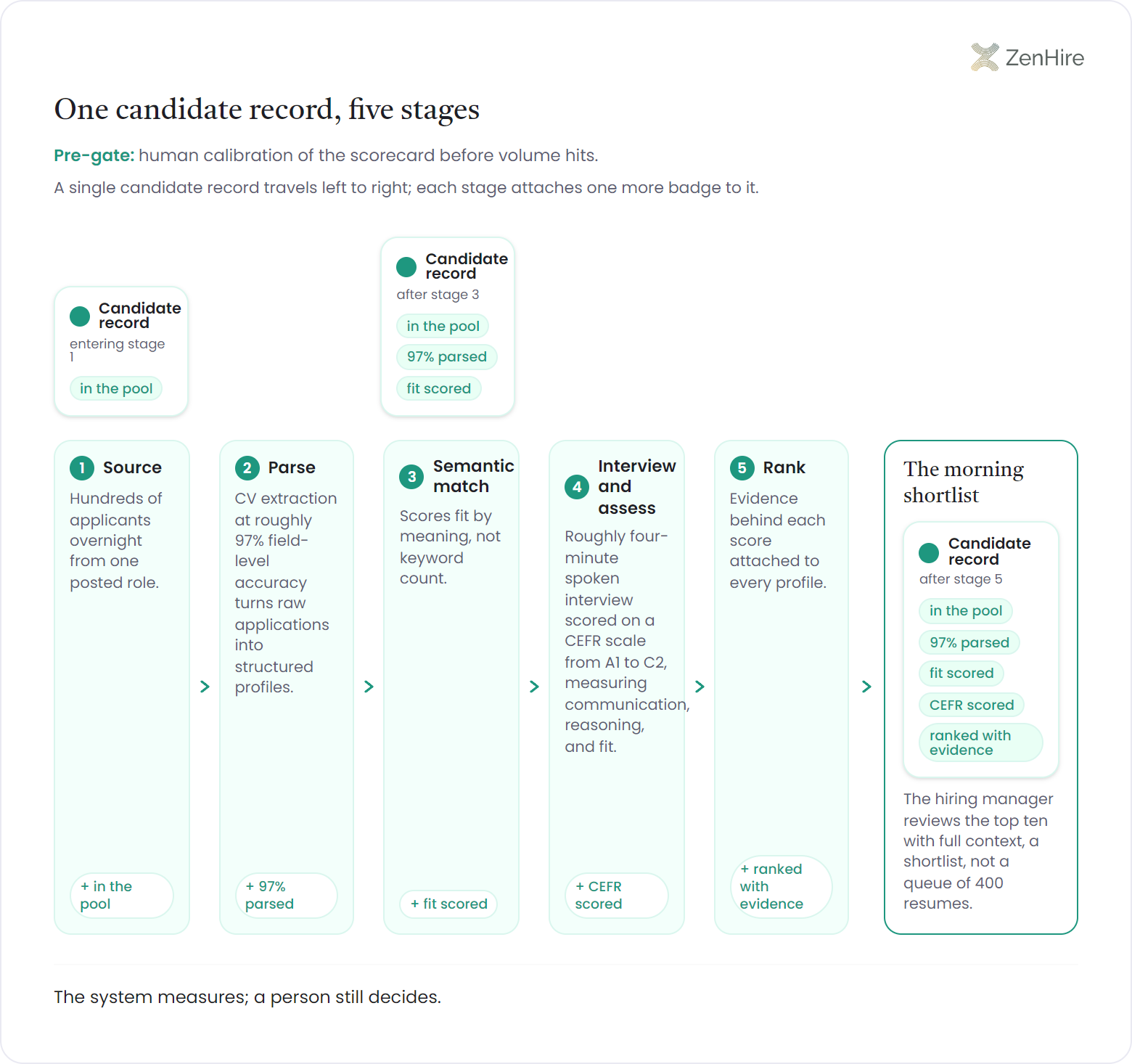
The mechanism is a single candidate record that travels through five stages. Sourcing and resume parsing turn raw applications into structured profiles, with CV extraction running at roughly 97% field-level accuracy. Semantic matching scores how well a candidate fits the role by meaning, not keyword count, closer to how semantic CV-to-role matching reads a profile than how a filter ranks one. A structured interview and validated assessments then measure communication, reasoning, and fit. Finally the system ranks everyone and surfaces the evidence behind each score, so a recruiter opens a shortlist rather than a queue of 400 resumes.
Concretely, picture a contact-center team posting one role and receiving hundreds of applicants overnight. By morning the AI recruiter has read every CV, put each applicant through a spoken-language interview that runs about four minutes, banded their English somewhere on the CEFR range from A1 to C2, and ordered the field with the transcript and signals sitting on each profile. The hiring manager opens the top ten with the full picture attached, rather than the whole pile, the same end-to-end arc the Recruitment OS is built to run.
Where this breaks down: an AI recruiter is only as good as the rubric it scores against. For a vague or fast-changing role with no clear definition of success, its rankings drift, because it is optimizing a target nobody has pinned down. The fix is human calibration of the scorecard before volume hits, not blind trust in the output afterward.
Why a ranked list beats the resume pile it replaces comes down to one comparison. A plain CV review predicts on-the-job performance at about r = 0.14; layer a structured interview onto cognitive and skills assessments and the signal clears 0.6, better than a fourfold gain over the resume by itself. And this is no longer a fringe practice, by 2025 roughly 70% of hiring teams report using AI somewhere in recruiting (industry research). What makes an AI recruiter worth the switch is that it applies those combined methods to every applicant, not only the handful who happen to reach a reviewer.
- Source and parse applications into one structured candidate profile, at roughly 97% extraction accuracy
- Match each candidate to the role by demonstrated meaning, not keyword frequency
- Run a structured interview and validated assessments on every applicant, scored on the same rubric
- Rank the field and attach the evidence behind each score for a human to review
Which hiring tasks can an AI recruiter own?
An AI recruiter should own the high-volume, rule-bound work where consistency beats intuition, and leave the nuanced, relational, and final calls to people. The dividing line is simple: the software measures, humans decide.
In practice that means it can fully own intake, parsing, first-pass matching, structured screening interviews, language and psychometric assessment, fraud and integrity checks, and the ranking itself. These are exactly the tasks where a tired human reviewer at resume number 380 grows inconsistent, and where a system applying one rubric to everyone is both fairer and faster. It cannot own the offer conversation, the read on team chemistry, the negotiation, or accountability for a mistake, which is the heart of how an AI recruiter compares to a human recruiter.
As a concrete split, a recruiter screening 100 applicants a day can hand every screening interview and assessment to the AI recruiter, reclaim those hours, and spend them coaching shortlisted candidates and partnering with the hiring manager. The work does not vanish; it moves up the value chain from sorting to judgment. That is also the mechanism behind ZenHire's public figures of 87% less manual screening and 36% lower time-to-hire: the volume work leaves the human queue.
The edge case worth naming: highly specialized or senior roles, where the signal is thin and context-heavy. Here the AI recruiter still adds a consistent baseline and surfaces overlooked candidates, but its weight in the decision should drop and the human's should rise. The more idiosyncratic the role, the more the rubric needs subject-matter calibration before you trust the ranking, and even a lean team can hire without a dedicated recruiter by leaning on that baseline for the repeatable stages.
| Hiring task | Who owns it | Why |
|---|---|---|
| Intake, parsing, first-pass match | AI recruiter | High volume, rule-based, consistency wins |
| Structured interview and assessment | AI recruiter | Same rubric on every candidate, fairer at scale |
| Fraud and integrity checks | AI recruiter | Pattern detection no human does at volume |
| Offer, negotiation, culture read | Human | Relational, context-heavy, judgment work |
| Accountability for the decision | Human | A person must own the outcome |
How is an AI recruiter different from a chatbot?
The difference between an AI recruiter and a chatbot is evaluation. A scripted recruiting chatbot answers questions and schedules calls; an AI recruiter conducts a structured assessment, scores the candidate against the role, and produces evidence that drives a decision. One responds, the other judges.
Under the hood, a chatbot follows a decision tree or a thin language-model wrapper: it matches intent to a canned reply and routes the conversation. An AI recruiter applies recruitment-specific models on top of language models, including semantic CV matching, validated psychometric scoring, CEFR-aligned spoken-language analysis, and integrity checks, then outputs a ranked, explainable scorecard. The chatbot improves response time; the AI recruiter improves who you hire. That depth is also what an AI interview captures that a scripted exchange cannot.
A fair counter-argument: some teams say any conversational tool that screens candidates is effectively the same thing, and that the distinction is just marketing. It is not. A chatbot that asks knockout questions still only collects answers it cannot weigh against role fit, while an AI recruiter scores them. The selection evidence draws the line clearly: a resume on its own is a weak predictor of performance, around 0.14 in validity, while combined structured methods carry that number past 0.6, and nothing but a system that genuinely scores those methods can bank the difference. Asking a question is not the same as evaluating the answer.
Concretely, ask both the same thing: how strong is this candidate's spoken English under pressure? A chatbot logs the reply verbatim. An AI recruiter comes back with a CEFR band and the signals under it (fluency, vocabulary range, hesitation patterns), landing in the 90 to 96% range against panels of PhD linguists, well clear of the 68 to 75% that untrained human recruiters reach. The edge case is overreach: a chatbot bolted with a scoring prompt is not an AI recruiter, and treating it like one produces confident numbers with no validated method behind them.
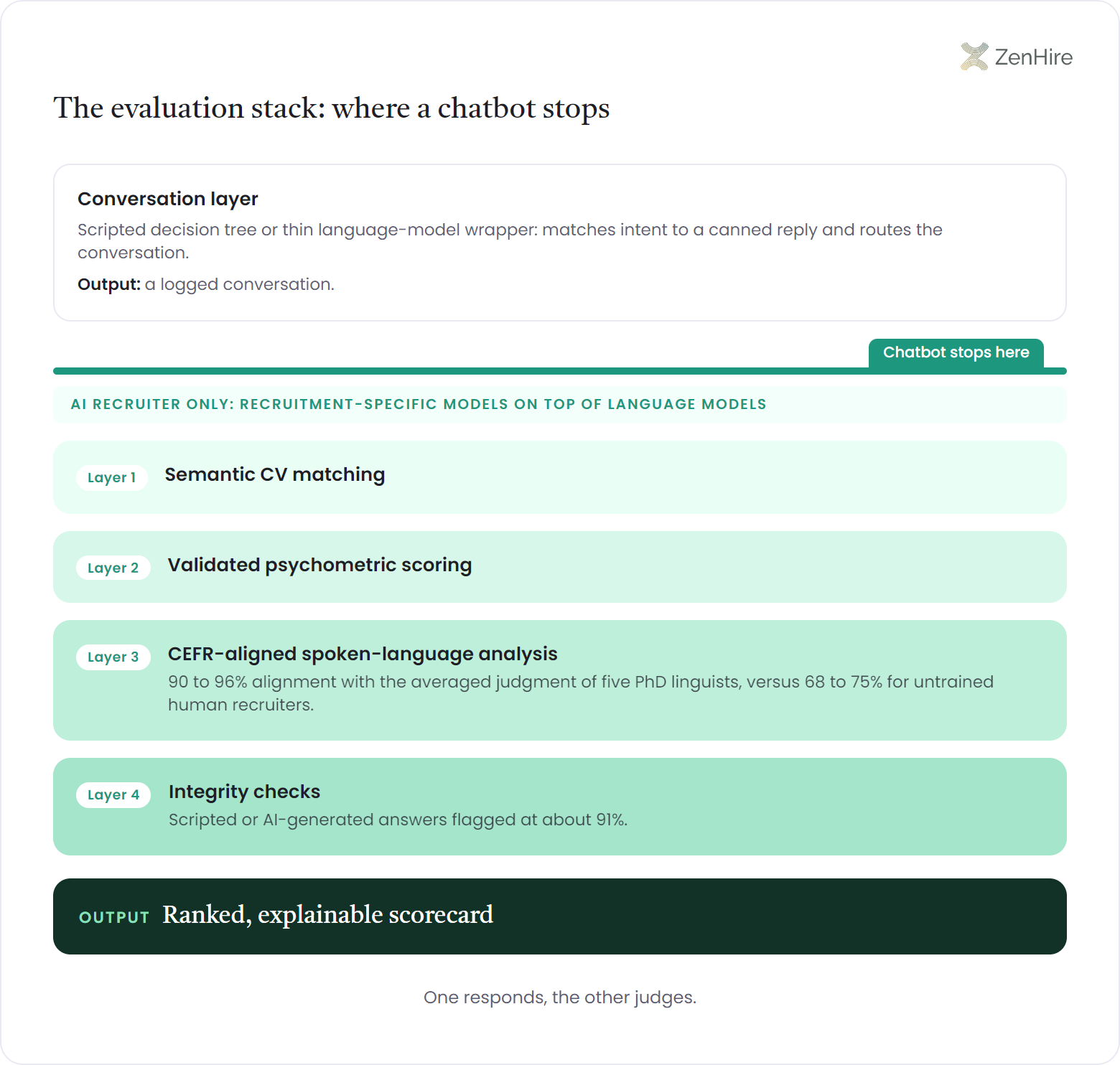
The line here is measurable, not rhetorical. ZenHire's language analysis tracks the averaged verdict of five PhD linguists to within 90 to 96%, against 68 to 75% for untrained human recruiters, and it trips scripted or AI-generated answers about 91% of the time. A chatbot can quote none of these figures, because scoring is exactly the step it skips; it records and moves on.
| Recruiting chatbot | AI recruiter | |
|---|---|---|
| Core job | Answers and routes | Evaluates and scores |
| Output | A logged conversation | A ranked, evidence-backed shortlist |
| Method | Scripted tree or LLM wrapper | Domain models for matching and assessment |
| Decision value | Saves response time | Improves who gets hired |
What does an AI recruiter actually do at each hiring task?
At every step of the pipeline, a generic chatbot moves the candidate along while an AI recruiter measures them: the chatbot collects and forwards, the AI recruiter parses, scores, and ranks against the role. The table below walks the same seven tasks through both, so the gap is concrete rather than rhetorical: one keeps a conversation tidy, the other produces a defensible decision input.
Read the rows top to bottom and a pattern emerges. The chatbot's column is full of verbs like ask, capture, log, and forward; it touches information but never weighs it. The AI recruiter's column is full of verbs like extract, match, assess, and rank, and every task ends in a structured signal that feeds the next. That is why a chatbot can run a hundred conversations and still leave a recruiter with a hundred resumes to read, whereas an AI recruiter runs the same hundred and returns the ten worth a human's time.
Two rows deserve a caveat. On scoring, the numbers an AI recruiter produces are only trustworthy when the method behind them is validated: a CEFR band or a fraud flag means something because it was tested against a known reference, not because a model emitted a confident-sounding figure. On scheduling, the one task a chatbot genuinely does well, the AI recruiter's advantage is narrow: it schedules off a ranked list rather than first-come-first-served, so the calendar fills with the strongest candidates instead of the fastest clickers.
The single tell across all seven rows: a chatbot never produces a number it can defend, because it never runs a validated method. An AI recruiter's output is a glass-box scorecard (explainable, with sensitive attributes architecturally excluded from scoring), which is why every score in the table ships with the evidence behind it rather than a verdict you have to take on faith.
| Hiring task | Generic chatbot | AI recruiter (Recruitment OS) |
|---|---|---|
| Source | Replies to inbound questions; nudges applicants to a form | Takes in applications at scale and structures every one into the same candidate record, built to absorb 3,000+ applications for a single role |
| Parse CVs | Stores the file or a few captured fields verbatim | Extracts skills, history, and qualifications into structured fields at roughly 97% field-level accuracy, across 1,000+ resume bulk imports |
| Match to role | Filters on keywords the script was told to look for | Scores fit by meaning with semantic matching that aligns 93%+ with human screeners, not keyword frequency |
| Interview | Asks pre-set knockout questions and records the replies | Puts every applicant through the same rubric in a structured async interview of about four minutes |
| Score | Cannot weigh an answer; it only logs what was said | Hands back validated signals: an A1-C2 CEFR language band, reasoning and fit scores, and scripted or AI-written answers caught around 91% of the time |
| Shortlist | Hands back the full conversation log, unranked | Ranks the field and attaches the evidence behind each score, so a recruiter opens a shortlist, not a queue |
| Schedule | Books calls first-come-first-served as people reply | Schedules off the ranked list, so the calendar fills with the strongest candidates first |
People hear "AI recruiter" and picture a robot that fires humans. That was never the point for me. I built ZenHire because the most capable recruiter I knew became unreliable somewhere around resume number 300, not from a lack of skill, but from fatigue no human escapes. An AI recruiter does not replace that person's judgment; it runs the same rubric on candidate one and candidate four hundred with identical attention, then hands them the ten that actually deserve a conversation. Consistency at volume is not a threat to good recruiters. It is the thing they have been quietly missing.
Frequently asked questions
What is an AI recruiter in plain terms?+
An AI recruiter is software that performs recruiting work end to end. It sources, parses, matches, interviews, assesses, and ranks candidates, then hands a person a shortlist with the evidence behind each score. It automates the repeatable measuring, roughly 97% accurate on CV extraction, so recruiters spend their time on judgment, relationships, and the final hiring decision.
Is an AI recruiter the same as a virtual recruiter?+
A virtual recruiter and an AI recruiter describe the same thing: a digital agent that runs hiring tasks without a person performing each step. The label virtual recruiter emphasizes that it works around the clock and at volume; AI recruiter emphasizes that it evaluates and scores candidates rather than merely tracking them.
Can an AI recruiter replace a human recruiter?+
An AI recruiter does not replace a human recruiter; it changes the job. The system owns the high-volume screening, assessment, and ranking, while people keep the offer, the relationship, the cultural read, and accountability for the decision. AI measures, humans decide. For the fuller picture, see whether AI will replace recruiters.
How does an AI recruiter avoid bias?+
A responsible AI recruiter [mitigates bias by design](/ethical-hiring/reduce-bias) rather than after the fact. It excludes sensitive attributes from scoring, uses explainable glass-box models so every score can be audited, runs audio-only assessment to avoid visual cues, and maintains a GDPR and SOC 2 posture, which can reduce exposure compared with undocumented manual screening.
Does an AI recruiter work with my existing ATS?+
An AI recruiter works alongside your existing ATS rather than replacing it. It plugs in as an intelligence layer over the system you already run, taking applicants in, evaluating them, and pushing a ranked shortlist back, so you add measurement without ripping out infrastructure. It can also sit on top of an all-in-one ATS you adopt with it.
Free for AI recruiter readiness
The AI recruiter readiness scorecard
A 12-point scorecard to gauge whether your hiring is ready to hand screening to an AI recruiter: which stages to automate first, what a defensible scorecard needs, and the red flags that mean you should calibrate before you scale.