
How Do You Build a Talent Pipeline?


· 8 min read
You build a talent pipeline by forecasting recurring roles, sourcing continuously, pre-assessing every candidate, and nurturing the pool, so a new requisition starts at a warm shortlist instead of a cold search. What decides whether a pool is worth keeping is the signal stored against each name: a resume on file forecasts on-the-job performance at only about r = 0.14 and a casual unstructured call at ~0.18, whereas a structured interview paired with skills testing lifts that predictive validity past 0.6. The payoff shows up in time to hire, because AI screening captures that stronger signal in minutes per candidate, letting a contact center that needs 200 agents in 60 days pull a ranked shortlist on day one.
What is a talent pipeline?
A talent pipeline is a pre-built, continuously maintained pool of candidates you have already sourced, assessed, and stayed in touch with, so they are ready to move when a role opens, not strangers you have to find from scratch. It is the difference between a database of names and a shortlist you can act on this week.
The mechanism is sequence. In reactive hiring, every step (find, screen, assess, engage) happens after the requisition, against the clock. A pipeline does the slow, judgment-heavy steps in advance and banks the result, so the deadline only triggers a final conversation. That is also why a real pipeline is not a spreadsheet of LinkedIn URLs: without an assessment signal attached, you have a contact list, and you will re-screen every name when the pressure is on. Pipeline-building sits alongside sourcing strategy and candidate relationship management as the proactive half of talent acquisition.
Edge case: a pipeline that is never refreshed decays. Candidates take other jobs, change goals, or go cold, so a pool built 18 months ago and left untouched is closer to a reactive search than a pipeline. The maintenance, not the initial build, is what keeps it a pipeline.
A talent pipeline is not the same as a sourcing list. The dividing line is evidence: a list tells you who exists; a pipeline tells you who is qualified and interested. Attaching a structured assessment to each candidate is what converts the former into the latter, and it is the part teams most often skip when they are in a hurry.
- Sourced: identified through inbound, referrals, past applicants, and outbound research
- Assessed: carrying a structured signal on skills, communication, and fit, not just a resume
- Nurtured: kept warm with periodic, relevant contact so they answer when you call
- Segmented: organized by role family, level, and readiness so you can draw the right pool fast
How do you build a talent pipeline before roles open?
You build a talent pipeline before roles open by forecasting demand, sourcing continuously against it, pre-assessing everyone you meet, and nurturing the pool so it stays warm, a four-step loop that runs whether or not a requisition is live. The core of a proactive talent pipeline is doing the work when there is no deadline, so the deadline never sets the pace.
Start from the forecast: which roles will you almost certainly hire for again (frontline agents, account managers, a recurring engineering profile), and how many per quarter? Source against those patterns year-round instead of in bursts, and pre-assess every candidate with the same structured screen so each one enters the pool with a comparable, reusable signal. This is where AI scale matters: ZenHire's AI interview software can assess communication, soft skills, and language in a few minutes per candidate, so pre-qualifying hundreds of pipeline prospects does not cost you hundreds of recruiter hours. The same screen also keeps the pool fair and consistent, which matters more when you are evaluating people far ahead of any specific opening.
Edge case: niche or one-off senior roles do not pipeline well: you will not see enough recurring volume to justify a standing pool, and the best fit may not exist until the role does. For those, run a targeted search when the need is real and reserve pipelining for your repeatable, high-volume roles where the math clearly pays back.
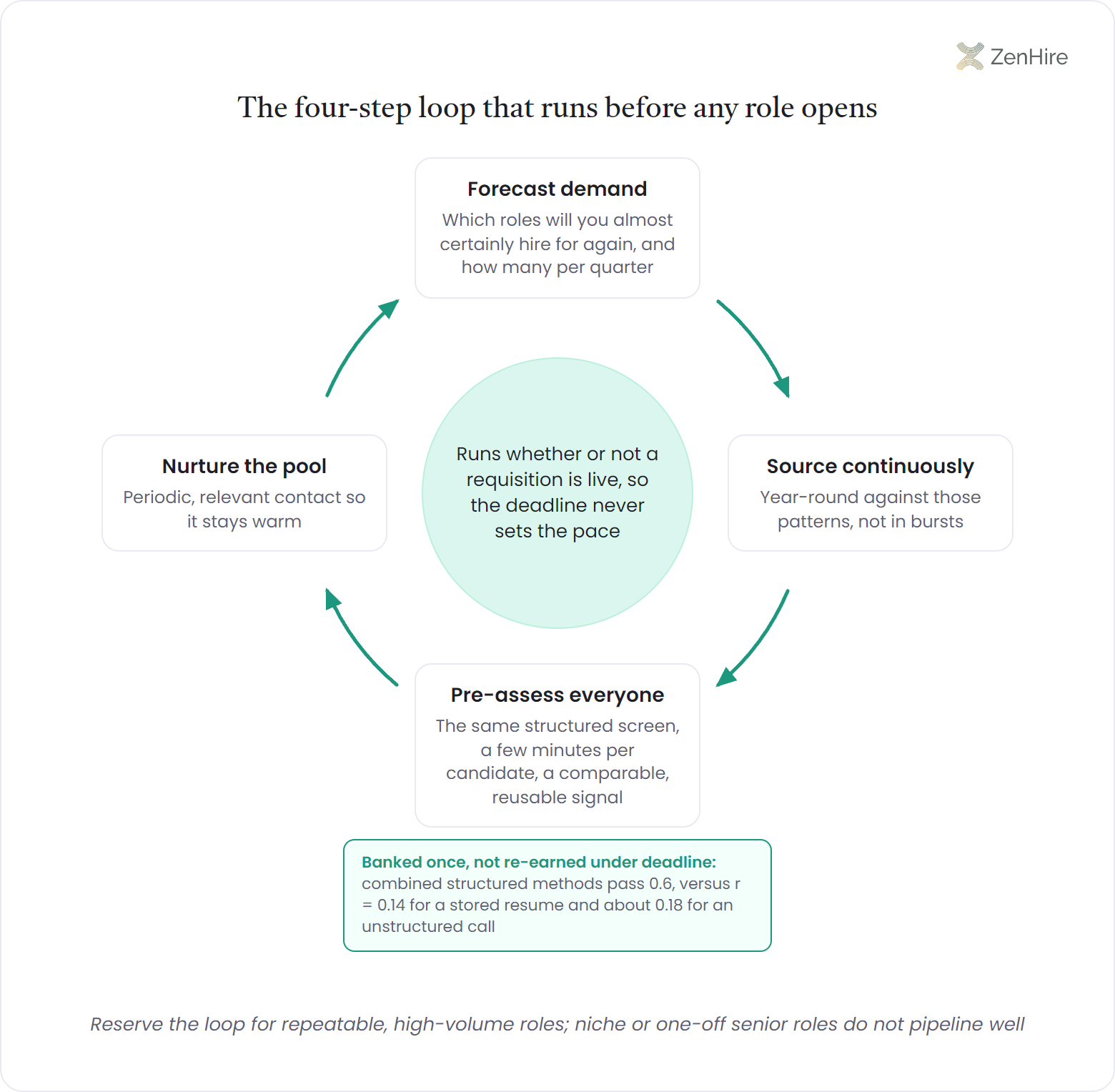
Front-loading is not busywork; it is where the leverage is. The resume sitting in your pool forecasts on-the-job performance at about r = 0.14, and a friendly unstructured catch-up call only ~0.18, while a structured interview run alongside cognitive and skills testing carries the signal past 0.6. Every candidate you pre-assess with structured methods enters the pipeline worth more than four times a resume-on-file, and because you store that signal once, you never have to re-earn it when the requisition lands.
How does a talent pipeline cut time to hire?
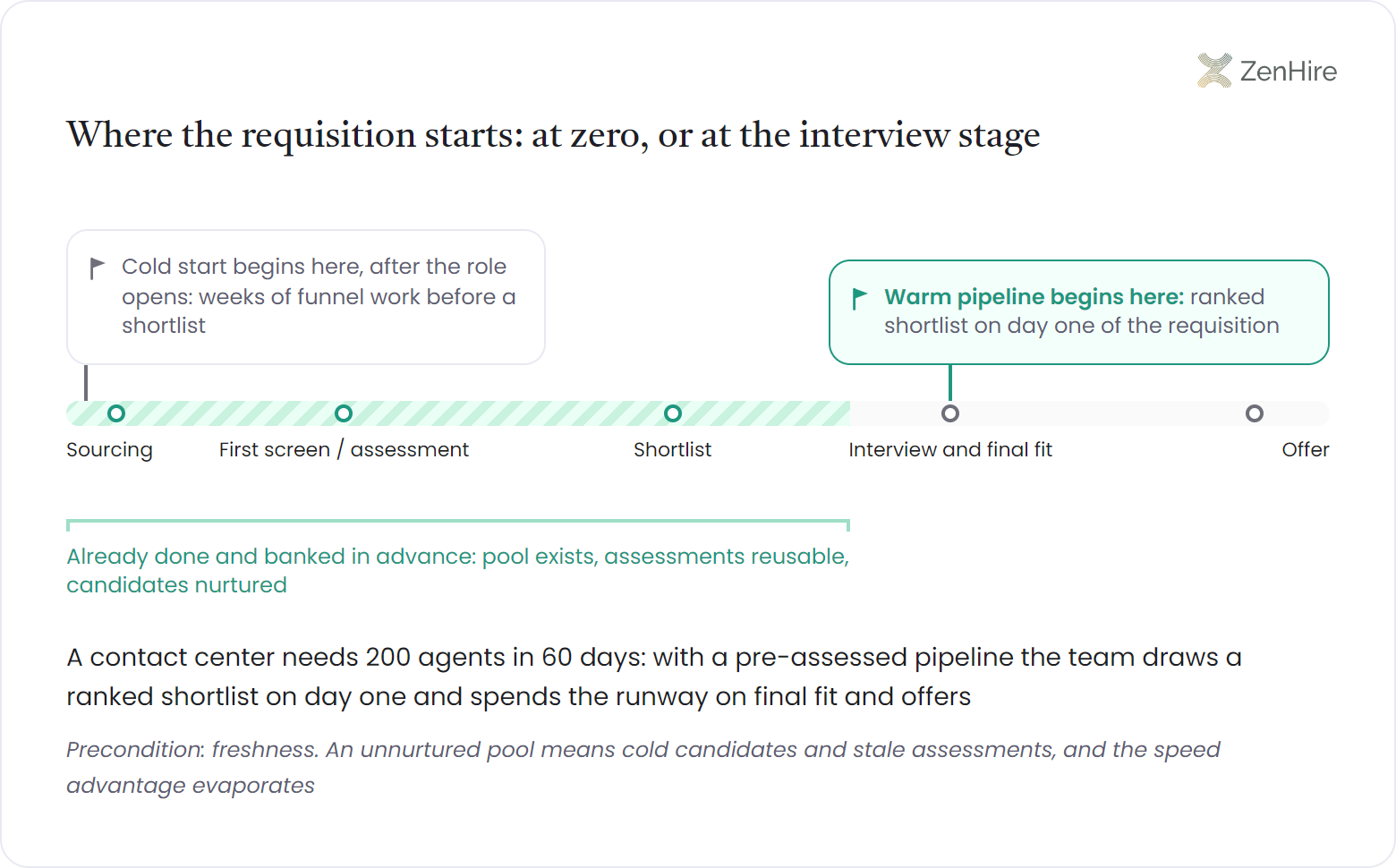
A talent pipeline cuts time to hire by collapsing the front half of the funnel: the sourcing, screening, and first-assessment work that normally consumes most of the calendar between a role opening and a shortlist. When that work is already done, the requisition starts at the interview stage, not at zero.
The mechanism is simple: most of the elapsed time in a hire is not interviewing, it is the gap before you have qualified people to interview. A warm pool short-circuits that gap. Concrete example: a contact center standing up a new campaign needs 200 agents in 60 days. With a cold start, sourcing and screening alone can eat weeks the launch does not have, but with a pre-assessed pipeline of agent profiles, the team draws a ranked shortlist on day one and spends the runway on final fit and offers. Track the effect with time to hire and cost per hire, since a faster, warmer funnel usually moves both.
Edge case: a pipeline cuts time to hire only if it is fresh. Pull from a pool you have not nurtured in a year and you inherit cold candidates, stale assessments, and ghosting: the speed advantage evaporates, and you are effectively doing a reactive search with extra steps. Freshness is the precondition for the time savings, not a nice-to-have.
| Hiring stage | Cold start | From a warm pipeline |
|---|---|---|
| Sourcing | Begins after the role opens | Already done, pool exists |
| First screen / assessment | Run reactively, under deadline | Banked in advance, reusable |
| Time to a shortlist | Weeks of funnel work | Day one of the requisition |
| Candidate warmth | Cold outreach, lower response | Nurtured and more likely to engage |
I am building an AI recruiter, and the thing I keep telling in-house teams is that a pipeline is not a CRM full of names; it is a pile of pre-earned judgment. The reason most pipelines fail is that the assessment never happens until a role is open, so the pool is really just a contact list wearing a fancier label. Flip that. Let the machine do a short, consistent, structured assessment on everyone the day they enter the pool, and store the signal, not just the resume. Then when the requisition lands, you are not asking who these people are; you already know, and your whole runway goes to the human part: the conversation, the fit, the offer. That is the calm version of high-volume hiring, and it only exists if the slow work is done before the clock starts.
Frequently asked questions
What is the difference between a talent pipeline and a candidate database?+
A talent pipeline differs from a candidate database in that the pipeline carries assessment and engagement, not just contact details. A database tells you who exists; a pipeline tells you who is qualified and interested. Attaching a structured screen and an active nurture relationship to each candidate is what turns a stored list into a pool you can hire from this week.
How long does it take to build a talent pipeline?+
Building a talent pipeline is continuous rather than a one-time project, but a usable pool for a repeatable role can form within a quarter of steady sourcing and pre-assessment. The pool then compounds, every cycle deepens it, so the real timeline is ongoing maintenance, not a finish line.
Which roles should you build a pipeline for?+
You should build a pipeline for your repeatable, high-volume roles: frontline agents, recurring sales or engineering profiles, anything you hire for predictably and often. Niche or one-off senior roles rarely justify a standing pool; for those, a targeted search when the need is real is usually more efficient.
How does a proactive talent pipeline reduce time to hire?+
A proactive talent pipeline reduces time to hire by moving sourcing and first-assessment ahead of the requisition, so the role starts at the interview stage instead of at zero. Most elapsed hiring time is the gap before you have qualified people to talk to, and a warm, pre-assessed pool removes that gap, as long as it is kept fresh.
Can you build a talent pipeline without a big team?+
You can build a talent pipeline without a big team by automating the pre-assessment step, which is the part that otherwise does not scale. AI-driven screening can assess communication, skills, and language in a few minutes per candidate, so a small team can pre-qualify a deep pool without spending hundreds of hours on it.
Free for building a talent pipeline
The talent pipeline starter kit
A practical worksheet for in-house TA teams: how to forecast pipeline roles, what to pre-assess for, the nurture cadence that keeps a pool warm, and the metrics that prove it cut your time to hire.