
How Do You Reduce Retail Turnover?


· 7 min read
You reduce retail turnover by screening store applicants for reliability, customer-facing soft skills, and shift fit before the offer, then freeing store managers to coach the first 90 days instead of re-staffing the same seat. Roughly half of frontline leavers quit inside their first 90 days, before training pays back, and frontline attrition commonly runs 30-45% a year in service-heavy retail roles. Replacing one associate costs $5,000-$20,000 (industry estimates), yet the between-rushes phone screen most stores rely on tracks who lasts on the floor at only about ~0.18, against 0.6+ once a structured interview and validated assessments do the sorting, so a consistent screen is the cheapest retention lever you have.
Why is retail staff turnover so high?
Retail staff turnover is so high because stores hire under pressure and screen inconsistently, because seats have to be filled before the next peak, so a busy manager scans a resume between customers and makes a gut call. That produces wrong-fit hires who never click with the pace, the customers, or the schedule, and they leave fastest of all, before the store earns back what it spent to train them.
Pay and scheduling matter, but they explain the late exits, not the early ones. The 90-day cliff in retail is a screening problem: an applicant who looked fine on paper could not actually stay calm at a register during a rush, show up for the shifts they committed to, or de-escalate a frustrated customer. It is most acute during peaks, where the rush to fill the floor invites the rushed, inconsistent screening that powers high-volume hiring churn, and the same dynamic drives seasonal hiring turnover when stores staff up for the holidays.
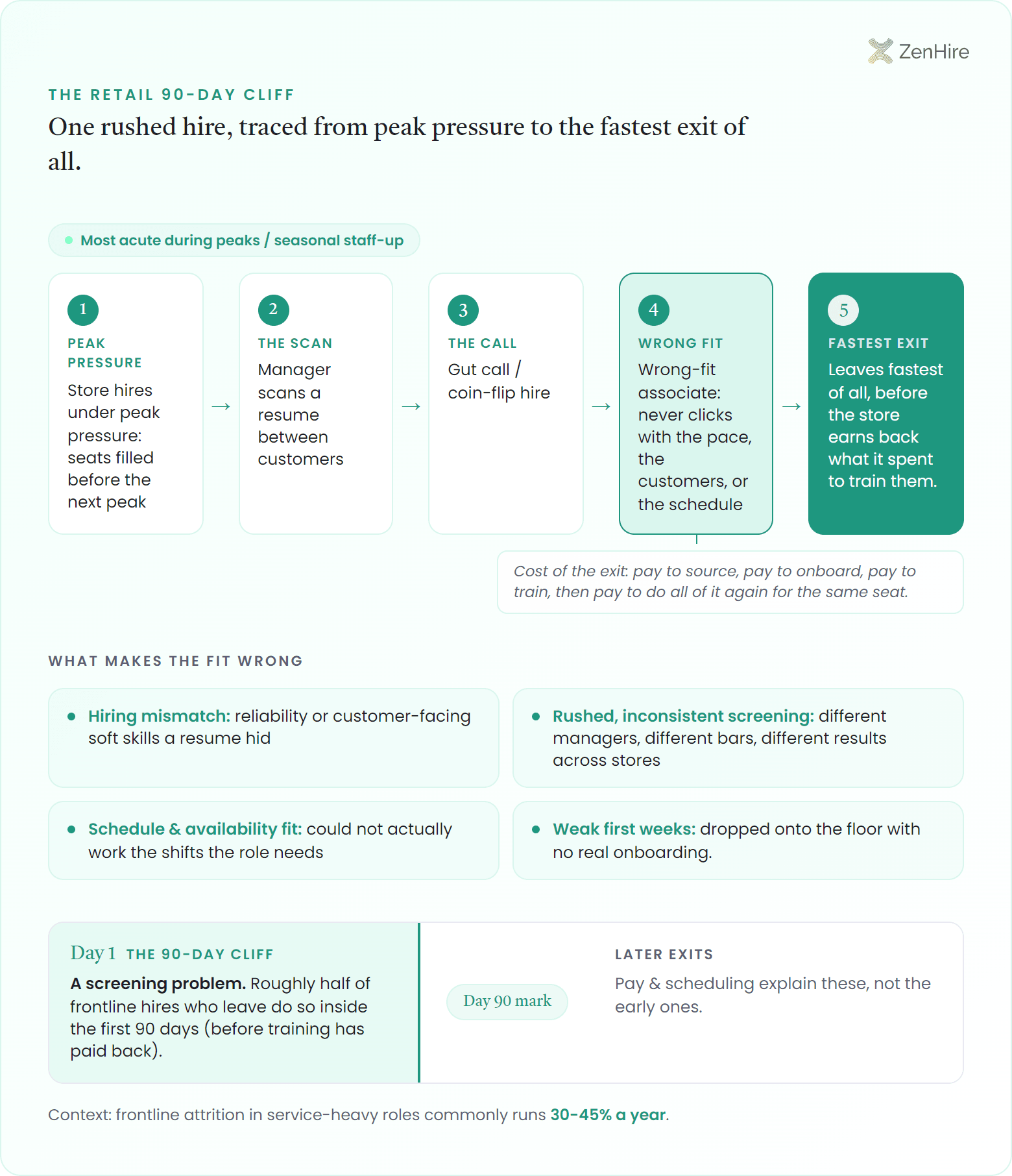
Roughly half of frontline hires who leave do so inside the first 90 days (before training has paid back), and frontline attrition in service-heavy roles commonly runs 30-45% a year (industry estimates). Early store churn is the most expensive kind: you pay to source, pay to onboard, pay to train, and then pay to do all of it again for the same seat.
- Hiring mismatch: the reliability or customer-facing soft skills a resume hid
- Rushed, inconsistent screening: different managers, different bars, different results across stores
- Schedule and availability fit: the applicant could not actually work the shifts the role needs
- Weak first weeks: a new associate dropped onto the floor with no real onboarding
How do you hire retail staff for fit and retention?
You hire retail staff for fit and retention by evaluating reliability and customer-facing soft skills consistently before the offer, using structured interviews and short validated assessments that predict who stays on the floor, not just who fills out an application. The aim is to catch the mismatch in screening, where it is cheap, instead of in week three on the sales floor, where it is not.
Structured, AI-assisted screening adds two things a manager juggling a live store cannot: consistency and scale. Every applicant clears the same bar, scored the same way, so a warm, reliable communicator is not lost because they applied during a Saturday rush. ZenHire's AI interview software for retail hiring picks up communication, composure under a rush, and reliability signals inside a roughly four-minute interview, and that interview analysis is on file whether you staff one store or two hundred. Pairing it with a structured interview means every store calibrates good the same way.
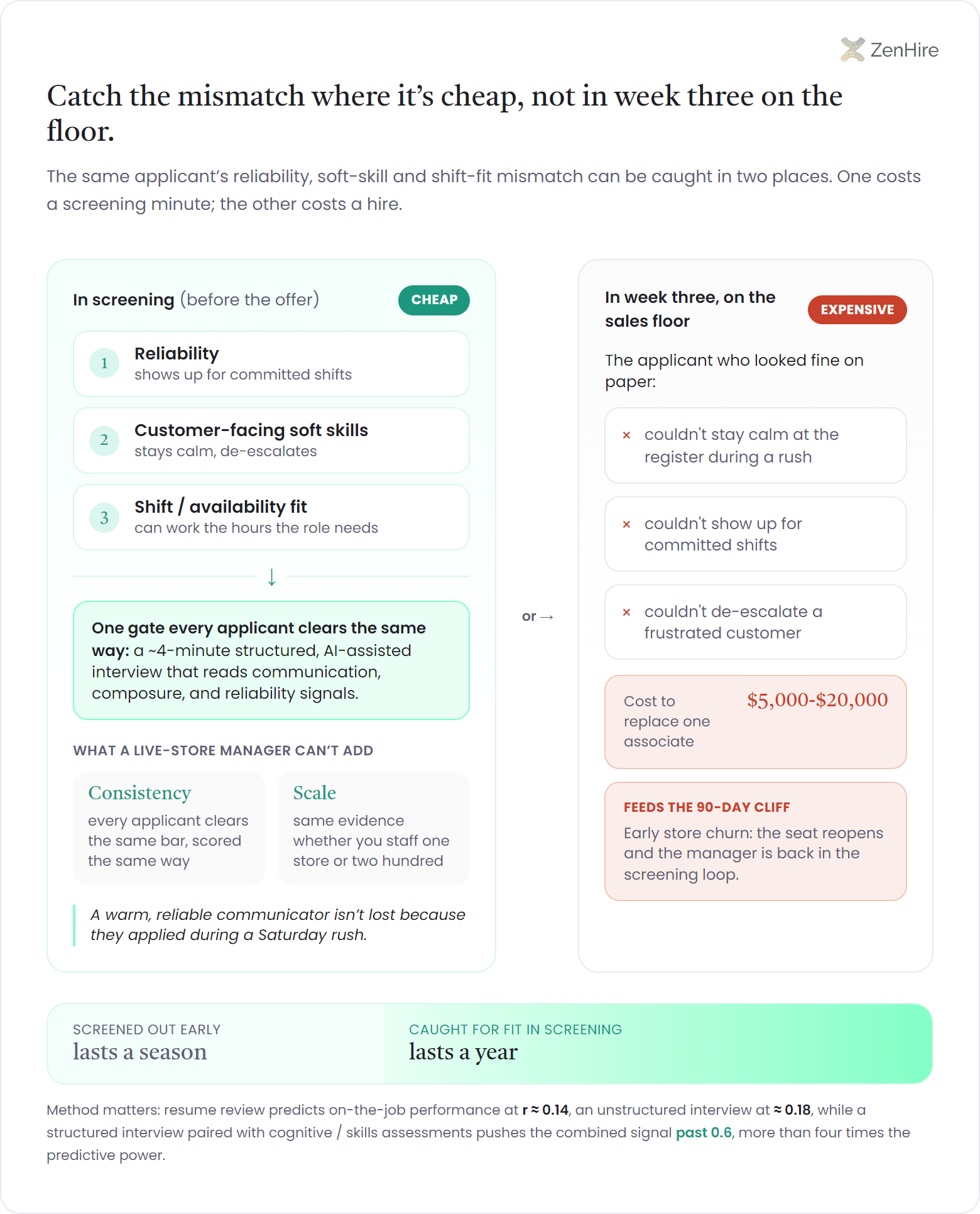
On the sales floor, how you screen beats how hard you screen: a resume scan tracks who actually performs at about r = 0.14 and the walk-in interview at ~0.18, but stack a structured interview onto cognitive and skills assessments and the signal climbs past 0.6, more than quadruple the read. In a store, that spread is the difference between an associate who clears one season and one who is still on the schedule a year on.
How do you free store managers to cut retail turnover?
You free store managers to cut retail turnover by taking screening off their plate so they can spend that time coaching new hires, because the manager doing the hiring is the same person who keeps the hire. Every hour a manager loses to reading resumes and phone-screening walk-ins is an hour they are not on the floor supporting the associate who is two weeks in and deciding whether to stay.
When screening is automated and consistent, managers review a ranked, scored shortlist instead of a stack of applications, and they hire from better-matched candidates in less time. That has a compounding effect: better-fit hires churn less, which means fewer open seats, which means the manager is not perpetually back in the screening loop. Tracking quality of hire by store and source shows which change actually moved retention, and watching your turnover rate by cohort tells you whether the fix is holding. The broader playbook lives on the reduce employee turnover guide.
| Where a manager's hours go | Effect on retail turnover |
|---|---|
| Manual resume scanning & phone screens | Time stolen from the floor, where coaching prevents churn |
| Reviewing a scored, ranked shortlist | Faster, more consistent hires across every store |
| Coaching the first 90 days | Directly lowers the 90-day cliff that drives early churn |
| Re-staffing the same seat | The most expensive loop, avoided by hiring for fit |
Everyone blames retail turnover on pay and schedules, and yes, those matter. But I keep seeing the same thing in stores: the manager who screens the hire is the same manager who is supposed to keep the hire, and they are drowning. They scan a resume between customers, make a coin-flip call, and then have no time left to coach the person they just hired. The fix is not another perk. It is taking the screening off the manager's plate and making it honest and consistent, so they hire someone who actually fits and then have the hours to keep them. Cut the mismatch at the door and most of your 90-day store churn simply never happens.
Frequently asked questions
Why is retail staff turnover so high?+
Retail staff turnover is so high because stores hire fast and screen inconsistently under peak pressure, producing wrong-fit associates who leave fastest. It shows up as the 90-day cliff, where industry studies put roughly half of frontline leavers gone before training pays back, and frontline attrition commonly runs 30-45% a year.
How do you reduce store employee churn?+
You reduce store employee churn by hiring for fit and reliability up front and supporting the first 90 days, because most early store exits are screening failures, not pay problems. Structured, consistent retail hiring that predicts who can handle the floor catches the mismatch before the offer, when it is cheap to fix.
How much does retail turnover cost?+
Replacing one retail associate costs about $5,000-$20,000 (industry estimates), and SHRM puts replacement at 50-200% of annual salary once you count sourcing, onboarding, training, and the lost productivity while the seat is empty or a new hire ramps up.
Does freeing store managers actually lower turnover?+
Freeing store managers from screening lowers turnover because the manager who hires is the manager who keeps the hire. Hours saved on reading resumes and phone-screening become hours coaching new associates through the first 90 days, the exact window where most early store churn happens.
What is a healthy retail turnover rate?+
A healthy retail turnover rate depends on format and season: frontline and seasonal store roles run far higher than office roles, with 30-45% a year common in service-heavy work. The more useful target is your own 90-day attrition trend, segmented by store and hiring source.
Free for reducing retail turnover
The retail 90-day retention checklist
A one-page checklist for cutting early store turnover at the hire: the reliability and customer-facing signals to screen for, how to score shift fit, and the first-90-days coaching that keeps new associates.