
How Do You Hire Seasonal Staff Quickly?


· 7 min read
You hire seasonal staff quickly by forecasting headcount weeks before the peak, running one structured AI screen on every applicant, and converting proven temporary hires into your permanent pipeline. A retailer losing 30% of seasonal hires before ramp must recruit roughly 285 to net 200, because frontline attrition runs 30-45% a year and half of leavers quit inside 90 days. AI-assisted screening scores thousands of candidates in about four minutes each, cutting hiring time roughly 62% and cost 59%, while a mid-peak washout costs $5,000-$20,000 to replace.
How do you forecast seasonal staff headcount?
You forecast seasonal staff headcount by working backward from your peak demand, your historical attrition, and your time-to-hire, not by guessing a round number in a planning meeting. Pull last season's sales or volume curve, divide by realistic output per worker, then pad for the people who will quit or no-show before the peak even starts.
The mechanism is a backward timeline. If you need 200 trained bodies on the floor by the first peak week, and proficiency takes 4-6 months for complex frontline roles, you cannot start in week zero. Anchor the plan to your real time-to-hire and order the funnel so screening, offers, and onboarding all clear before demand spikes, not during it.
A concrete example: a retailer that needs 200 holiday staff and historically loses 30% of seasonal hires before they finish ramp should not recruit for 200; it should plan to hire roughly 285 to net 200 reliable workers on the floor. The edge case is the over-correction: hiring a huge buffer drives up screening cost and post-peak layoffs, so the buffer should be sized to measured attrition, not fear. Track it as a cost-per-hire line so the buffer pays for itself instead of bloating the budget.
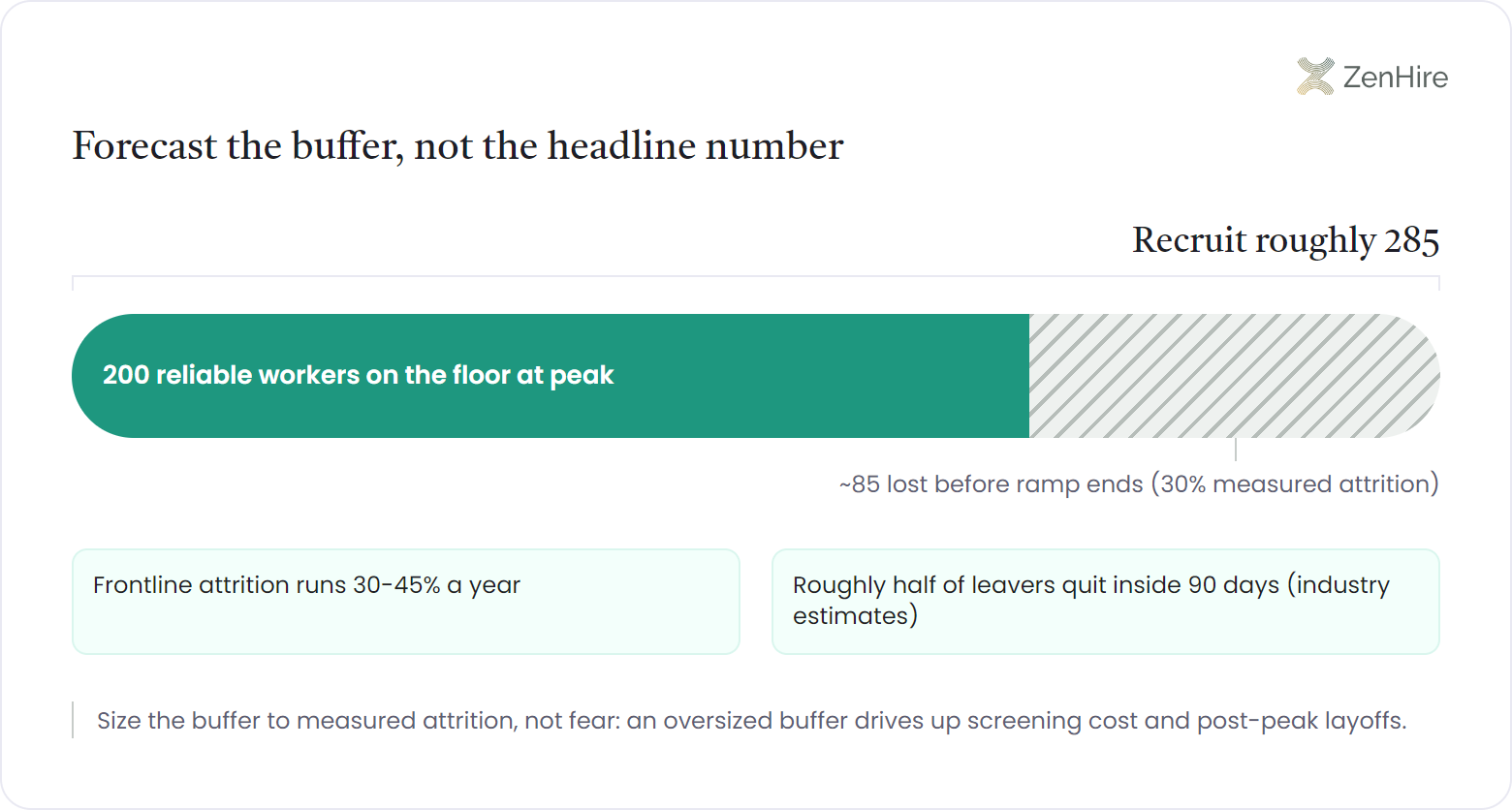
Seasonal demand is unforgiving on timing: frontline and contact-center attrition runs 30-45% a year and roughly half of leavers quit inside 90 days (industry estimates), which for a 12-week season means a chunk of your hires can churn before the peak ends. Forecast the buffer, not just the headline number.
- Demand curve: last season's volume by week, scaled to this year's plan
- Output per worker: realistic units, calls, or covers per shift, not best-case
- Attrition buffer: extra hires sized to your measured no-show and early-quit rate
- Backward timeline: screen, offer, and onboard dates anchored to your true time-to-hire
How do you hire seasonal staff fast for peak?
You hire seasonal staff fast for peak by collapsing the screen into a single consistent step that every applicant clears the same way, so a small recruiting team can evaluate thousands without lowering the bar. The slow part of seasonal hiring is never the job ad; it is reading resumes, scheduling phone screens, and chasing interviewers, all of which break under volume.
The mechanism is consistency at scale. A structured, AI-assisted screen scores every candidate on the same fit and reliability signals in a few minutes, so a strong communicator is not lost because they applied on a busy Tuesday. ZenHire's AI interview software reads communication, soft skills, and reliability in about a four-minute interview, and a structured interview bar that holds whether you hire 50 people or 5,000 is exactly what a peak rush needs. This is the core of any serious high-volume hiring playbook.
A concrete example: a grocery chain facing a holiday rush replaces three rounds of phone screens with one asynchronous AI interview, shortlists in hours instead of weeks, and routes only the top-ranked candidates to a human for the final yes. The edge case is fraud and proxies at volume: when thousands apply fast, duplicate CVs and AI-generated answers spike, which is why integrity checks (roughly 91% fraud detection in industry-grade systems) matter more in a seasonal sprint than in everyday hiring.
In a peak sprint the temptation is to skim resumes faster, but a stack of paper only predicts who lasts the season at about r = 0.14, and a rushed phone screen barely improves on that at ~0.18. Pair a structured interview with skills and cognitive checks and the signal climbs past 0.6 more than four times as predictive so the seasonal hires you rank first are the ones who actually show up and stay through the peak.
How do you convert seasonal staff to permanent?
You convert seasonal staff to permanent by treating the season as a live audition and tracking who actually performed, not just who showed up. The temporary hires who hit their numbers, stayed reliable, and fit the team are the lowest-risk permanent candidates you will ever have, because you have weeks of real on-the-job evidence instead of a 20-minute interview.
The mechanism is data continuity. If you captured a consistent screening score at hire and pair it with in-season performance, you can rank seasonal workers on proven fit and extend offers before competitors do. Read both against quality-of-hire so the conversion decision is grounded in performance and tenure, not a manager's favorite. Done well, this turns each season into a recurring, pre-vetted talent pool that compounds.
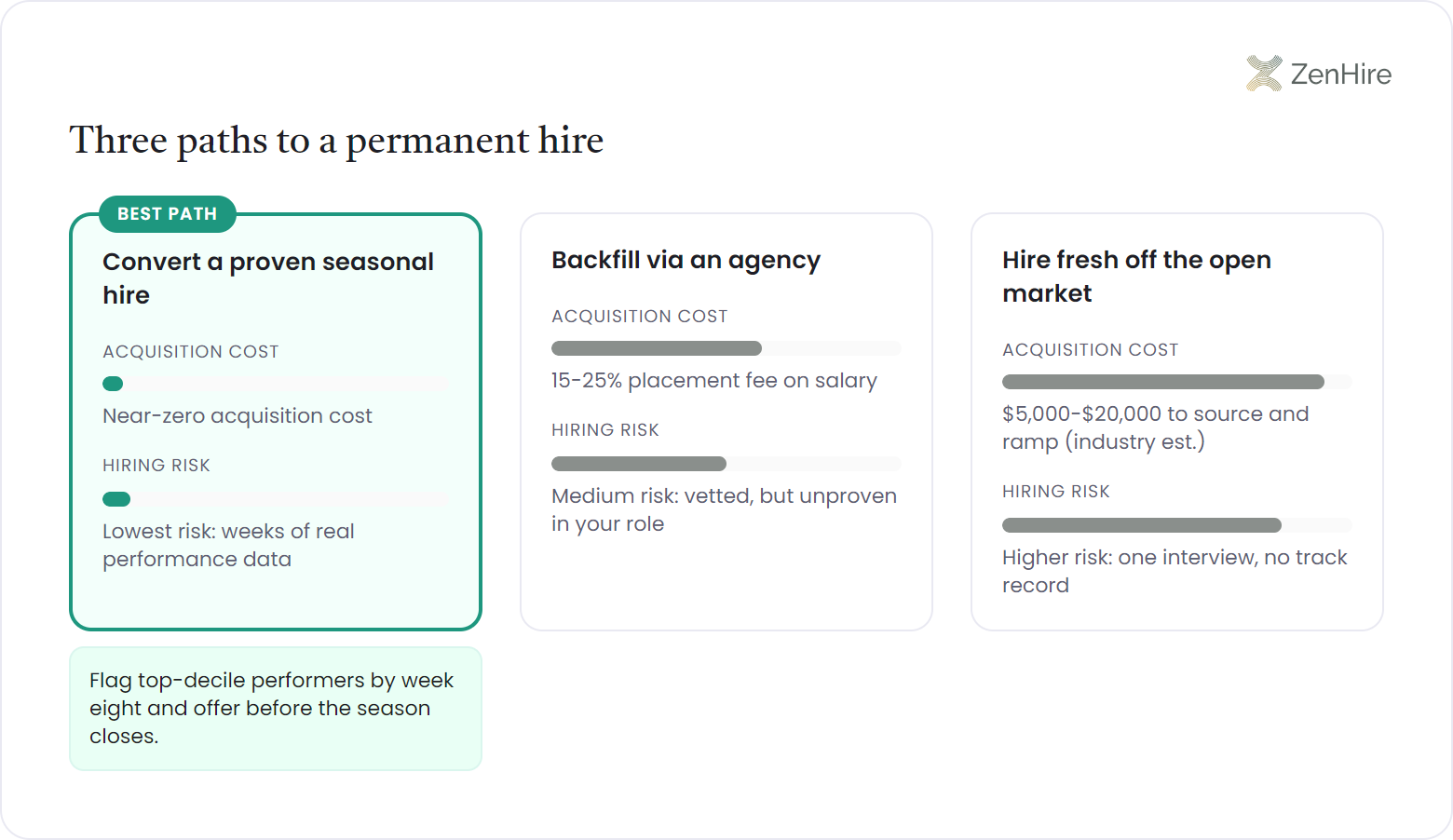
A concrete example: a hospitality operator flags its top-decile seasonal performers in week eight and offers them year-round roles before the season closes, filling permanent vacancies at near-zero acquisition cost. The edge case is the legal and expectation-setting side: seasonal contracts should be explicit that conversion is performance-based and not guaranteed, so the audition stays fair and you avoid implying an offer you may not extend.
| Path to permanent | What it costs you | Risk level |
|---|---|---|
| Convert a proven seasonal hire | Near-zero acquisition cost | Lowest: weeks of real performance data |
| Hire fresh off the open market | $5,000-$20,000 to source and ramp (industry est.) | Higher: one interview, no track record |
| Backfill via an agency | 15-25% placement fee on salary | Medium: vetted, but unproven in your role |
Most companies treat seasonal hiring as disposable: fill the seats, survive the peak, lay everyone off, and start from zero next year. That is the most expensive way to do it. The season is the best interview you will ever run: you get weeks of real behavior under real pressure, which no 20-minute call can match. We built ZenHire so the score you give a candidate in October is still there in December, when you decide who to keep. Hire seasonal once, evaluate honestly, and you stop re-hiring the same roles forever.
Frequently asked questions
How early should you start seasonal hiring?+
You should start seasonal hiring far enough ahead that screening, offers, and onboarding all finish before the peak begins, typically several weeks to a few months, because complex frontline roles take 4-6 months to reach full proficiency. Anchor the start date to your real time-to-hire, not the calendar.
How do you hire a lot of seasonal staff quickly without lowering quality?+
You keep quality by applying one consistent, structured screen to every applicant instead of rushing different judgments. AI-assisted screening scores thousands of candidates on the same fit and reliability signals in minutes, so speed comes from removing manual bottlenecks, not from skipping evaluation.
How much does it cost to replace a seasonal hire who quits mid-peak?+
Replacing a frontline hire runs about $5,000-$20,000 (industry estimates), and SHRM puts replacement at 50-200% of salary. During a season that cost lands hardest, because you pay it again with no time to recover the training investment before the peak ends.
Should you convert seasonal workers to permanent roles?+
Converting your top seasonal performers is usually the cheapest, lowest-risk way to fill permanent roles, because you have weeks of real on-the-job evidence instead of a single interview. Keep conversion explicitly performance-based in the contract so the audition stays fair.
What is the biggest mistake in seasonal recruitment?+
The biggest mistake is starting late and hiring for exactly the headcount you need, with no buffer for attrition. With frontline attrition at 30-45% and half of leavers gone in 90 days, a no-buffer plan leaves you short during the exact weeks you cannot afford to be.
Free for seasonal hiring
The seasonal hiring playbook
A step-by-step guide to forecasting peak headcount, running one fast screen at scale, and converting your best seasonal hires to permanent, with the timeline and reliability signals to weight.