
What Is a Candidate Skill Score (1-100)?


· 9 min read
A candidate skill score is a 1-100 rating of your demonstrated ability for a specific role, built from skills tests, an AI interview, and verified signals like a CEFR A1-C2 language level. The whole reason the number exists is that a resume line item barely moves the needle on predicting who performs (about r = 0.14), whereas the validated tasks feeding your score sit in the 0.45-0.6+ range, so the digit you see reflects work you actually did. Read it like a ladder: 80-100 is role-ready, 60-79 is competitive, and for many roles the assessment behind it is just a ~4-minute async interview plus a short skills check.
What does a 1-100 candidate skill score mean?
A 1 to 100 candidate skill score means a normalized rating of your demonstrated ability for a given role, where higher is a stronger match between what you can do and what the job needs. Think of it as a 1 to 100 skill rating that replaces the yes-or-no gut call a recruiter makes from a six-second resume scan with the kind of skills-based hiring that is measured, consistent, and visible to you.
The number is built from evidence, not from claims. It blends how you perform on validated skills tests, how clearly you communicate and reason in a short AI interview, and verified ability signals like a real spoken-language level. Because the score is data-driven, two candidates with identical resumes can land far apart once their actual ability is measured, which is exactly the point if you are the one who can do the work but does not have the polished CV to prove it.
Crucially, the score is bias-excluded by design. Sensitive attributes are kept out of the inputs, and the system uses glass-box, explainable scoring rather than an opaque black box, so the same answers produce the same number every time and you can see what drove it. That is the same discipline behind reducing bias in hiring that fair-minded employers now expect.
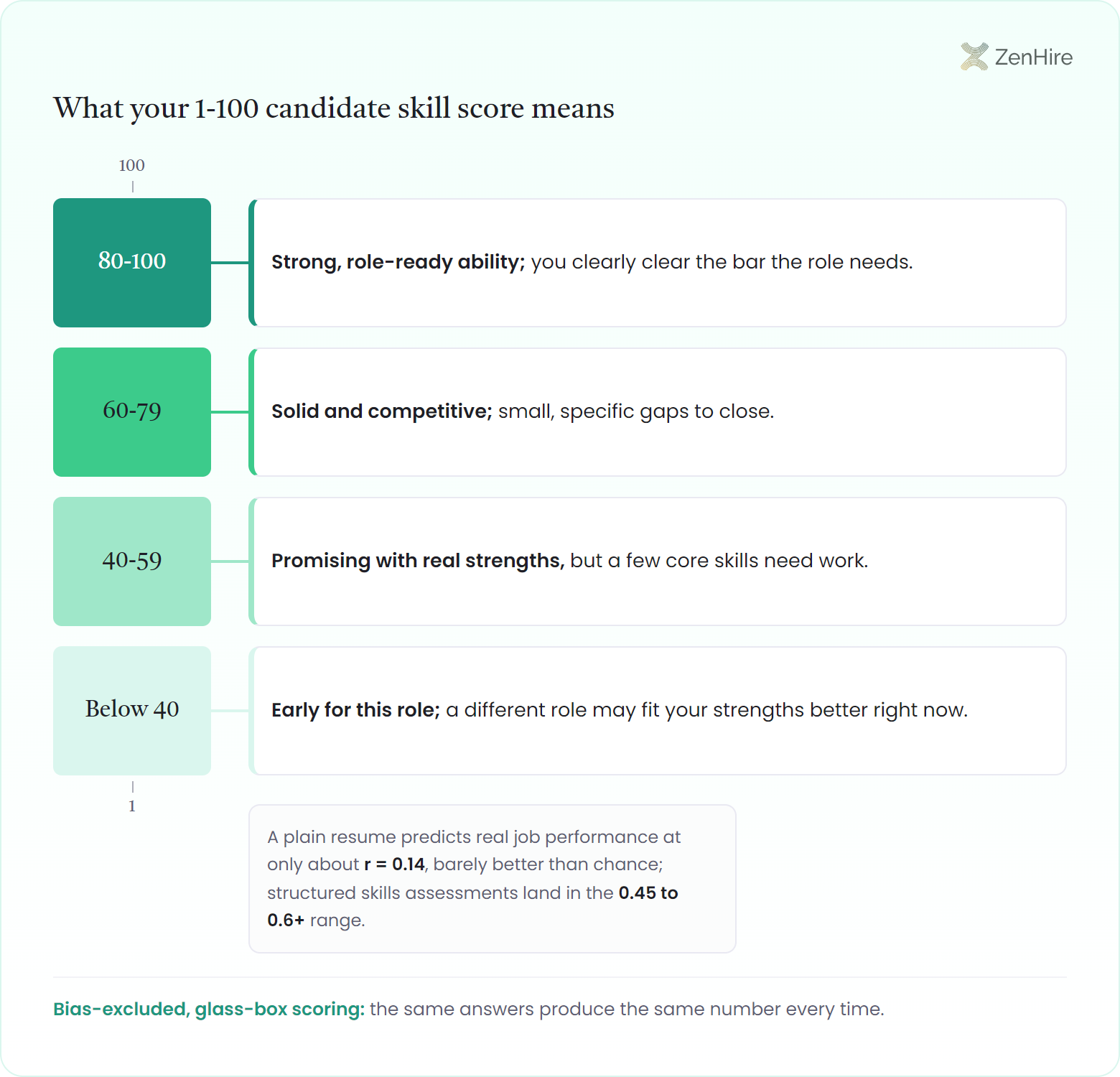
Put the two numbers side by side and the case for a score makes itself. Sort candidates by resume alone and your predictive validity is about r = 0.14, barely above a coin toss; sort by the validated skills work that builds this score and you are up in the 0.45 to 0.6+ band. That gap is the whole point: a keyword filter drops a strong candidate for a missing buzzword, whereas the score is engineered to surface exactly the ability that filter never saw.
- 80-100: strong, role-ready ability; you clearly clear the bar the role needs
- 60-79: solid and competitive; small, specific gaps to close
- 40-59: promising with real strengths, but a few core skills need work
- Below 40: early for this role; a different role may fit your strengths better right now
How is your candidate skill score calculated per role?
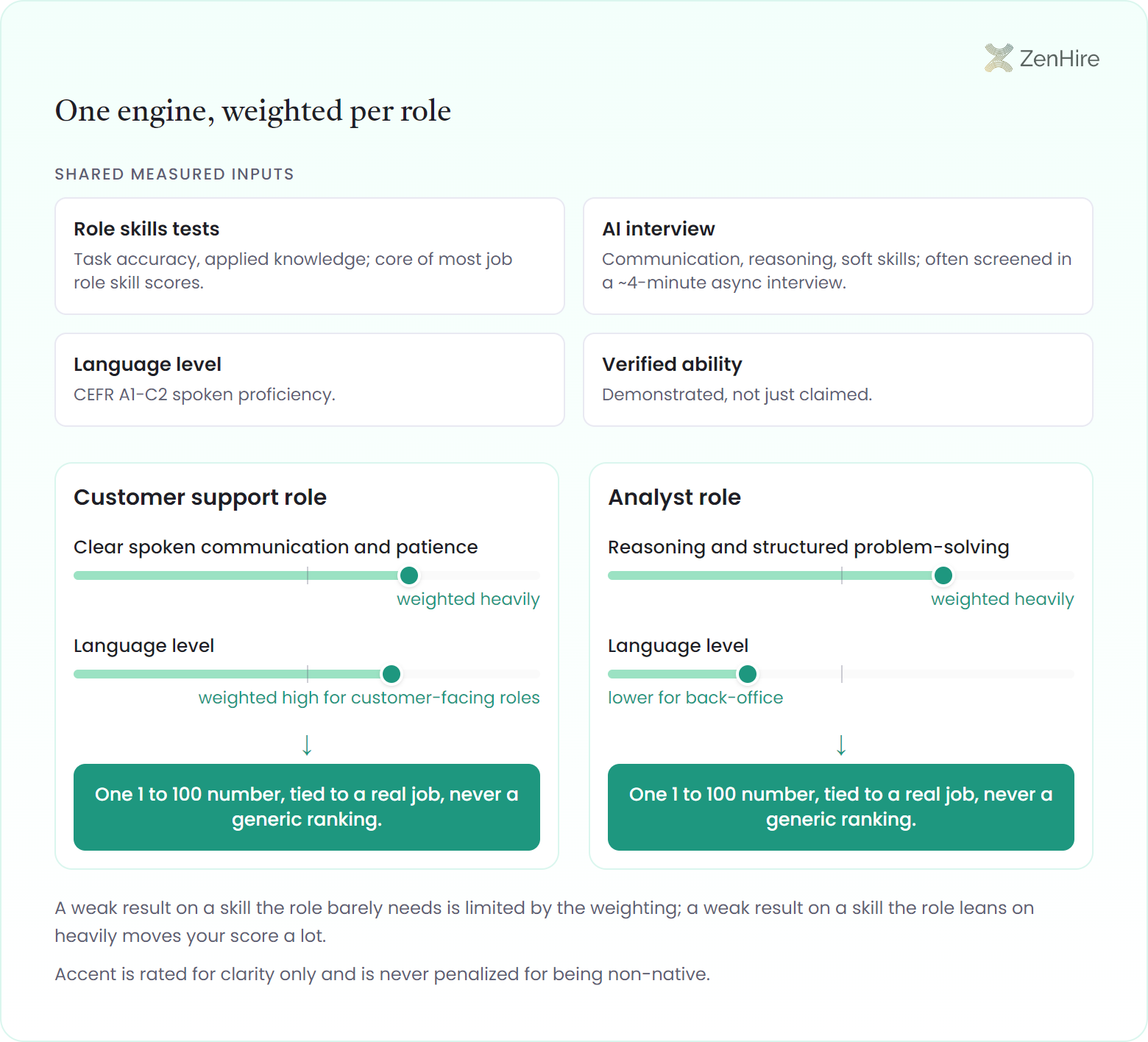
Your candidate skill score is calculated per role by weighting the specific skills that role actually requires, then combining your results across each input into one 1 to 100 number. A job role skill score for a customer-support position weights clear spoken communication and patience heavily; the same engine weighting different skills for an analyst role would lean on reasoning and structured problem-solving instead, so your number is always tied to a real job, never a generic ranking.
Under the hood, three measured feeds roll up into the single digit. First, your results on role-relevant skills tests. Second, how you communicate and reason, captured in an async interview that for many roles runs about four minutes. Third, verified signals such as your spoken-language level, placed on the standard CEFR ladder from A1 up to C2. Each feed is scored, scaled by how much the role leans on it, and folded into the 1 to 100 result. One guardrail matters here: accent is judged for clarity alone and is never marked down for being non-native, so the question is only whether a listener follows you, not where you learned to speak. If you would rather see which roles suit your strengths first, start with what jobs fit my skills.
An edge case worth knowing: a low score on one input does not automatically tank the whole number. If a role barely needs written grammar but you stumble there, the role-specific weighting limits the damage, whereas a weak result on a skill the role leans on heavily will move your score a lot. That is the fairer version of evaluation, because it scores you against what the job needs, not against an arbitrary universal checklist.
| What it measures | Example signal | Why a role weights it |
|---|---|---|
| Role skills tests | Task accuracy, applied knowledge | Core of most job role skill scores, proves you can do the work |
| AI interview | Communication, reasoning, soft skills | Captured in an async interview of about ~4 minutes |
| Language level | Spoken proficiency on the CEFR A1-C2 ladder | Weighted high for customer-facing roles, lower for back-office |
| Verified ability | Demonstrated, not just claimed | Confirms a skill you may never have proven on a resume |
How do you improve your candidate skill score?
You improve your candidate skill score by closing the specific gaps it shows you, proving skills you already have, and practicing the assessment format so your real ability comes through. Because the score is explainable, it does not just hand you a number; it points at the dimensions you can lift, which turns a vague rejection into a concrete to-do list you can fold into your candidate profile.
Start with the gap the score flags hardest for your target role. If communication is dragging an otherwise strong profile, a few rounds of practice answering structured questions out loud will help more than another certificate; if a core skill is genuinely missing, short, targeted study closes it faster than broad cramming. ZenHire surfaces free courses to get a job mapped to exactly those gaps, and you can work on the human side with our guide to improve your soft skills. Then verify what you already know: many candidates carry real skills their resume never documented, and a clean assessment turns that into score-moving evidence.
One edge case to plan for: a low language sub-score is often a clarity-and-confidence problem, not a vocabulary one. Practicing speaking in full sentences at a steady pace, recording yourself, and reducing filler words can lift a CEFR-driven sub-score without you learning a single new word, because the system measures whether you are understood, not your accent. Once your score reflects your real ability, it travels with you, which is how you get hired faster.
The clock favours a high number. Around 70% of employers now run AI somewhere in hiring, often an AI recruiter that screens before a human ever looks, and when the gate is a ~4-minute async interview rather than a stack of resumes, a strong score can promote you to a real conversation within days instead of leaving you buried for weeks. Lifting that score is the single highest-leverage move you have, precisely because it is the one part of the pipeline you can steer yourself.
I have sat on both sides of the table, and the thing that bothered me most was watching genuinely capable people get filtered out before anyone heard them, rejected by a keyword scan or a name on a resume. That is not a fair test of ability, and it is not even a good one. We built the skill score to flip that: keep sensitive attributes out, measure what you can actually do, and show you the number and what drove it. If you are good at the work, you deserve a system that can see it, and a score you can read, trust, and raise.
Frequently asked questions
What is a good candidate skill score out of 100?+
A good candidate skill score is generally 80 or above for your target role, signaling role-ready ability, while 60 to 79 is solid and competitive with small gaps to close. Because the number is calculated per role, a score that is strong for one job may sit lower for another that weights different skills.
Does my candidate skill score change for different jobs?+
Yes, your candidate skill score changes for different jobs because it is calculated per role. The same engine weights the skills each role actually needs, so a profile strong in spoken communication may score higher for a customer-facing role than for a back-office one, even with identical underlying ability.
Is the candidate skill score fair if I do not have a strong resume?+
The skill score is built to be fairer than a resume screen, because it grades what you demonstrate rather than the pedigree on the page. A resume on its own predicts performance at only about r = 0.14, so a 1 to 100 rating of measured ability is exactly the correction for candidates a keyword filter would otherwise reject unseen.
Will my accent lower my candidate skill score?+
No, your accent will not lower your candidate skill score. The spoken-language part of the score sits on the CEFR ladder from A1 to C2 and reads only for clarity and intelligibility, with a non-native accent explicitly left unpenalized. What counts toward the number is whether a listener can follow you, not where your voice comes from.
How long does it take to get a candidate skill score?+
You can often get a candidate skill score in minutes, since the assessment behind it is usually an async AI interview of about four minutes paired with a brief skills check. With roughly 70% of employers now leaning on AI in hiring, a strong number can fast-track you to a human conversation.
Free for candidate skill score
See your candidate skill score
Create a free candidate profile, take a short skills assessment, and get a 1 to 100 score per role plus the exact gaps to close to raise it.