
What Jobs Fit My Skills?


· 10 min read
Jobs fit your skills when your verified abilities clear a role's real requirements: map scored skills, soft skills, and graded language evidence against what each role demands, not your last job title. The reason a fit map beats a job hunt is what each signal predicts: your resume alone tracks real performance at barely r = 0.14, whereas a scored skills assessment lands anywhere from 0.45 to past 0.6 — the difference between a title a filter recognizes and abilities a role can actually use. That is why roughly one job in your true fit-set stays invisible on a keyword search, and why a short async interview with bias-excluded, glass-box scoring is worth more to you than another rewrite of your CV.
How do you map which jobs fit your skills?
You map which jobs fit your skills by turning what you can do into measured evidence and lining that evidence up against what roles actually require, not by reading a job title backwards into a list of duties. When your skills, soft skills, and spoken-language ability are scored and stored as proof, you can compare your real strengths to an open role's real requirements and see where the overlap is genuine. The map runs on ability, so a capable person is not steered away from a fitting job for using the wrong keywords.
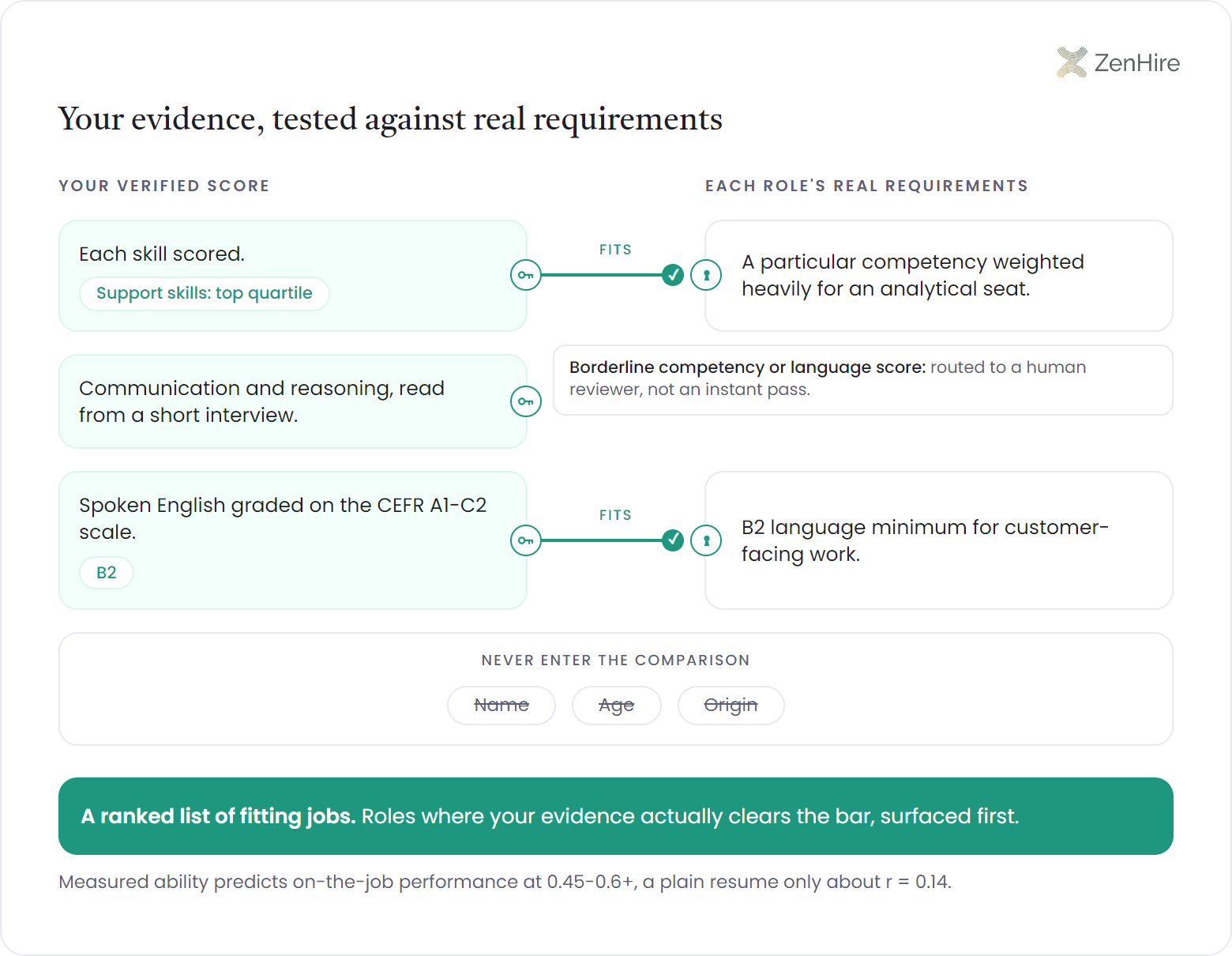
Here is the mechanism. A useful skills map starts from a structured picture of you: each skill scored, your communication and reasoning read from a short interview, and, for many roles, your spoken English placed on the CEFR ladder that runs from A1 up to C2. Each role carries its own requirements: a B2 language minimum for customer-facing work, or a particular competency weighted heavily for an analytical seat. Matching the two surfaces the jobs where your evidence clears the bar, and because the score is glass-box and bias-excluded, things like your name, age, or origin never enter the comparison. The fastest way to get a map worth trusting is to build a candidate profile so there is real evidence to compare against.
A concrete example: you finish one verified assessment that scores your support skills in the top quartile and rates your spoken English at B2. The map immediately points you at customer-facing and bilingual coordination roles that need exactly that, not the single job title on your resume. The edge case worth knowing: a fitting map is a strong signal, not a verdict. A borderline competency or language score may route a role to a human reviewer rather than an instant pass, which protects you from being filtered out by a single number. See how the candidate skill score is built so you know exactly what your map is reading.
The map rewards what you can measure over what you can word: matched against actual performance, a resume scores about r = 0.14 while a scored skills assessment climbs to 0.45-0.6+. Roughly the whole distance between those two numbers is the set of fitting jobs a keyword filter never shows you.
- Your verified score: skills, soft skills, and CEFR language graded as real evidence, not adjectives
- Each role's real requirements: a B2 language minimum or a weighted competency, not a buzzword list
- A bias-excluded comparison: name, age, and origin kept out of the map entirely
- A ranked list of fitting jobs: roles where your evidence actually clears the bar, surfaced first
How do you find the vertical where your skills fit best?
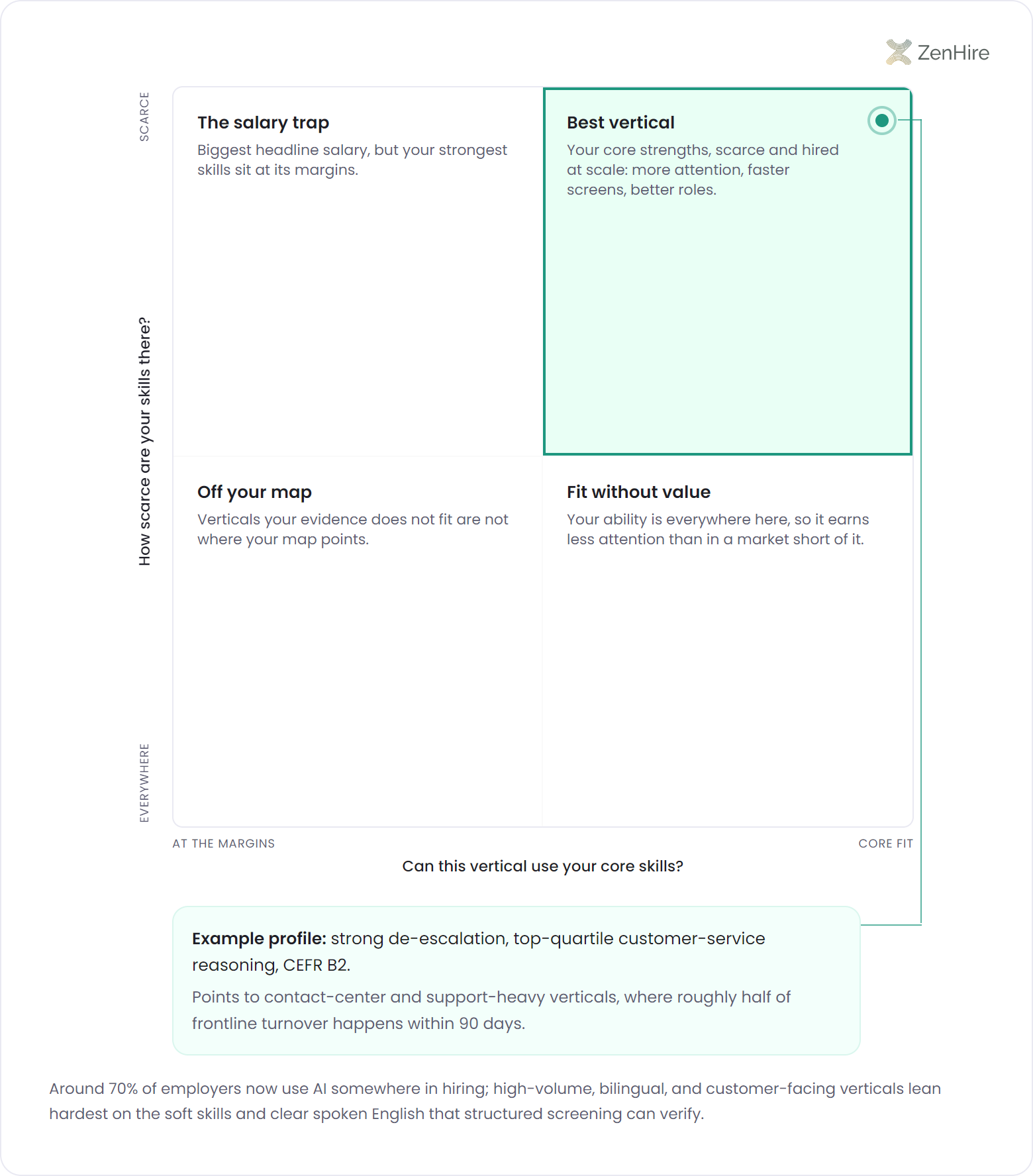
You find the vertical where your skills fit best by separating two questions a resume blurs together: which industries can use what you do, and which one values it most because the supply is thin. A skills map shows you the full set of careers for your skills; choosing the best vertical is then a scarcity question. The same ability earns more attention, faster screens, and better roles in a market that is short of it than in one where it is everywhere.
The mechanism is the difference between fit and value. Around 70% of employers now use AI somewhere in hiring, and the verticals leaning hardest on it, including high-volume, bilingual, and customer-facing hiring, are precisely the ones starved for the soft skills and clear spoken English that structured screening can verify. So a candidate whose strongest proof is calm communication and a CEFR B2 score will fit best in a vertical that has to hire those traits at scale, even if their last job sat in a different industry. To see which signals a vertical actually weighs, look at how a fair AI interview reads communication and reasoning, and strengthen your soft skills so the traits the scarce verticals want show up as scores, not claims.
A concrete example: your assessment shows strong de-escalation, top-quartile customer-service reasoning, and a B2 language level. Those map to several verticals, but contact-center and support-heavy industries, where roughly half of frontline turnover happens within 90 days and demand for reliable communicators never lets up, are where that exact profile is scarcest and most rewarded. The edge case: the highest-paying vertical is not always the best fit if your strongest skills sit at its margins. Chase the market that needs your core strengths, not the one with the biggest headline salary. If you are weighing several directions, find the right career starts from the same evidence base.
| What you compare | How it points you to the best vertical |
|---|---|
| Where your skills can be used | The full map of careers for your skills, surfaced from your verified score |
| Where those skills are scarce | The vertical short of your strengths values them most, with faster screens and better roles |
| Your language level, A1 through C2 | Bilingual and customer-facing verticals match on a clear CEFR threshold; accent read for clarity only |
| Where fit meets demand | Your core strengths matched to a market that hires them at scale, not a margin role |
How do you pivot into new jobs that fit your skills?
You pivot into new jobs that fit your skills by proving the transferable abilities the new role needs and letting a fair screen judge them directly, instead of being rejected for a job title that does not match the listing. A pivot fails on a resume because the reader pattern-matches your last role to the new one and sees a gap. A pivot succeeds on a skills-based screen because the evaluation reads what you can do now, so a switcher with the right underlying abilities competes on equal footing with an insider.
The mechanism is verification of transferable skills. A pivot lives or dies on whether the new employer trusts the evidence, and a scored assessment carries far more of that trust than a resume: it tracks performance at 0.45-0.6+ where a resume tracks it at 0.14, so the reader can act on proof you can do the work even when your history sits in another field. Generating that proof usually costs you one async AI interview of about four minutes, and a glass-box, bias-excluded score keeps the career switch itself from reading as a red flag. Closing a genuine skill gap first makes the pivot land: free courses to get a job turn a missing requirement into a fresh score, and you can get hired faster once the new evidence is in your profile.
A concrete example: a retail floor lead pivots into a bilingual support role. Their resume reads "retail," so a keyword filter drops them, but a verified assessment shows strong de-escalation, calm communication under pressure, and a CEFR B2 score, which is exactly what the support role needs. The screen surfaces them on ability, not industry. The edge case worth naming: a pivot still needs the genuine skill, not just confidence. If the new role demands a competency you cannot yet demonstrate, the map will show the gap honestly, and the right move is to close it with a course and re-score, not to apply over it. Refreshing your profile after that turns a near-fit into a real one.
A whole pivot can turn on one short proof. The async AI interview that generates your matchable score runs about 4 minutes; inside it, spoken English is placed on the CEFR ladder from A1 to C2, and accent is read for clarity alone, never marked down for sounding non-native. Clear that once and a fair screen weighs your fit for the new job on its own terms, not on the title you are leaving behind.
So many people stay stuck in a role they have outgrown because they assume the only jobs that fit them are the ones that match their last job title. That is the resume talking, not your ability. I have seen genuinely capable people written off in seconds because a filter could not see past where they had been, and I have seen the same people thrive the moment someone actually measured what they could do. We built the evaluation to read your real skills, how you communicate, your actual ability, and to keep the things that should never decide it, like where you are from or how your name sounds, out of the score entirely. If a job fits what you can do, you deserve to be discovered for it, even if your history does not spell it out.
Frequently asked questions
What jobs fit my skills if my resume only shows one industry?+
The jobs that fit your skills are the ones your verified abilities map to, even when your resume shows a single industry. A skills-based screen reads your scored skills, soft skills, and CEFR language level directly, so transferable strengths like calm communication or strong reasoning surface roles across several verticals, not just the one your last title sat in.
How do I know which careers for my skills are worth pursuing?+
The careers for your skills worth pursuing are where your strongest abilities are also scarce. A map shows every role your evidence fits; the best ones are in verticals short of your core strengths, because the same ability earns faster screens and better roles in a market that needs it than in one where it is common.
Can I really pivot into a new job that fits my skills without matching experience?+
Yes: you pivot on proof of transferable skills rather than matching experience. A verified assessment forecasts performance at 0.45-0.6+ where a resume manages only about 0.14, so an employer can hire on evidence you can do the work even when your history sits in another field — the switcher and the insider are judged on the same ability, not on whose title fits the listing.
Is role fit for my experience judged fairly when AI runs the screen?+
A well-built screen is designed to judge role fit for your experience more fairly, not more harshly. Glass-box, bias-excluded scoring keeps name, age, and origin out of the evaluation and reads what you can do, which gives a career switcher or a non-traditional candidate a fairer shot than a resume scan that reads a pivot as a gap.
Does my accent change which jobs fit my skills?+
Your accent does not shrink the jobs that fit your skills on a fair system; it is read for clarity only, never marked down for being non-native. Your spoken English is placed on the CEFR ladder from A1 to C2 by how clearly you can be understood, so roles match you against a real proficiency threshold, not against how native you sound.
Free for finding jobs that fit my skills
See which jobs fit your skills
Create a verified profile scored on real skills, soft skills, and language, then get a map of the roles and verticals that fit what you can actually do, and get matched to employers who need exactly that.