
How Do You Get Recruited Without Applying?


· 10 min read
You get recruited without applying by putting verified skills into a talent pool that recruiters search directly: build a skills-first profile, complete a short assessment, and set your role and location preferences. The reason this works in your favor is what recruiters are searching on: the resume that would normally represent you barely predicts on-the-job performance (a validity of roughly 0.14), whereas the verified-skill signal a pool carries lands in the 0.45-0.6+ band, so proven ability surfaces you where a keyword screen would have skipped past. And because most employers, on the order of 70%, now let AI help with sourcing, a profile you can complete in one sitting, including a four-minute spoken assessment that rates your language on a CEFR scale for clarity, is exactly what puts you in front of a search instead of behind it.
How do talent databases get you recruited without applying?
Talent databases get you recruited without applying by storing your skills, experience, and verified ability where recruiters search proactively, so when a role opens that fits what you can do, a recruiter finds your profile and reaches out, no application required. Instead of you scanning job boards and submitting to a queue, the search runs in the other direction: hiring teams query the talent pool for the skills they need and you surface as a match.
The mechanism is semantic matching, not a keyword lookup. Modern matching engines read your profile in context and distinguish whether you actually used a skill versus merely listed it, then score how well your real abilities line up with a job description. That is why a candidate who never wrote the exact phrase in a posting can still rank as a strong fit; the system reads the underlying capability, which is the whole point of getting matched with employers rather than filtered out by a literal keyword screen.
For example, picture a support specialist who handled escalations, de-escalated angry callers, and trained two new hires, but whose resume only says "customer service representative." A keyword filter passes them over for a "team lead" req. A skills-based talent pool, reading the demonstrated competencies, surfaces them to the recruiter as a credible lead-track match, and the recruiter reaches out first.
The edge case worth knowing: a database only helps if your skills are actually represented in it. A thin, outdated, or skills-light profile is invisible to a proactive search, no matter how strong you are in person. Pulling your real abilities into a structured profile is the difference between being in the pool and merely being adjacent to it, which is why it pays to build a candidate profile that leads with what you can prove.
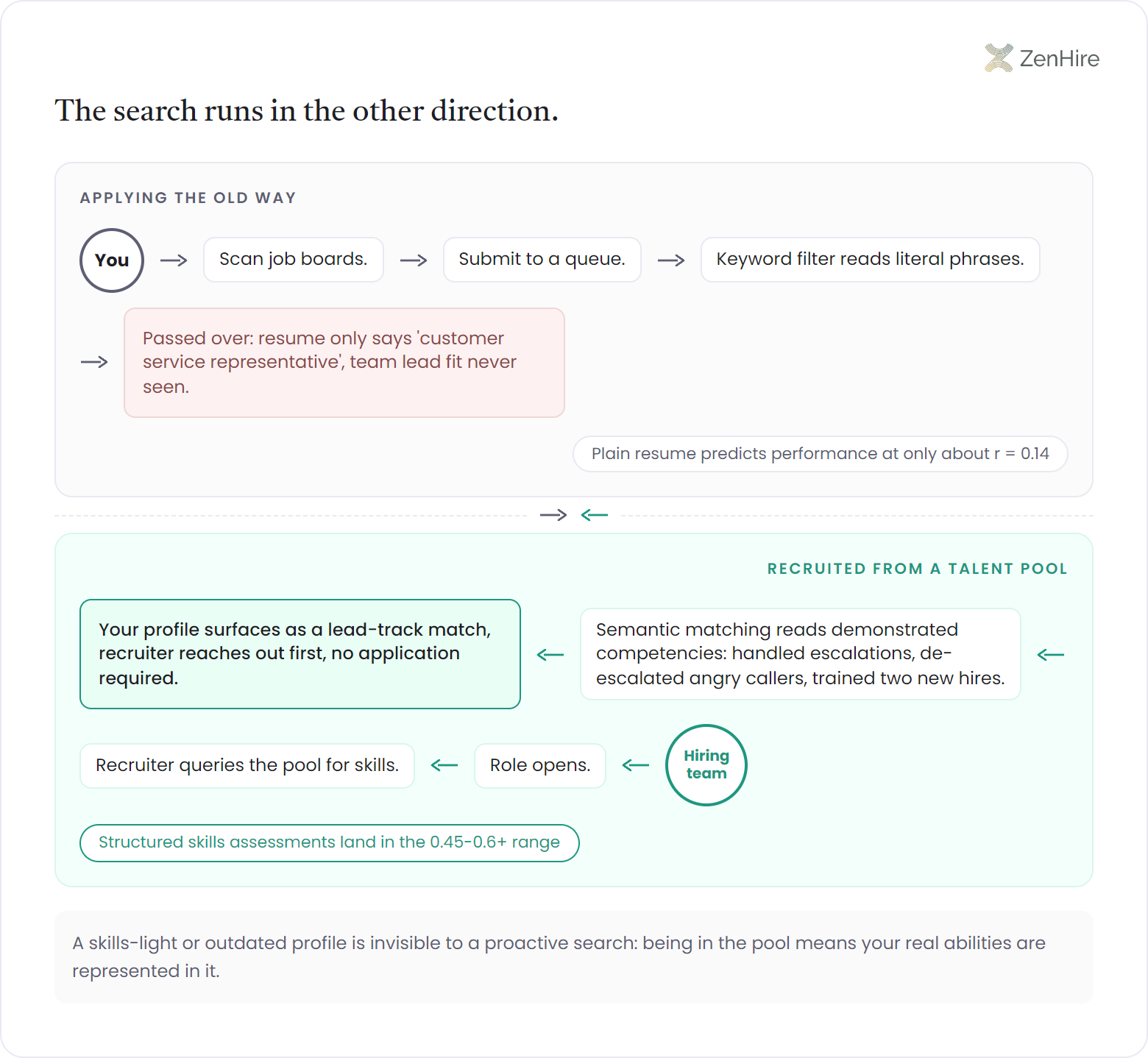
Think of it as a signal-quality problem. The CV a proactive search would rank you on tracks real performance at only 0.14, while the verified-skill evidence a well-built pool holds tracks it at 0.45-0.6+. When a recruiter queries the pool, they are reading that stronger signal, so the person a keyword filter would have buried is exactly the person the search can surface.
What makes recruiters reach out so you're recruited without applying?
What makes recruiters reach out so you're recruited without applying is a clear, verifiable match between the skills you can demonstrate and the role they are trying to fill: the closer and more provable that fit, the more confident a recruiter is that the message is worth sending. Recruiters do not headhunt at random; they reach out when a profile lowers their risk of a bad first conversation, and proven ability does exactly that.
The strongest reach-out signals are the ones a recruiter cannot easily get from a resume alone: verified skills, evidence of soft skills like clear communication under pressure, and consistent role-fit signals. When evaluation is structured and bias-excluded, that signal is also cleaner: sensitive attributes are kept out of the match, so you are surfaced because your ability fits. This reflects the spirit of reducing bias in how candidates get found. A profile that shows a candidate skill score gives the recruiter a concrete reason to start the conversation.
Concrete example: two candidates have near-identical resumes, but one has a verified language and communication assessment showing a solid CEFR level rated for clarity. For a customer-facing role with international clients, the recruiter reaches out to the candidate whose spoken ability is already documented, because that removes the single biggest uncertainty in the screen. The proof did the persuading.
An important edge case: recruiters also weigh fit honestly, and that protects you. Roughly half of frontline turnover happens within the first 90 days, usually because the match was wrong, so a recruiter who reaches out on a genuine skills fit is also less likely to pull you into a role you would leave. Good matching is not just about getting contacted; it is about getting contacted for roles where you would actually thrive.
With roughly 70% of employers now letting AI take part in hiring, the tools doing the searching often confirm a match with a short 4-minute async interview rather than a callback. Those systems are built to surface demonstrable skill, so making your ability legible to them is the lever that turns quiet presence in a pool into an active reach-out.
- Verified skills: proof you can do the work, not just a claim that you can
- Soft-skill evidence: communication, reliability, and composure a resume hides
- Role-fit signals: your real strengths mapped against what the job needs
- Bias-excluded scoring: surfaced for ability, not name, age, or background
How do you opt in to be recruited without applying?
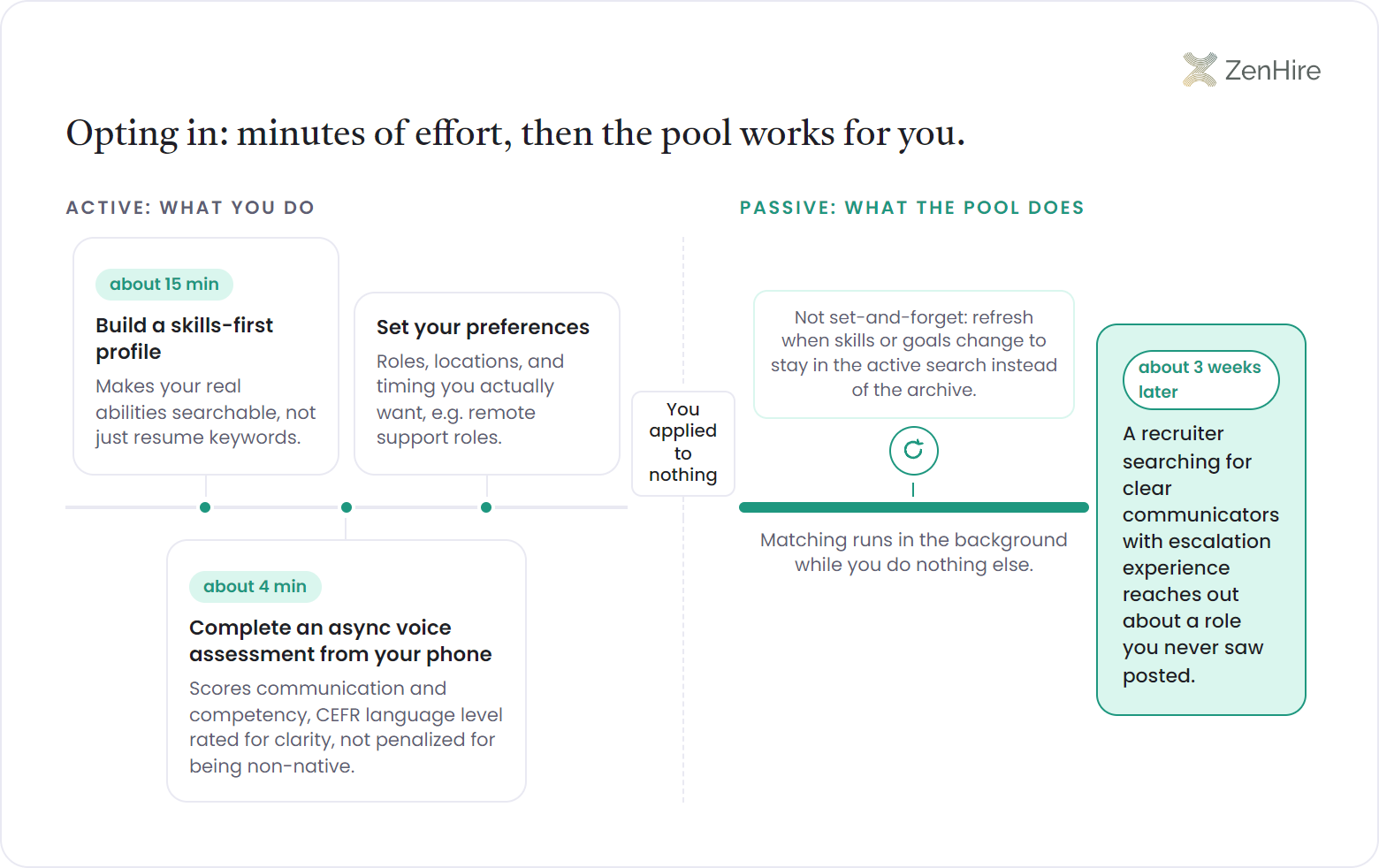
You opt in to be recruited without applying by creating a skills-first profile, completing a short assessment so your ability is verified, and setting your preferences for the roles, locations, and timing you want, and then the pool works for you in the background. Opting in is an act you control: you decide what to share, you complete a brief evaluation that turns your skills into evidence, and you stay reachable without ever sitting in an application queue.
The practical path is short. Build the profile, lead with skills you can demonstrate, and record the assessment, which is usually a four-minute spoken interview you take on your own time; it scores communication and competency, and where language matters it places you on the CEFR scale by how clearly you come across, not by whether the accent is native. From there you can keep your profile sharp and your match quality high by working on the abilities employers actually search for, the same logic behind getting hired faster and continuing to improve soft skills over time.
Example in practice: you spend roughly fifteen minutes building a profile and four minutes on a voice assessment from your phone, set your preference to remote support roles, and then do nothing else. Three weeks later a recruiter who searched the pool for clear communicators with escalation experience reaches out about a role you never saw posted. You applied to nothing; your verified profile applied for you.
The edge case to plan for: opting in is not set-and-forget forever. Skills age, preferences change, and a stale profile slowly stops matching. Refreshing your profile when you learn something new or shift what you want keeps you in the active search rather than drifting to the bottom of it, and because evaluation runs on a glass-box, explainable model, you can understand why you match what you match rather than guessing at a black box.
| Step to opt in | What it does for you |
|---|---|
| Build a skills-first profile | Makes your real abilities searchable, not just resume keywords |
| Complete a ~4-min assessment | Turns claimed skills into verified signal recruiters trust |
| Set role and location preferences | Filters reach-outs to roles you would actually take |
| Refresh when skills or goals change | Keeps you in the active search instead of the archive |
When I was a candidate, the worst part was never the rejection; it was the silence after sending a resume into a void, knowing a keyword filter probably tossed it before a human read a word. We built ZenHire so that what you can actually do is the thing that gets seen, and so the parts that should never decide your shot (your name, your age, your background) are kept out of the math entirely. If you are good at the work, I want a recruiter to find that out in four minutes, not for an algorithm to miss it because your resume did not phrase it the way a posting did. Being recruited without applying is just hiring working the way it always should have: ability first, you in control.
Frequently asked questions
How do you get recruited without applying to jobs?+
You get recruited without applying by being in a talent pool that recruiters search directly, with a profile built around skills you can prove. When a role opens that fits your verified abilities, a recruiter finds your profile and reaches out; the search runs toward you instead of you chasing posts.
How do you get headhunted if you are not actively job hunting?+
You get headhunted by making your proven skills findable while staying a [passive candidate](/candidates). Recruiters reach out when a profile lowers their risk, so verified skills, soft-skill evidence, and clear role-fit signals are what draw the message, even when you never applied and are only quietly open to the right move.
Does getting recruited from a talent pool mean lower-quality roles?+
No, being recruited from a talent pool often means better-fit roles, because recruiters reach out on a genuine skills match rather than to whoever applied that day. Since roughly half of frontline turnover happens in the first 90 days from poor fit, a match made on real ability tends to be a role you would actually stay in.
Will my resume keywords still hold me back if I am in a talent pool?+
A skills-based talent pool is built to look past resume keywords. Semantic matching reads whether you actually used a skill, not just whether you listed the right phrase. That matters because the resume itself is a weak predictor of performance, roughly 0.14, next to 0.45-0.6+ for a verified skills assessment. A profile that carries the stronger signal is the gap-closer between being screened out and being searched up.
Is being scored by AI to get recruited fair to non-native speakers?+
Fair scoring keeps sensitive attributes out and rates language for clarity, not native-ness. The spoken assessment places you on the CEFR scale by how understandable you are, so a strong non-native speaker is rated for getting the message across, never docked for an accent. And because the model is glass-box and bias-excluded, you can see why you were surfaced for a role instead of trusting a black box to be fair.
Free for getting recruited without applying
Get found by employers, not filters
A short guide to making your skills searchable so recruiters reach out: what to put in a skills-first profile, how verified ability lifts your visibility, and how to set preferences so the right roles find you.