
Will AI Replace Recruiters?


· 10 min read
AI will not replace recruiters: it takes over resume triage, scheduling, and first-round screening, while judgment, candidate relationships, closing, and the final hiring decision stay firmly with a person. By 2025 roughly 70% of hiring teams had folded AI into some step, and the reason it starts with screening is telling: reading a CV by itself is nearly the weakest thing a recruiter does, worth only about 0.14 in predictive validity against on-the-job performance, whereas combined validated methods clear 0.6. ZenHire runs that measuring at a scale no person can, with glass-box scores that agree with human screeners 93%+ of the time across 3,000+ applications per role and cut manual screening by a reported 87% — the machine measures, the recruiter decides.
Will AI replace recruiters entirely?
No, AI will not take over the recruiter role outright. The job is part data work and part human work, and only the data work is mechanizable. A person still weighs trade-offs, sells the role, and stands behind the decision when it is questioned.
Mechanically, an AI recruiter that screens and ranks your pipeline parses applications, scores demonstrated fit against the role, runs a structured interview, and returns a ranked shortlist with the evidence behind each score. None of that is a hiring decision. It is measurement that compresses a thousand applications into a defensible shortlist a person then acts on. ZenHire keeps that boundary explicit: scoring is glass-box and auditable, sensitive attributes are excluded, and a human signs off.
Picture a contact-center team fielding several thousand applications a month. AI can run each candidate through a CEFR-aligned spoken-language check in roughly four minutes and float the top tier upward. The recruiter never opens the bottom 80 percent — but still interviews the finalists in person and picks who gets hired. The tool cleared the queue; it did not take the recruiter's seat.
This breaks down at the edge. A single executive search or a deeply relationship-driven hire has too little volume for automation to add value, and nearly all of the work is judgment, persuasion, and trust. There the recruiter does almost everything and AI contributes little, the opposite of the high-volume case.
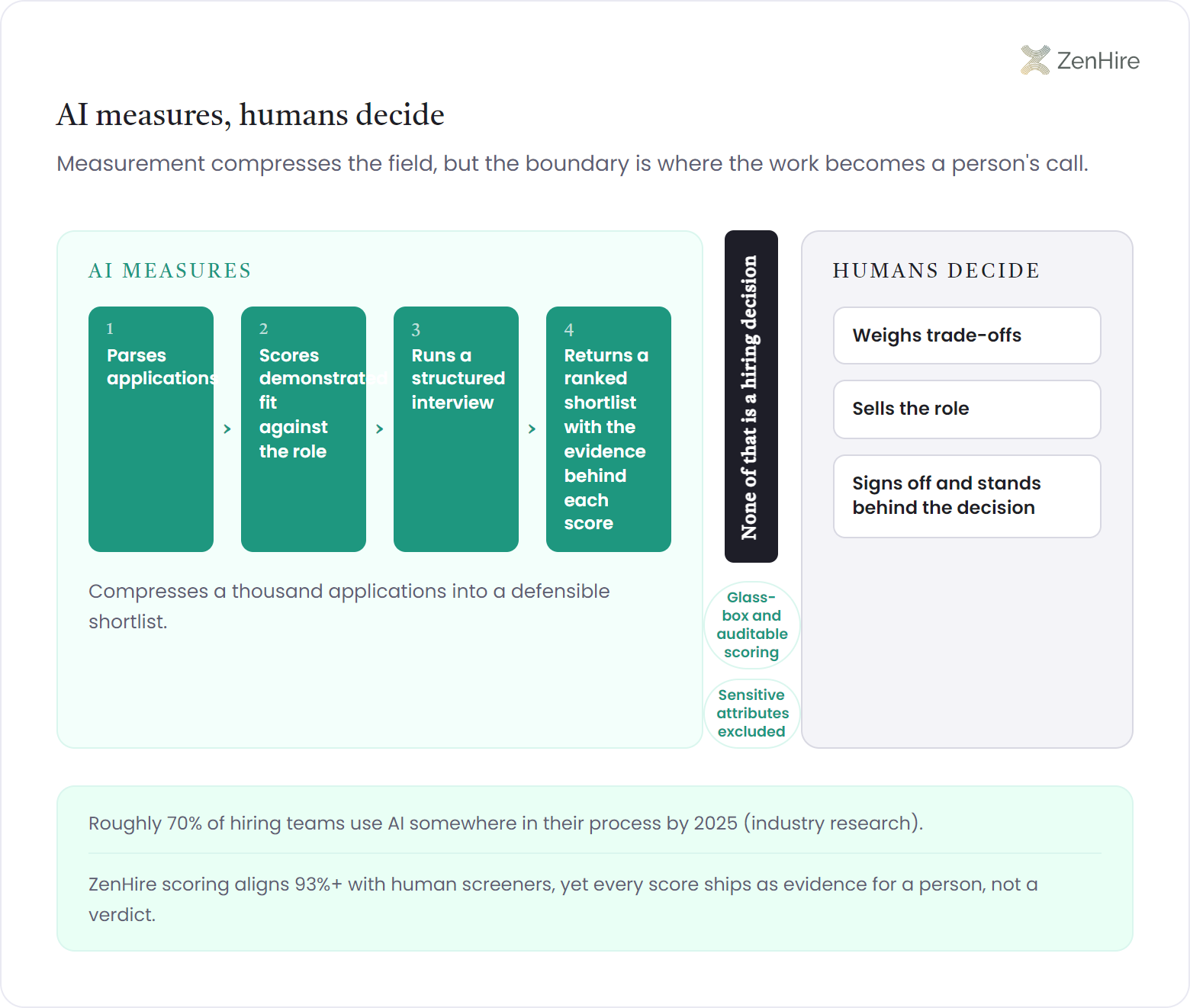
AI measures, humans decide. By 2025 roughly 70% of hiring teams had put AI somewhere in their process (industry research), and the headcount of recruiters did not collapse — the job simply stepped off the screening treadmill. ZenHire's scoring agrees with human screeners 93%+ of the time on the same CVs, yet each score leaves the system as evidence for a person to weigh, never as the verdict itself. That boundary is designed in, not bolted on.
Which recruiter tasks does AI take over first?
AI takes over the most repetitive, high-volume, rule-based recruiter tasks first: anything that scales linearly with applicant count and follows a consistent rubric. That is precisely where humans are slowest and least consistent, so the gain from automating it is largest.
In practice the order is predictable. Resume triage goes first: instead of keyword filters that reject strong people for phrasing, semantic CV matching that scores real fit judges whether a skill was actually used versus merely mentioned. Scheduling goes next, since coordinating calendars carries no judgment. First-round screening follows, where a structured AI interview captures communication, reasoning, and language signals consistently for every applicant, not only the ones a person had time to call.
Take a recruiter who used to burn most of the week on CV stacks and calendar tag: hand both to the system and that time comes back for hiring-manager calibration and candidate outreach. The research says why the trade is worth making — a CV reviewed on its own predicts [performance at only about 0.14](/metrics/quality-of-hire) — so the chore eating the most hours happens to be the flimsiest signal in the pipeline. Automating it costs the recruiter nothing they were good at.
The edge case is the niche or novel role with no rubric yet. When a position is being defined for the first time there is no validated pattern to score against, so automation has to wait until a person sets the calibration the model can then apply at scale.
- Resume triage and ranking: replacing keyword filters with semantic, evidence-based matching
- Interview scheduling and candidate logistics: coordination that carries no judgment
- First-round screening: a consistent, structured AI interview for every applicant, not just the ones a person could call
- Routine status updates and personalized feedback: delivered at volume, regardless of outcome
- [Fraud and integrity checks](/ethical-hiring/recruitment-fraud): duplicate-CV, scripted-answer, and proxy-interview detection at 91% accuracy
| Recruiter task | Automated first? | Why |
|---|---|---|
| Resume triage and ranking | Yes, first | High volume, rubric-based, and the weakest manual signal (~0.14) |
| Interview scheduling | Yes | Pure logistics, zero judgment required |
| First-round screening | Yes | A structured AI interview scores every applicant consistently |
| Defining a brand-new role | No, waits | No validated rubric yet; a human must calibrate first |
| Closing a finalist | No | Persuasion, context, and accountability stay human |
How does a recruiter stay valuable alongside AI?
A recruiter stays valuable by owning what a model cannot: the decision, the relationship, and the calibration. As measurement gets automated, the human premium shifts onto judgment, persuasion, and accountability, which become worth more, not less.
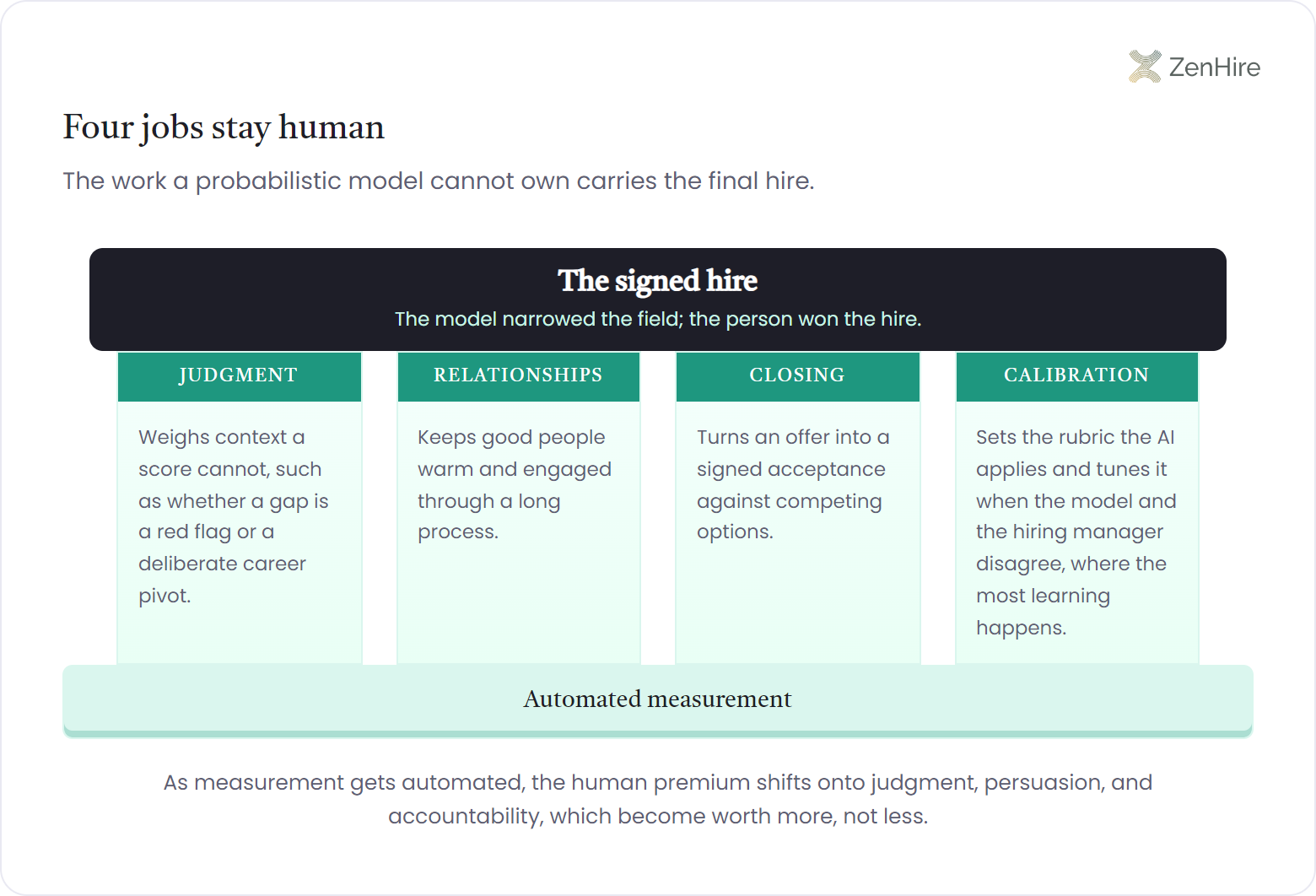
Concretely, four jobs stay human. Judgment weighs context a score cannot, such as whether a gap is a red flag or a deliberate career pivot. Relationships keep good people warm and engaged through a long process. Closing turns an offer into a signed acceptance against competing options. Calibration sets the rubric the AI applies and tunes it when the model and the hiring manager disagree, where the most learning happens. This is the augmentation answer to the fear that AI will cost recruiters their jobs: the role moves up the value chain, and the difference is mapped in detail on AI recruiter versus human recruiter.
A concrete example: when AI flags two finalists as near-identical on measured fit, the recruiter reads the room on the hiring manager's unstated priorities, manages the counter-offer, and gets the chosen candidate to sign. The model narrowed the field; the person won the hire. For where this human-plus-AI split is heading, see the future of recruitment.
The counter-argument, and why it falls short
Some argue that as models improve they will close the judgment gap and eventually decide too, making the recruiter optional. It is a fair point: scoring has gotten dramatically better, and language analysis now aligns 90 to 96 percent with averaged evaluations from five PhD linguists, versus 68 to 75 percent for untrained recruiters.
Where it falls short is accountability and context. A hiring decision changes a person's livelihood, and someone has to be answerable for it, including for the model's mistakes, which a probabilistic system cannot own. Stronger measurement does not remove the need for a decider; it raises the quality of the evidence the decider works from. That is precisely the AI-measures-humans-decide split, and better measurement reinforces it rather than erasing it.
Which recruiter tasks does AI own, assist with, or leave human?
Sort every recruiter task into one of three buckets: AI does it now, AI assists, or it stays human. The dividing line is not difficulty. It is whether the task is repeatable measurement against a rubric (AI does it), an information problem where a model drafts and a person edits (AI assists), or an act of judgment, persuasion, or accountability that has to be owned by a person (stays human).
The table below classifies the seven tasks that fill most of a recruiter's week. The pattern is consistent: the closer a task sits to high-volume, rule-based scoring, the more fully AI owns it; the closer it sits to a one-off human relationship or a decision someone must answer for, the more firmly it stays with a person. Most roles, in practice, are a blend of all three.
Read the table as a workflow, not a verdict. The top rows are where AI removes the volume drudgery so the pipeline arrives pre-measured; the bottom rows are where the recruiter's hour is worth the most. A team that pushes screening and scoring fully into the "AI does it now" column buys back the time that closing and candidate relationships actually need, which is the whole point of augmentation.
| Recruiter task | Classification | What that means in practice |
|---|---|---|
| Resume screening and ranking | AI does it now | Field extraction runs at 97% accuracy and fit scoring agrees 93%+ with human screeners, sustained across 3,000+ applications per role — a volume no recruiter could ever read |
| Interview scheduling and logistics | AI does it now | Pure coordination with zero judgment; the recruiter never touches a calendar invite again |
| Sourcing and outreach | AI assists | AI drafts targeted messages and surfaces candidates; the recruiter sets the strategy and adds the personal note that earns a reply |
| Structured interview scoring | AI does it now | A ~4-minute async interview rates communication, reasoning, and CEFR A1-C2 language the same way for every applicant, then hands a person the glass-box evidence to judge |
| Offer negotiation | Stays human | Reading unstated priorities, managing a counter-offer, and trading on trust; a probabilistic model has no standing here |
| Candidate relationships | Stays human | Keeping strong people warm and engaged through a long process is empathy work, not measurement |
| Closing the finalist | Stays human | Turning an offer into a signed acceptance against competing options, and owning accountability for the hire |
Every few months someone asks me if I am building the thing that ends recruiting jobs. I am not, and I would not want to. I spent years watching good recruiters drown in CV stacks they could not possibly read fairly, and that is the part I want gone, not the recruiter. My conviction is almost boring: a machine should never be the one answerable for changing someone's livelihood. So we built ZenHire to do the measuring at a scale no human can match, and to hand the decision (and the accountability) back to a person every single time.
Frequently asked questions
Will AI replace recruiters in the next decade?+
AI will not replace recruiters in the next decade. What it will keep doing is automating the repetitive screening recruiters were never good at anyway — a CV-only review lands near 0.14 predictive validity, while combined validated methods reach 0.6+. That gap means AI sharpens the shortlist while a person still decides, tends the relationships, and closes the hire.
Is recruiting being automated, and which parts?+
Recruiting is being automated only in its repetitive, rule-based parts: resume triage, interview scheduling, first-round screening, status updates, and fraud checks. Judgment, candidate relationships, offer closing, and rubric calibration stay human, which is why the recruiter role is being reshaped rather than removed.
What is the future of recruiter jobs as AI matures?+
The future of recruiter jobs is higher-value work, not unemployment. As AI absorbs volume tasks, recruiters move toward hiring-manager calibration, candidate experience, employer branding, and strategic decisions, and they own accountability for the final call, because a probabilistic system cannot be answerable for a hire.
Can AI make the final hiring decision instead of a recruiter?+
AI should not make the final hiring decision instead of a recruiter. It should measure while a human decides. A score is evidence, not a verdict, and someone must be accountable for the outcome, so responsible systems keep scoring explainable and auditable while leaving the decision and any override with a person.
Does using an AI recruiter mean fewer recruiter jobs?+
Using an AI recruiter does not have to mean fewer recruiter jobs. More often it means one recruiter can carry more open roles with far less manual screening — ZenHire users report 87% less of it. The hours that frees up move from reading every CV toward coaching candidates, calibrating the model, and partnering with hiring managers.
Free for recruiter AI-readiness
The recruiter's AI-readiness scorecard
A short self-assessment that maps which of your tasks AI should take over first, which stay human, and where your time moves next, so you lead the shift instead of fearing it.