
In-House Recruiting vs Agency: Which Should You Choose?


· 9 min read
In-house recruiting vs agency comes down to repeatability: keep steady, same-profile hiring in-house and rent an agency only for burst campaigns and rare executive searches. Agencies charge a placement fee of 15-25% of first-year salary per hire, $12,000 on one $60,000 role and $120,000 across ten, while an internal team's fixed cost amortizes across every hire. The historical reason to outsource was raw capacity, not sharper judgment, and that gap is exactly what AI now fills: structured screening reaches predictive validity above 0.6 against 0.18 for the unstructured phone screen an agency typically runs, and with roughly 70% of hiring teams using AI by 2025 (reporting 62% faster screening and 59% lower cost), a lean internal team can screen at agency scale without the per-placement fee.
When does in-house recruiting beat an agency?
In-house recruiting beats an agency when your hiring is repeatable and your brand is worth owning. When you hire the same kinds of roles at a steady cadence, an internal team that learns your business out-converts and out-economizes an agency that starts cold on every brief. The fixed cost of a recruiter spreads across dozens of hires; an agency fee is paid in full, every single time, with nothing compounding in your favor.
The mechanism is ownership of context. An in-house recruiter knows which traits actually survive 90 days in your environment, holds the candidate relationship through onboarding, and feeds what they learn back into the next req. That loop is where talent acquisition compounds, and it is precisely what an agency, paid per placement and incentivized to fill fast, cannot build for you. In-house also owns employer branding and the candidate experience, which an outside firm can represent but never truly carry.
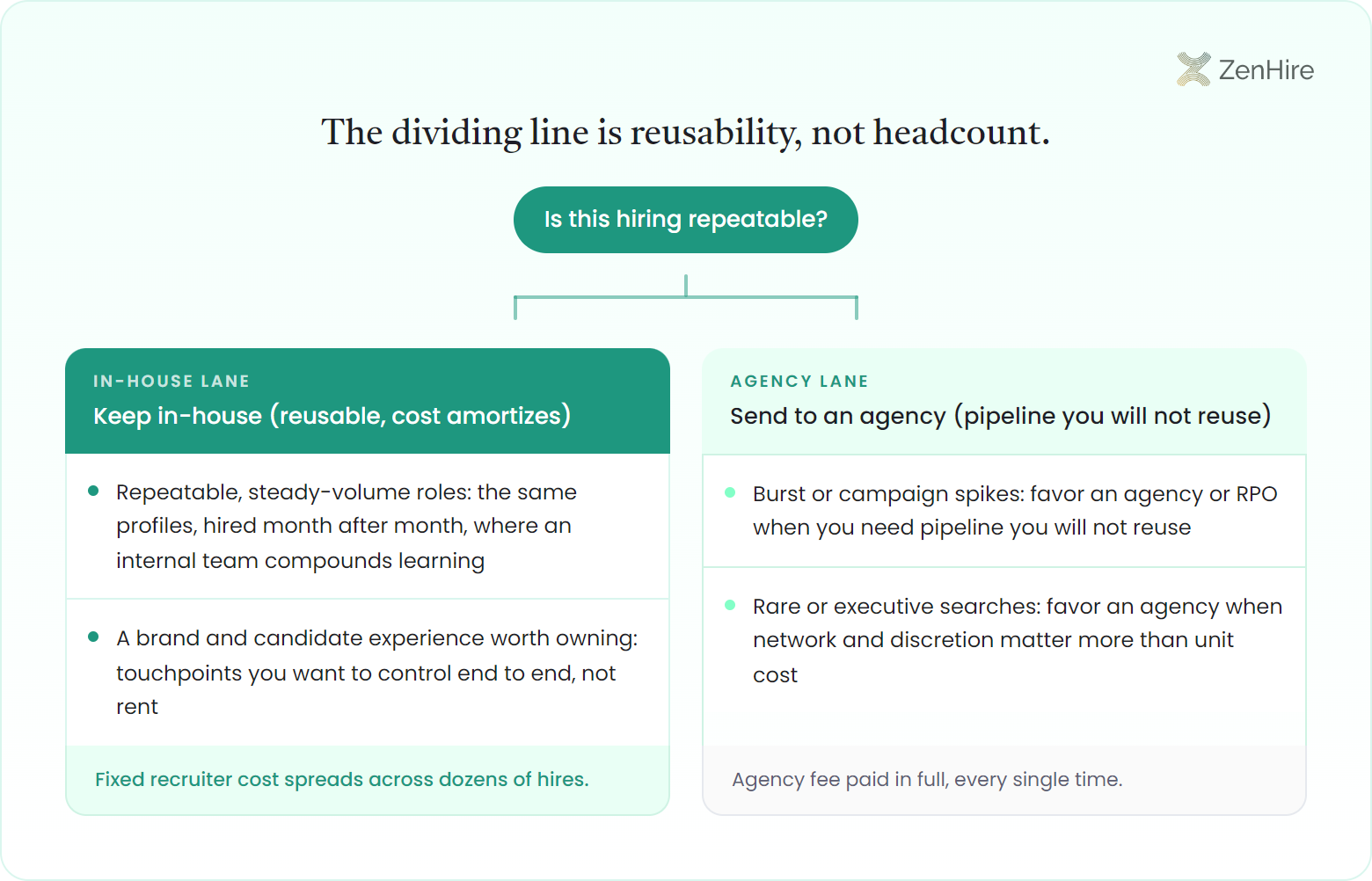
The honest edge case: in-house loses when the work is not repeatable. A one-time campaign to stand up two hundred agents in sixty days, the kind of high-volume hiring spike an internal team is not staffed for, a single C-suite search in a market where you have no network, or a niche specialism you will hire for once: those favor an agency, because you would be paying to build a pipeline you will never reuse. The dividing line is reusability, not headcount.
The recruitment-services market sits near $450B (2023) and is projected toward ~$870B by 2032 at roughly 7.5% CAGR (industry research). A market that large exists because outsourcing hiring is genuinely valuable when capability is scarce. The strategic question is not whether agencies add value, but which slice of your hiring is repeatable enough to pull back in-house.
- Repeatable, steady-volume roles: the same profiles, hired month after month, where an internal team compounds learning
- A brand and candidate experience worth owning: touchpoints you want to control end to end, not rent
- Burst or campaign spikes: favor an agency or RPO when you need pipeline you will not reuse
- Rare or executive searches: favor an agency when network and discretion matter more than unit cost
What does in-house recruiting cost versus an agency?
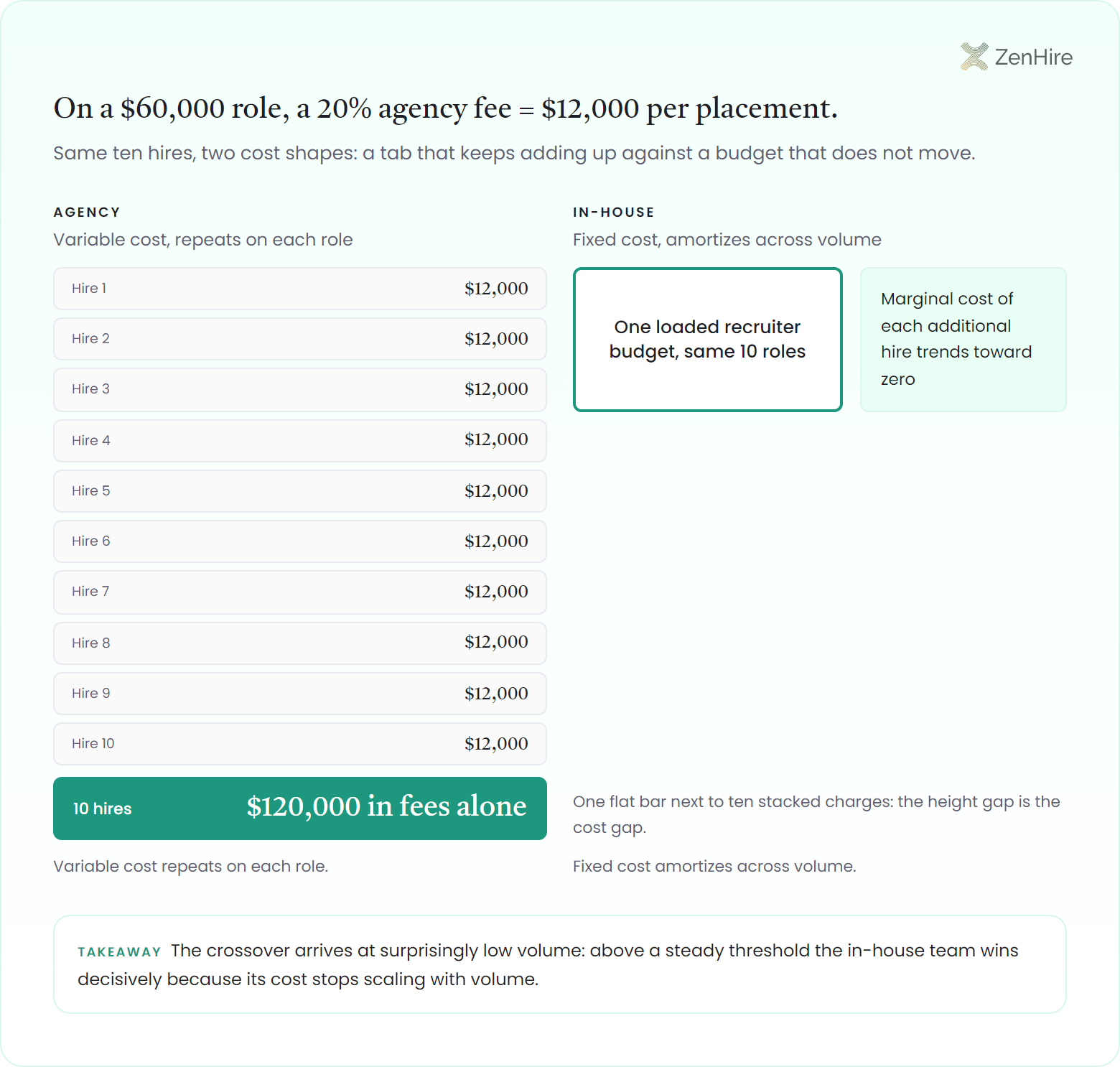
In-house recruiting costs you a fixed team budget that amortizes across every hire, while an agency costs a placement fee of 15-25% of first-year salary on each one, so the comparison is not price-per-hire in isolation, it is a fixed cost spread over volume versus a variable cost paid fresh each time. Below a few hires a year the agency's pay-as-you-go model can be cheaper; above a steady threshold the in-house team wins decisively because its cost stops scaling with volume.
Work a concrete example. On a $60,000 role, a 20% agency fee is $12,000 per placement; ten such hires cost $120,000 in fees alone. An in-house recruiter on a comparable loaded budget who fills those same ten roles drives the marginal cost of each additional hire toward zero. The crossover is not exotic; it arrives at surprisingly low volume, which is why teams with even modest, predictable hiring usually find the in-house number better once they actually run it against cost-per-hire.
The edge case that protects the agency is fall-off. An agency typically guarantees a replacement if a placement leaves inside a guarantee window, and that risk transfer has real value when your own screening is weak: you are buying insurance against a bad hire. But that guarantee only pays off if the agency's screen actually beats yours, and the evidence says both sides usually run the same weak instrument: an unstructured interview predicts on-the-job performance at only about r = 0.18 and a resume scan near 0.14, no matter whose recruiter is holding the phone. Buying a replacement guarantee on top of a coin-flip screen is paying to redo the same mistake, so the fall-off protection is worth less than the invoice suggests unless the underlying evaluation is genuinely stronger.
| Cost driver | In-house | Agency |
|---|---|---|
| Per-hire fee | None, cost is the team, not the placement | 15-25% of first-year salary, every hire |
| Scaling behavior | Fixed cost amortizes across volume | Variable cost repeats on each role |
| Brand & relationship | Owned end to end | Represented, not owned |
| Burst capacity | Limited by headcount | Elastic, buy it when you need it |
| Fall-off risk | Carried by you | Guarantee window transfers some risk |
How does AI make in-house recruiting more competitive?
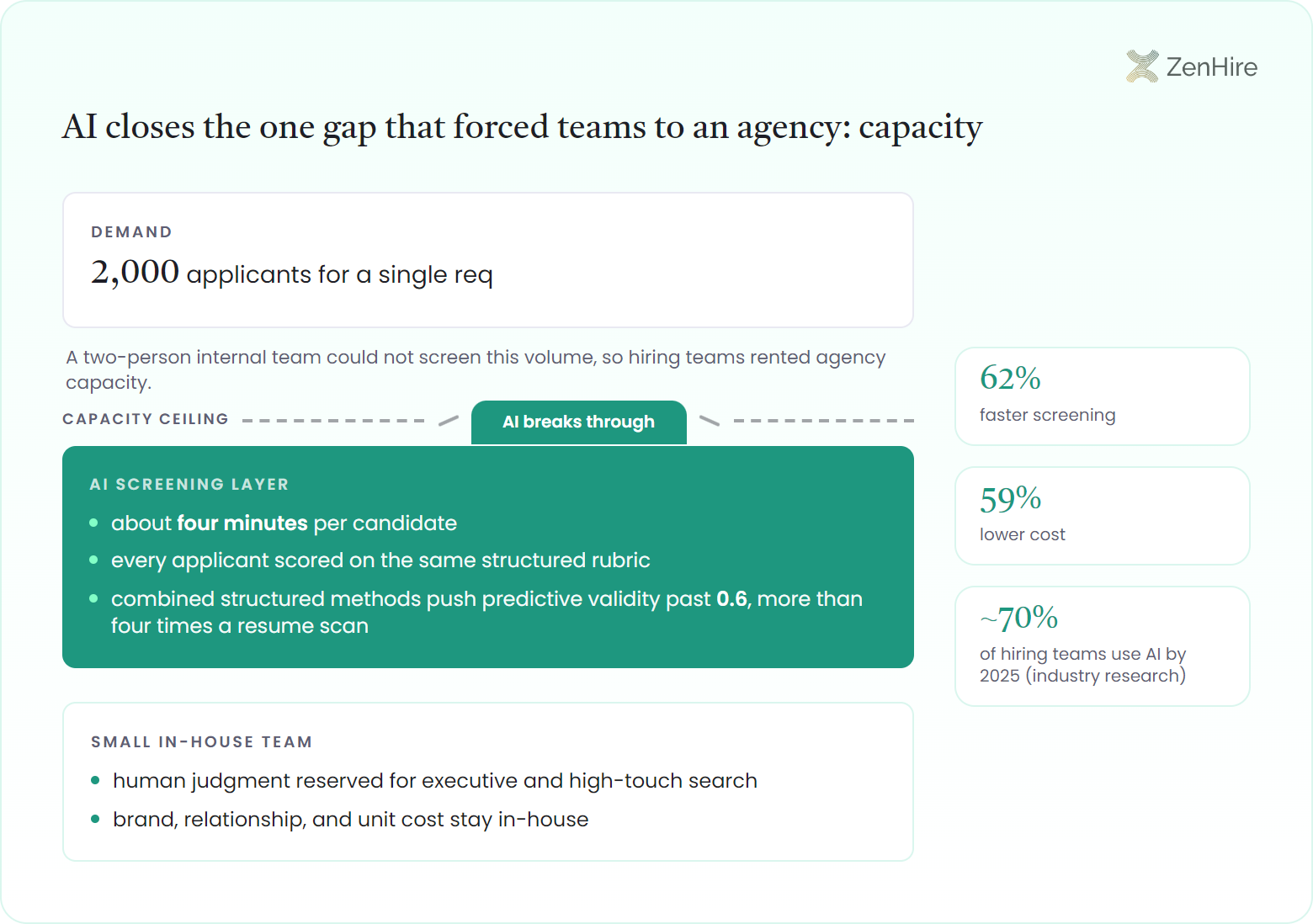
AI makes in-house recruiting more competitive by closing the one gap that historically forced teams to an agency: capacity. The classic reason to outsource was never that agencies judge talent better; it was that a two-person internal team could not screen two thousand applicants for a single req. AI removes that ceiling, letting a small in-house function evaluate at agency scale while keeping the brand, the relationship, and the unit cost in-house.
The mechanism is consistent, structured evaluation applied to everyone. ZenHire's AI interview software reads communication, soft skills, and reliability signals in about four minutes per candidate, holding every applicant to the same rubric so a strong hire is not buried because they applied the week your one recruiter was underwater. Because those structured, combined methods carry predictive validity past 0.6, more than four times a resume scan, the in-house team does not merely match an agency's throughput, it out-screens the unstructured phone call most agencies still lean on. Wire the output into a structured interview loop and each new req inherits a sharper, more consistent bar than the last.
The insourcing shift is already visible in the numbers: roughly 70% of hiring teams use AI by 2025, reporting about 62% faster screening and 59% lower cost, which is precisely the throughput advantage that used to sit only on the agency side of the ledger. The edge case to respect is rare, high-touch search: a single executive hire still rewards human network and discretion more than automated screening, so the smart in-house model is AI for the repeatable volume and human judgment reserved for the searches that genuinely need it. For everything in between, the build-versus-rent calculus that once pointed at an agency now points back home; the same logic governs in-house talent acquisition vs RPO.
ZenHire's screening is built to be defensible, not just fast: 97% CV-extraction accuracy, 93%+ alignment with human evaluators on job-match ranking, 90-96% agreement with PhD linguists on language assessment, and 91% fraud detection for AI-generated or proxy answers, all glass-box and explainable, SOC 2 and GDPR compliant. That is the agency-scale capacity an in-house team needs, with an audit trail an agency placement rarely gives you.
- Volume without headcount: screen thousands of applicants without renting an agency's recruiters
- Consistency across every candidate: the same structured rubric, not a different bar on a busy day
- Owned data and audit trail: explainable scorecards that stay inside your team, not a vendor's
- Human judgment where it counts: reserve recruiters for executive and high-touch search
I am building an AI recruiter, so people assume I think every team should pull all hiring in-house tomorrow. I do not. Agencies earned their place by solving a real problem: capacity you could not staff for. But that was a capacity problem dressed up as a judgment problem, and the two have quietly separated. The moment a small in-house team can screen two thousand applicants as consistently as a forty-person agency, the only honest reason left to outsource is a network you genuinely lack: an executive search, or a market you have never hired in. For everything repeatable, keep it in-house. Own the brand, own the relationship, own the data. Rent capacity for the spikes, and stop renting it for the work you do every week.
Frequently asked questions
Should you hire in-house or use an agency?+
You should hire in-house when your hiring is repeatable and use an agency when it is not. Steady, same-profile volume favors an internal team whose fixed cost amortizes across every hire; one-off campaigns, rare specialisms, and executive searches favor an agency, because you would otherwise pay to build a pipeline you will never reuse.
Is in-house recruiting cheaper than an agency?+
In-house recruiting is cheaper than an agency above a steady volume threshold, because an agency charges 15-25% of first-year salary on every placement while an internal team's cost is fixed and spreads across all hires. At very low or unpredictable volume the agency's pay-as-you-go model can win; the crossover usually arrives at modest volume once you run the numbers.
What is the difference between in-house talent acquisition and RPO?+
In-house talent acquisition vs RPO is a build-versus-rent decision for your whole recruiting function. In-house means you own and staff the function; RPO means a provider runs all or part of it under contract. You outsource to RPO when the capability or capacity gap is real and bring it back in-house once the work becomes predictable enough to staff and systematize yourself.
Can a small in-house team really compete with an agency on volume?+
A small in-house team can now match agency volume because AI removes the capacity ceiling. Structured AI screening evaluates thousands of applicants on a consistent rubric in minutes each, so the historical reason to outsource, throughput an internal team could not staff for, no longer holds for repeatable, high-volume hiring.
When is an agency still the better choice?+
An agency is still the better choice for rare searches and burst capacity: a single executive hire where network and discretion matter, or a sudden campaign to stand up hundreds of roles fast. In those cases you are paying for reach you lack rather than throughput, which AI does not replace.
Free for in-house vs agency recruiting
The in-house vs agency cost worksheet
A one-page worksheet to run your own numbers: agency fees at your volume versus a loaded in-house cost, plus the screening-capacity threshold where bringing hiring in-house starts to pay.