
How Is AI Used in Talent Acquisition?


· 8 min read
AI is used in [talent acquisition](/talent-acquisition) to automate the high-volume stages of hiring: sourcing, CV matching, first-round screening interviews, and scheduling, while recruiters keep the final decision. By 2025 roughly 70% of hiring teams had put AI somewhere in their funnel, and those that did report cutting time-to-hire by about 62% and cost by about 59%. What separates a good deployment from a risky one is the method underneath: a resume read on its own tracks job performance at only about r = 0.14, whereas the validated, structured methods AI can run at scale push past 0.6, and a tool like ZenHire pulls CV data at 97% accuracy while grading spoken English across CEFR A1-C2 to within 90-96% of PhD linguists.
Where is AI for talent acquisition used today?
AI for talent acquisition is used today at the high-volume, repetitive stages of the funnel, sourcing and CV matching, first-round screening interviews, and interview scheduling, where the same evaluation has to be applied hundreds or thousands of times. These are the stages where human consistency breaks down first: a strong candidate who applies on a busy Friday gets a different read than the same candidate on a quiet Monday.
In practice, a TA team feeds a role and a pile of applications into the system, and AI surfaces a ranked shortlist with the reasoning attached, runs a short async interview whose interview analysis scores communication and soft skills, and books the qualified candidates without a back-and-forth. The recruiter starts the day with a shortlist and evidence instead of an inbox. For teams running high-volume hiring, this is the difference between reviewing every CV and reviewing the right ten.
The edge case worth naming: AI is weakest where data is thinnest. For a one-of-a-kind executive search or a deeply niche technical role with five qualified people on earth, the volume that makes AI valuable simply is not there. That is human-led sourcing strategy territory, where AI assists at the margins rather than leading.
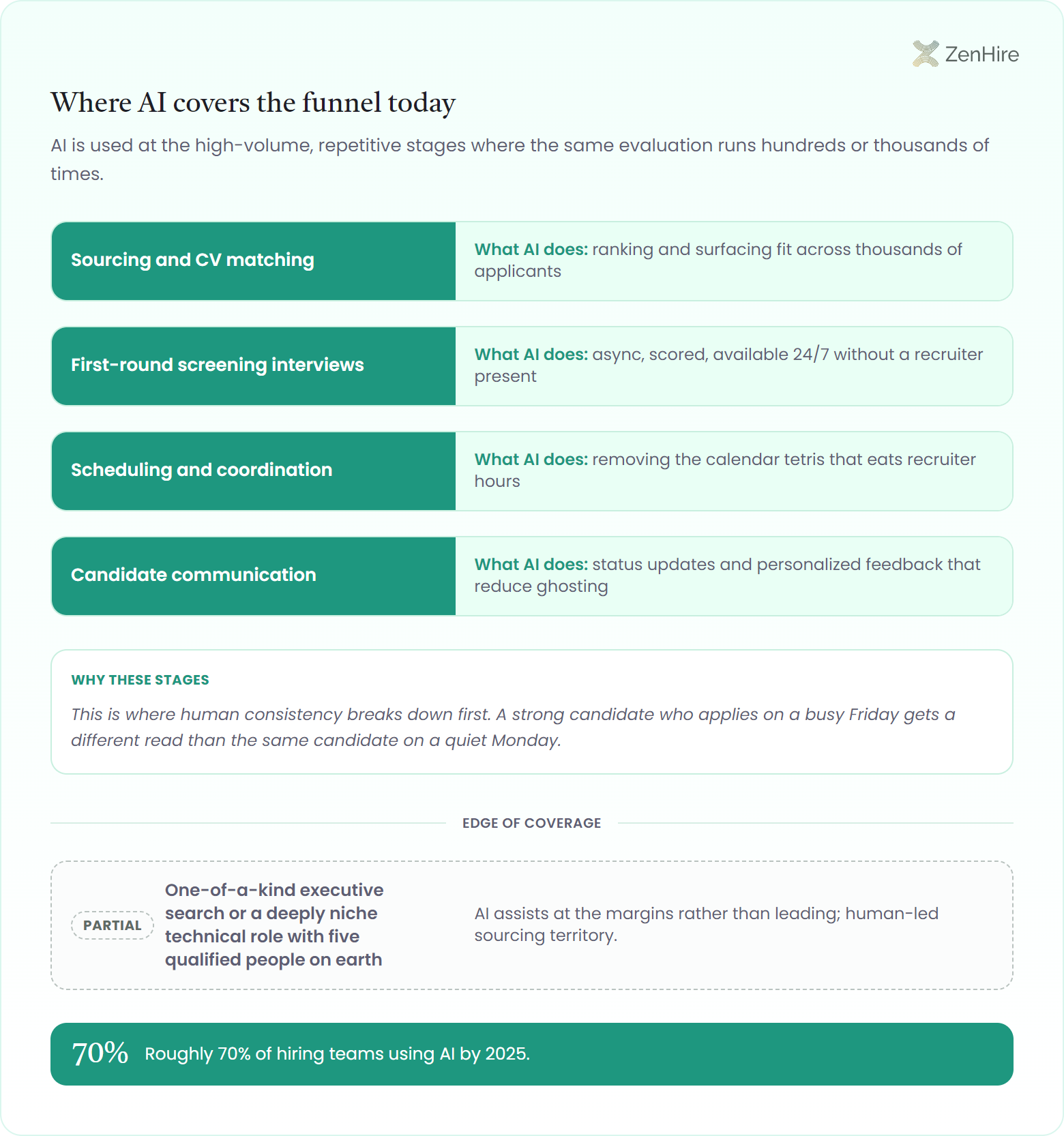
This is no longer early-adopter territory: industry research shows roughly 70% of hiring teams running AI in their process by 2025, and those teams report about 62% faster hiring and 59% lower cost. The recruitment-technology market behind it is projected to climb from about $450B in 2023 to roughly $870B by 2032 (around 7.5% CAGR), with AI doing most of the pulling.
- Sourcing and CV matching: ranking and surfacing fit across thousands of applicants
- First-round screening interviews: async, scored, available 24/7 without a recruiter present
- Scheduling and coordination: removing the calendar tetris that eats recruiter hours
- Candidate communication: status updates and personalized feedback that reduce ghosting
Which tasks can AI for talent acquisition automate?
AI for talent acquisition can automate the structured, repeatable tasks, CV parsing and matching, language and soft-skills assessment, first-round interviews, scoring, and scheduling, while leaving judgment-heavy decisions to recruiters. The reliable test is simple: if a task has a consistent rubric, AI can run it at scale; if it needs context, relationship, or a trade-off call, it stays human.
Take one stage as an example: ZenHire's AI interview software hands a candidate a structured interview of about four minutes, scores their communication and soft skills, reads CV data at 97% accuracy, and places spoken English on the CEFR A1-C2 scale to within 90-96% of what PhD linguists would give, all of it work that would otherwise eat a recruiter's week candidate by candidate. What comes back is a scorecard, not a verdict; a person still owns the offer. Layer structured interview design on top and every applicant meets the same bar.
The edge case: automation amplifies whatever you point it at. If your rubric is vague or biased, AI will apply that flaw consistently and at scale, which is worse than applying it occasionally. That is why the tasks AI handles best are the ones you can define crisply, and why fraud and gaming need a detection layer, which is where signals like 91% scripted-response detection earn their place.
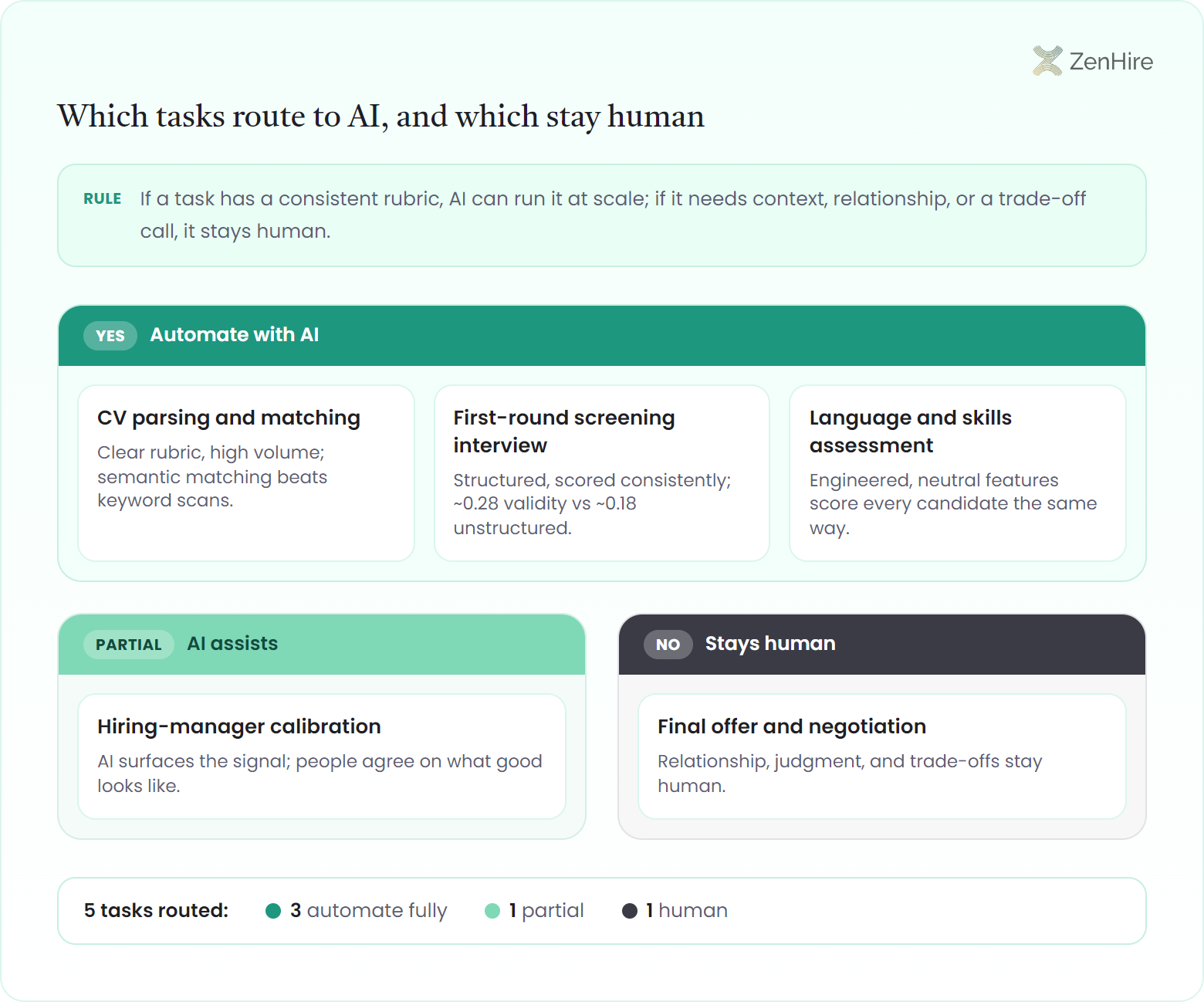
| Task | Automate with AI? | Why |
|---|---|---|
| CV parsing and matching | Yes | Clear rubric, high volume; semantic matching beats keyword scans |
| First-round screening interview | Yes | Scored to one rubric every time; structured interviews validate near 0.28 against roughly 0.18 for off-the-cuff ones |
| Language and skills assessment | Yes | Engineered, neutral features score every candidate the same way |
| Final offer and negotiation | No | Relationship, judgment, and trade-offs stay human |
| Hiring-manager calibration | Partial | AI surfaces the signal; people agree on what good looks like |
How do you adopt AI for talent acquisition responsibly?
You adopt AI for talent acquisition responsibly by keeping AI in a measurement role, demanding explainable scores, and running a human-in-the-loop on every consequential decision, never letting a model auto-reject without a person able to see and override why. Responsible adoption is a design choice you make before the first candidate, not a policy you bolt on after a complaint.
The mechanism that makes this work is a glass-box approach: every score traces to engineered, demographically neutral features rather than an opaque embedding, decisions are logged for audit, and the system runs under a SOC 2 and GDPR posture. A concrete adoption path is a small pilot: run 50 to 100 candidates through AI alongside your current process and watch where the rankings disagree. Disagreement is not failure; it is calibration. Build the habit early with bias-reduction practices and document who is accountable for the call.
The edge case to plan for: candidate trust. Some applicants distrust AI screening, and a thin, faceless flow makes drop-off worse, which is a candidate experience problem, not just a compliance one. The fix is transparency and feedback: tell candidates what is measured, give every applicant individualized feedback regardless of outcome, and keep a human review queue for edge cases. Speed that costs you fairness or brand is not a bargain.
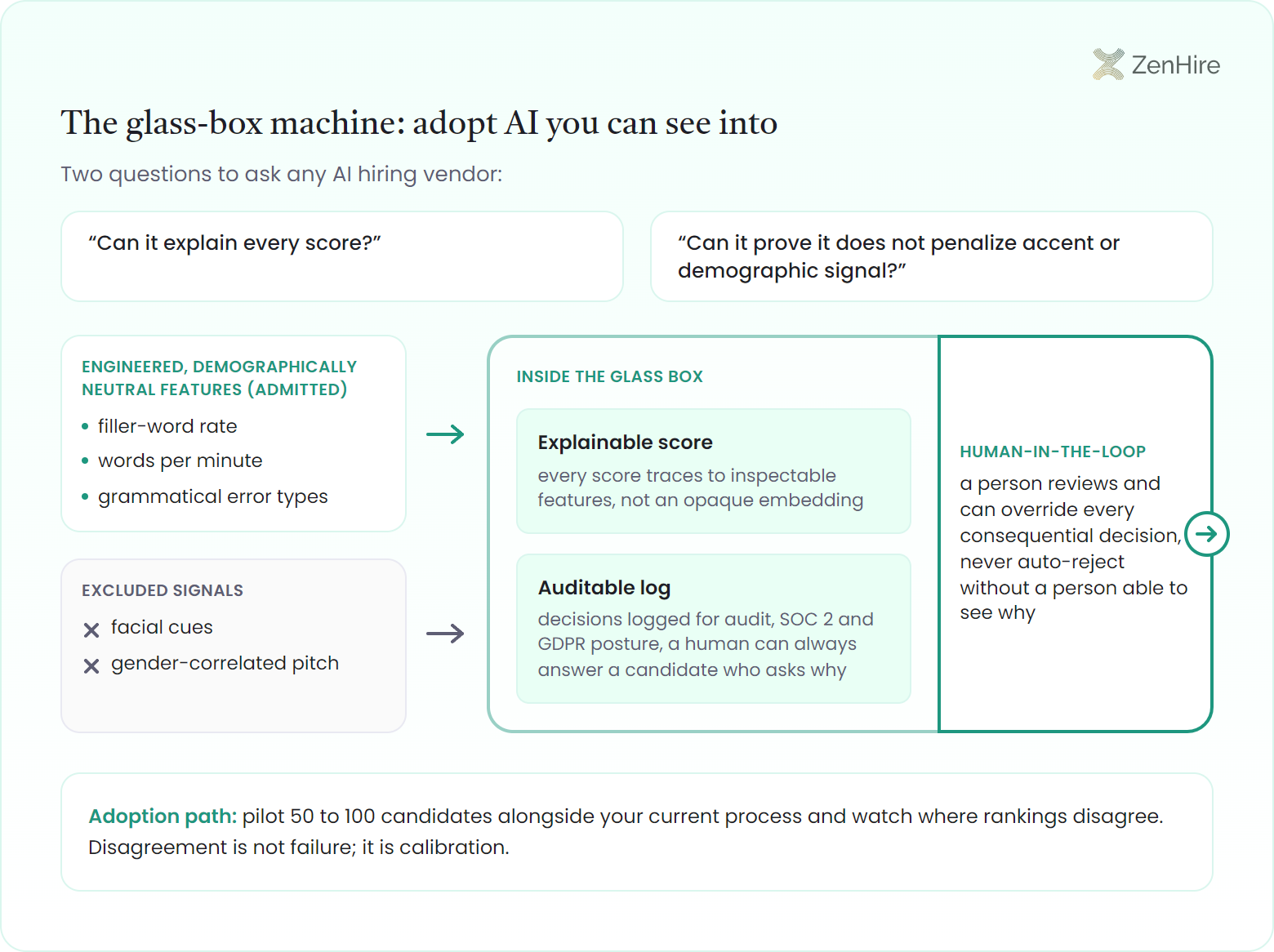
Two questions to ask any AI hiring vendor: can it explain every score, and can it prove it does not penalize accent or demographic signal? A defensible system uses neutral, engineered features (filler-word rate, words per minute, grammatical error types) and excludes facial cues and gender-correlated pitch, and it keeps an auditable log so a human can always answer a candidate who asks why.
I am building an AI recruiter, and the thing I want every in-house TA team to hear is this: AI should measure, not decide. The moment a model quietly auto-rejects someone with no person able to explain why, you have not bought efficiency; you have bought risk you cannot see. My rule is boring on purpose. AI carries the repetitive weight, holds one consistent bar across every candidate, and shows its work; a recruiter still owns the offer and stays accountable for the mistakes. Done that way, the recruiters I talk to do not lose their jobs to AI; they get them back, trading resume triage for the conversations and judgment that were the reason they got into this work.
Frequently asked questions
What is AI for talent acquisition?+
AI for talent acquisition is the use of machine learning to automate the repetitive parts of hiring, sourcing, CV matching, first-round interviews, scoring, and scheduling, so in-house TA teams apply one consistent bar at scale and reserve their judgment for the decisions that matter. The best implementations have AI measure and recruiters decide.
Will AI replace recruiters in talent acquisition?+
AI will not replace recruiters; it replaces the repetitive screening that buries them. Recruiters move from resume triage to higher-value work: candidate relationships, hiring-manager calibration, employer brand, and the judgment calls AI cannot make. The model that works is AI as the evaluation layer with a human accountable for the offer.
Are AI talent acquisition tools biased?+
The real risk is opacity, not AI itself: undocumented human screening often hides more bias than a transparent, audited system. Defensible AI tools exclude demographic and accent signals, score on neutral engineered features, explain every result, and keep auditable logs, which can reduce legal exposure compared with informal manual decisions.
How do you measure ROI from AI in talent acquisition?+
You measure ROI from AI in talent acquisition with time-to-hire, [cost-per-hire](/metrics/cost-per-hire), recruiter hours saved, and quality of hire. The headline numbers adopters cite, roughly 62% faster hiring and 59% lower cost, are the easy wins; the one that actually compounds is whether the people your AI-screened funnel sends through go on to perform and stay. Track quality of hire against your old process, not just the clock.
How accurate is AI candidate screening?+
On structured tasks AI candidate screening holds a steadier line than most human reviewers: think 97% CV extraction accuracy, 93%+ agreement with human evaluators on matching, and spoken-English grading that lands within 90-96% of PhD linguists where untrained recruiters manage 68-75%. The catch is the rubric: give it fuzzy criteria and it will be reliably, uniformly wrong.
Free for ai for talent acquisition
The AI-in-TA adoption checklist
A one-page checklist for adding AI to your talent acquisition stack without losing fairness: which tasks to automate first, the vendor questions to ask, and the human-in-the-loop guardrails to set before your first candidate.