
Talent Acquisition Software for In-House Teams


· 8 min read
Talent acquisition software is the platform an in-house team uses to source, evaluate, and hire candidates in one system, and the version worth buying scores candidates instead of just tracking them. For an in-house function, the buying decision comes down to what the platform does after it collects an application: by 2025 roughly 70% of hiring teams run AI-driven tools, and those adopters report about 62% faster hiring at around 59% lower cost (industry research). That gap is earned in the evaluation layer, where ZenHire extracts CV data at 97% accuracy and matches candidates to a role in 93%+ agreement with blind human reviewers, and where combining structured methods lifts performance prediction past 0.6 against the roughly 0.18 an unstructured interview manages on its own.
What should talent acquisition software do for an in-house team?
Talent acquisition software should do three things for an in-house team: organize the pipeline, evaluate candidates consistently, and surface evidence you can defend, not just store resumes and move cards across a board. The dividing line in the category is intelligence: legacy systems track and route applicants, while a modern talent acquisition platform adds a scoring layer that tells you who can actually do the job, not just who applied.
For an in-house team, that distinction is the whole point. You are not an agency forwarding resumes; you own the hire and you live with the mis-hire. So the software has to carry the parts that do not scale on human attention, such as reading every application, scoring spoken communication, and flagging integrity issues, and hand the recruiter a ranked, documented shortlist instead of a 2,000-row inbox. The recruiter then spends their time on judgment, relationships, and closing, which is where a person beats a model.
A useful test when you evaluate tools is whether the system can explain its scores. A glass-box, explainable platform produces an auditable scorecard for each candidate; a black-box ranker gives you a number you cannot defend to a hiring manager or a regulator. For in-house teams building durable talent pipelines, explainability is what turns a one-time shortlist into a reusable, trustable record.
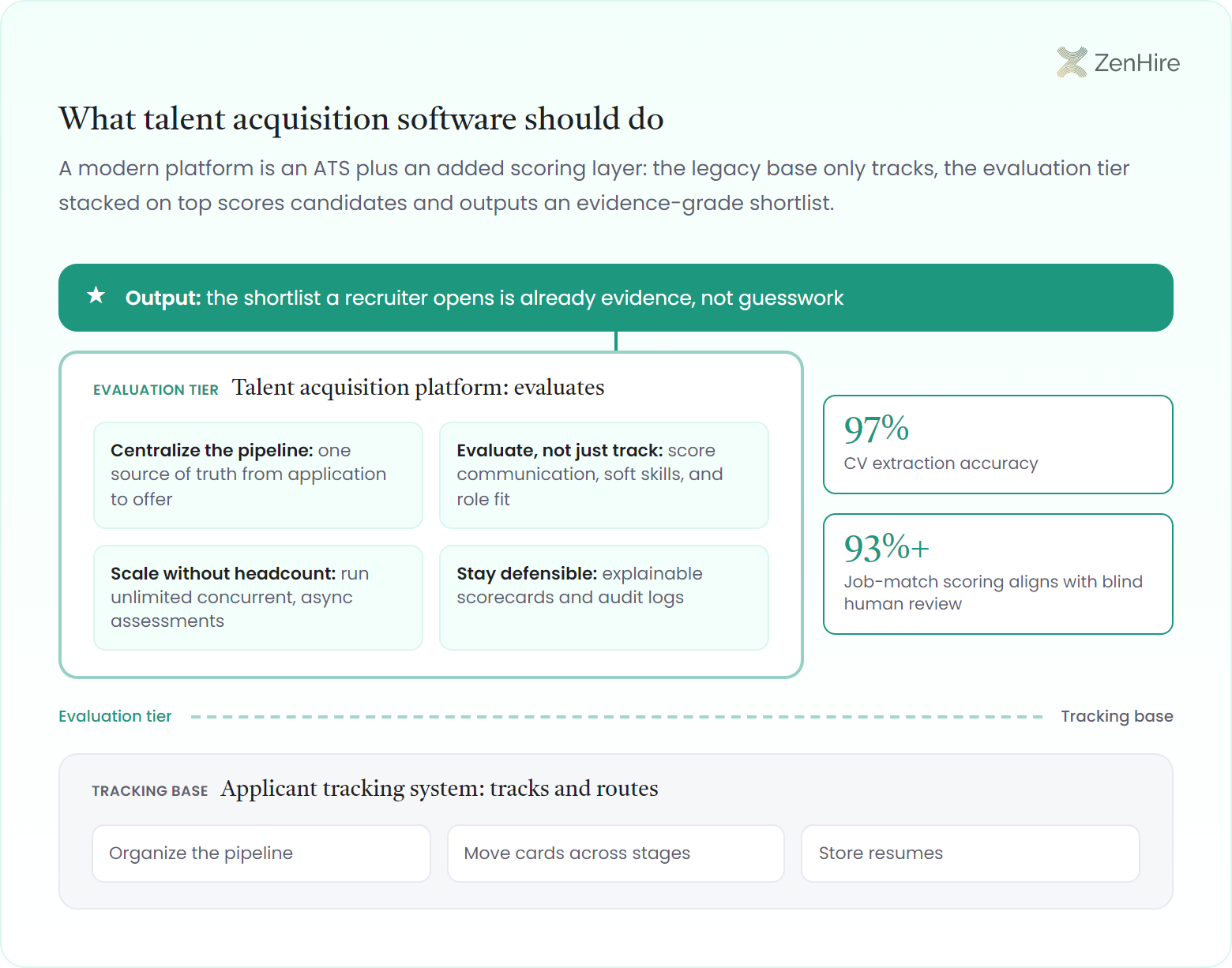
The category splits cleanly: a traditional applicant tracking system tracks and routes candidates, while a modern talent acquisition platform evaluates them, scoring communication, soft skills, and fit with an auditable scorecard. ZenHire's CV extraction runs at 97% accuracy and its job-match scoring aligns 93%+ with blind human review, so the shortlist a recruiter opens is already evidence, not guesswork.
- Centralize the pipeline: one source of truth from application to offer, not five disconnected tools
- Evaluate, not just track: score communication, soft skills, and role fit, not keyword counts
- Scale without headcount: run unlimited concurrent, async assessments so volume does not break the process
- Stay defensible: explainable scorecards and audit logs you can show a hiring manager or an auditor
How does talent acquisition software speed sourcing to offer?
Talent acquisition software speeds sourcing to offer by collapsing the slow, manual stages (resume review, first-round screening, and scheduling) into automated steps that run 24/7 and in parallel. The bottleneck in most in-house funnels is not finding people; it is the human hours it takes to read, screen, and coordinate them. Software removes the wait states between stages, which is where most of the calendar time hides.
Concretely: instead of a recruiter reading 2,000 applications over days, CV matching ranks them in minutes; instead of booking a week of phone screens, candidates take a short async AI interview on their own time; instead of debating who advances, the team reviews a scored shortlist. A ZenHire async interview takes a candidate about four minutes and returns a consistent read on communication, soft skills, and CEFR-aligned spoken English, so an in-house team fielding a global pipeline scores the 9am applicant and the midnight one against the exact same bar. The same engine feeds a cleaner recruitment funnel because every stage hands off structured data, not loose notes.
The edge case worth planning for is the high-volume spike, a seasonal campaign or a new account that needs hundreds of hires in 60 to 90 days. Manual screening simply cannot absorb that, and quality collapses under the pressure to fill seats. Because async assessment scales without adding recruiters, the spike becomes a throughput problem the software handles rather than a quality crisis the team eats. That is also why faster sourcing should never mean a looser screen.
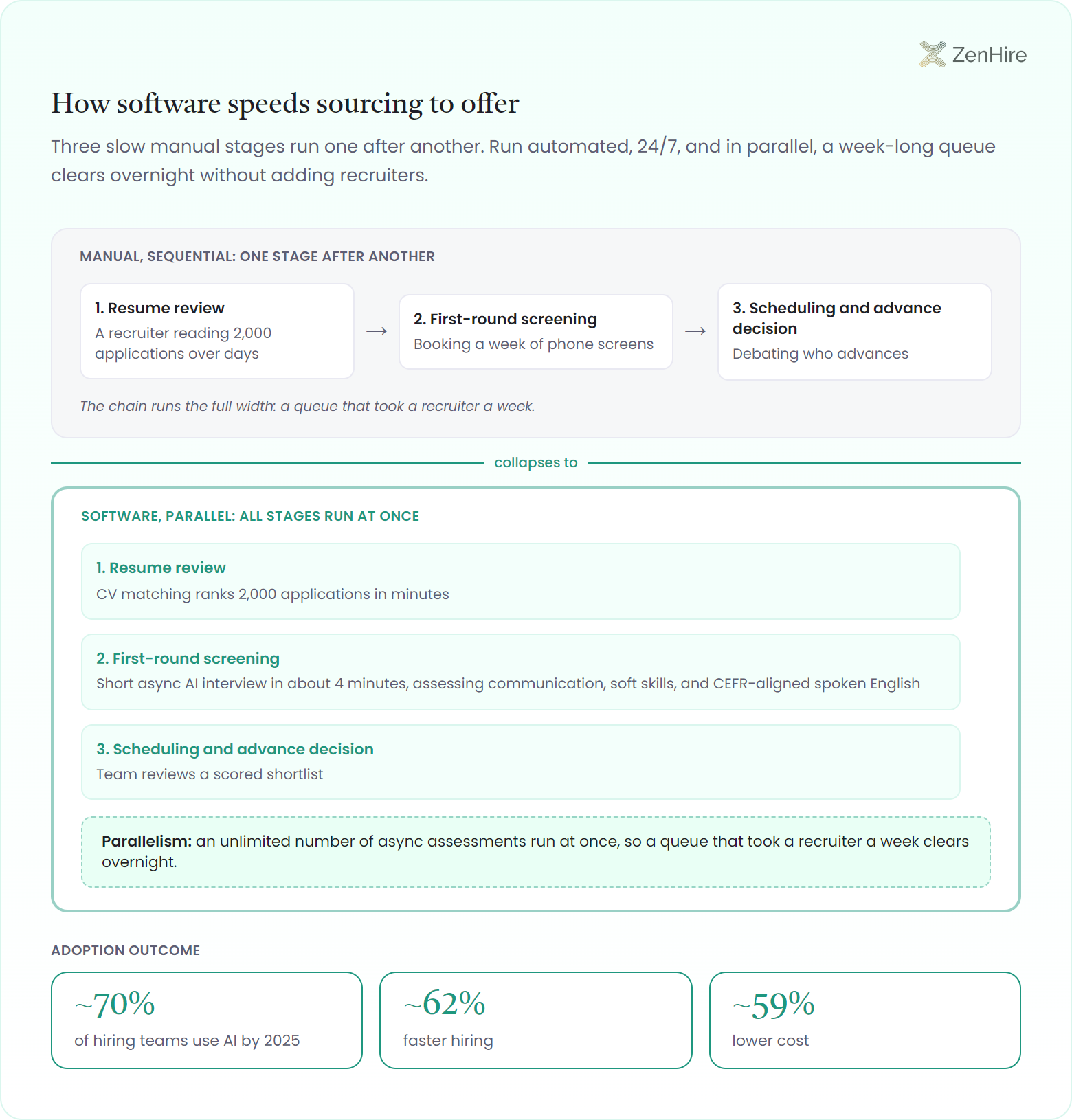
The adoption numbers follow the speed: industry research puts around 70% of hiring teams on AI by 2025, with those adopters reporting roughly 62% faster hiring at about 59% lower cost. For an in-house team the mechanism is parallelism, not shortcuts: async assessments run with no cap on concurrency, so a screening queue that used to eat a recruiter's week clears overnight while the team sleeps.
Can talent acquisition software prove ROI to leadership?
Yes, talent acquisition software can prove ROI to leadership by tying its use to three measurable outcomes: lower cost-per-hire, shorter time-to-hire, and higher quality-of-hire. ROI for a TA platform is not a vibe; it is a before-and-after on numbers the CFO already respects. The trick is to instrument the funnel so the change the software made is visible and attributable, not buried in a headline rate.
Start with the levers leadership funds. Recruiter time saved is the clearest: hours per week reclaimed from manual screening, multiplied by loaded hourly cost. Time-to-hire reduction reads as revenue, because an unfilled seat is a revenue leak, not just an empty desk, and fewer weeks open against revenue-per-employee is real money. And quality-of-hire, tracked as 90-day retention and ramp speed, closes the loop by showing the faster process did not buy worse hires. Pair these with cost-per-hire and you have the full board-ready story.
The quality number only holds up if the method behind it does, and this is where the evidence lands hardest with a skeptical CFO. Screening on a resume alone predicts on-the-job performance at about r = 0.14, and an unstructured interview barely improves on that at ~0.18; move to a structured interview and you reach 0.28, then layer cognitive and skills assessments on top and the signal climbs past 0.6. The edge case worth naming for leadership is the low-volume hire, where ROI per hire is actually highest, because a single senior mis-hire that SHRM prices at 50-200% of salary swamps whatever the assessments cost. To present this cleanly, track the leading and lagging metrics together so a single screening change shows up before the annual numbers move.
| ROI lever | What you measure | Why leadership cares |
|---|---|---|
| Recruiter time saved | Hours/week reclaimed from manual screening x loaded cost | Direct cost removed from the TA budget |
| Time-to-hire reduction | Weeks a seat stays open vs. revenue per employee | An open seat is a revenue leak, not just a cost |
| Quality-of-hire | 90-day retention and ramp speed of new hires | Proves speed did not buy worse hires |
| Avoided mis-hire | Replacements avoided x 50-200% of salary (SHRM) | One bad senior hire can erase a year of savings |
Hiring ROI calculator
What automation is worth to your team
Estimate the recruiter hours and cost you reclaim by automating the manual steps of screening, using your own volume and rates.
Your result
Automating manual screening, scheduling, and assessment reclaims about 233 recruiter hours a month, roughly $210k a year, without adding headcount or lowering the bar. ZenHire runs that first-pass screen, so your team spends its hours on the shortlist, not the pile.
How the ROI is estimated+
- 1.Monthly hours saved = (positions x setup minutes + positions x applicants x per-applicant manual minutes) / 60.
- 2.Per-applicant manual minutes default to the homepage model: CV screen 5, phone 15, scheduling 15, assessment 4, feedback 5, all overridable.
- 3.Annual cost savings = hours saved x 12 x your loaded hourly rate, plus an efficiency share of any recruiting spend.
- 4.Time-to-hire reduction is illustrative: it reflects how much of your per-applicant time sits in the stages automation compresses most.
Most in-house teams I meet are not short on tools; they are short on evidence. They have an ATS that tells them where a candidate is in the pipeline but nothing about whether that candidate can do the job. I am building an AI recruiter for exactly that gap: software that does the reading and the first-round evaluation so your recruiters spend their hours on the human work a model will never do well. The goal is not to replace your team. It is to make a team of three screen like a team of thirty, without ever lowering the bar they are proud of.
Frequently asked questions
What is the difference between talent acquisition software and an ATS?+
The difference is evaluation: an ATS tracks and routes candidates, while talent acquisition software also scores them. A traditional applicant tracking system tells you where a candidate sits in the pipeline; a modern platform tells you whether they can do the job, with an explainable scorecard you can defend to a hiring manager.
Do in-house teams need talent acquisition software or can they use agencies?+
In-house teams use talent acquisition software to own their hiring instead of renting it. Agencies charge 15-25% of first-year salary per placement; software is a fixed cost that builds a reusable pipeline and an evidence trail your team controls. See the trade-offs in in-house vs agency.
How does talent acquisition software speed up hiring?+
Talent acquisition software speeds up hiring by automating the slow stages (resume review, first-round screening, and scheduling) and running them in parallel, 24/7. The roughly 62% faster hiring adopters report in industry research comes from deleting the wait states between funnel stages, not from rushing the decision at the end.
Can talent acquisition software reduce bias?+
Talent acquisition software can reduce bias when it is explainable and structured, because the real risk is opacity, not AI itself. A platform that excludes demographic factors, scores every candidate on the same rubric, and keeps an audit log can lower legal exposure compared with undocumented manual screening. More on the approach in reduce bias.
How do you prove the ROI of talent acquisition software to a CFO?+
You prove ROI with three before-and-after numbers: cost-per-hire, time-to-hire, and quality-of-hire. Recruiter hours saved are a direct cost cut, shorter time-to-hire reads as recovered revenue per open seat, and 90-day retention confirms the faster process did not buy worse hires.
Free for talent acquisition software
The in-house TA software buyer's checklist
A one-page checklist for evaluating talent acquisition software: the must-have evaluation features, the ROI levers to instrument before you buy, and the explainability questions to ask every vendor.