
What Is Candidate Relationship Management (CRM)?


· 8 min read
Candidate relationship management (CRM) is the systematic practice of building, tracking, and nurturing relationships with potential candidates before a role opens, keeping prospects, past applicants, and silver-medalists warm across every future requisition. Unlike an ATS, which tracks active applicants through one open req, a CRM nurtures people who have not applied yet, so searches launch from a warm shortlist, not a cold market. With the recruitment market growing from roughly $450B in 2023 toward $870B by 2032 (about a 7.5% CAGR), a nurtured pool compresses time-to-hire without outbidding rivals on job-board budget.
What is candidate relationship management?
Candidate relationship management is the systematic practice of building and maintaining relationships with potential candidates over time, independent of any single open role. Where applicant tracking starts when someone applies and ends when the req closes, candidate relationship management runs underneath all of that: a long-horizon layer that keeps prospects, prior applicants, referrals, and event contacts engaged so they are warm and reachable when the right opening appears.
The mechanism is simple: you capture a candidate once, enrich what you know about them, segment them by skill and intent, and then send relevant, low-pressure touchpoints (content, role updates, a personal check-in) at a cadence that keeps you top of mind without burning goodwill. Over months, that turns a flat list of names into a living, ranked pool. This is the connective tissue between talent acquisition as a whole and a deliberately built talent pipeline you can actually draw from.
A concrete example: a fintech TA team interviews five strong engineers for one staff role, hires one, and politely closes the other four. Without CRM, those four vanish into the void and get re-sourced from scratch six months later. With CRM, they are tagged as silver-medalists, sent the occasional product or engineering-culture update, and called first when the next backend role opens: a hire that closes in days, not weeks. The edge case worth naming: CRM without consent or relevance becomes spam. Nurturing a passive candidate who never opted in, or pinging someone monthly with nothing useful to say, damages your employer brand faster than no contact at all.
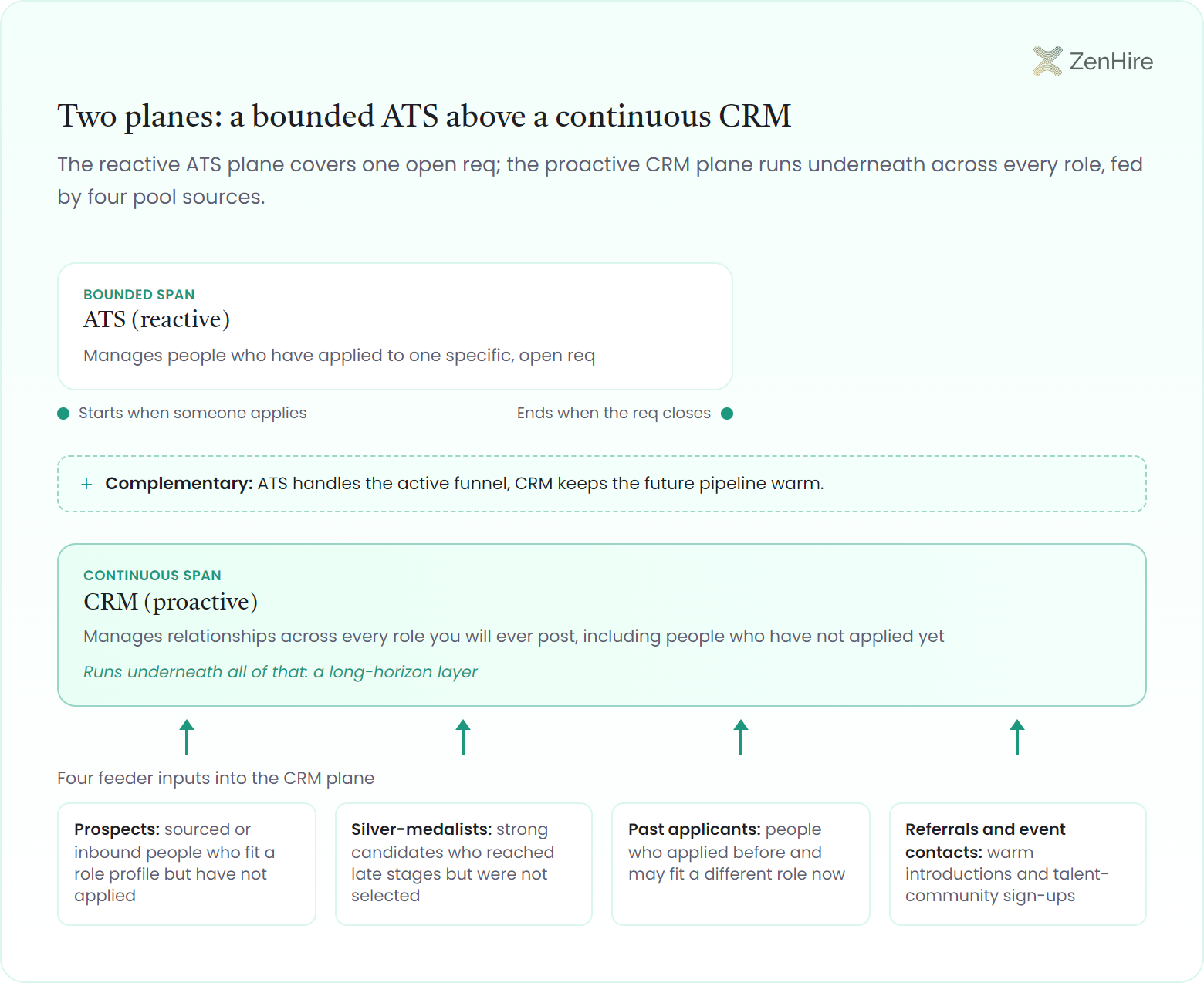
CRM and an ATS solve different problems. An ATS is reactive: it manages people who have applied to a specific, open req. A CRM is proactive: it manages relationships with people who may never have applied yet, across every role you will ever post. The two are complementary: a modern ATS handles the active funnel while the CRM keeps the future pipeline warm.
- Prospects: sourced or inbound people who fit a role profile but have not applied
- Silver-medalists: strong candidates who reached late stages but were not selected
- Past applicants: people who applied before and may fit a different role now
- Referrals and event contacts: warm introductions and talent-community sign-ups
How does candidate relationship management warm a pipeline?
Candidate relationship management warms a pipeline by doing the slowest, most expensive recruiting work, finding people and earning their interest, before the requisition is even approved. When a role opens against a cold market, you start at zero: write the post, wait for applicants, source, and persuade. When a role opens against a nurtured pool, you start at the shortlist, because the discovery and trust-building already happened.
The mechanism is front-loading. Sourcing, screening signals, and relationship-building are decoupled from the urgency of an open seat, so the work happens calmly in advance rather than under a fire-drill deadline. That is also where structured, consistent evaluation pays off: if you have already captured a validated signal on a prospect, whether communication, soft skills, or role fit, re-activating them does not mean re-screening them from scratch. Pairing a warm CRM pool with the right sourcing strategy is what separates a list of names from a pipeline that actually shortens time-to-hire.
A concrete example: a BPO standing up a 200-seat campaign in 60 days cannot afford to source cold. A nurtured talent community of pre-engaged, pre-assessed customer-service candidates means the campaign launches against a warm pool, and the bottleneck shifts from finding people to onboarding them. The edge case: a warm pipeline is only as good as its data freshness. Contact details rot, people change jobs, and an un-nurtured pool quietly decays, so a CRM that is captured but never tended is barely better than no CRM at all.
Re-engaging a known, nurtured candidate skips the costliest stage of hiring: persuasion. Industry research shows the recruitment market growing from roughly $450B in 2023 toward $870B by 2032 (about a 7.5% CAGR), and warm-pipeline strategies are how lean in-house teams compete for attention against that rising spend without simply outbidding everyone on job-board budget.
Which candidate relationship management tactics work best?
The candidate relationship management tactics that work best are tight segmentation, value-led touchpoints on a deliberate cadence, and disciplined re-engagement of silver-medalists, in that order. A generic newsletter blasted to your whole database is the tactic that feels productive and converts almost no one; relevance is the entire game.
The mechanism behind each: segmentation ensures a message reaches only the people it fits, so a senior data engineer never gets an entry-level retail blurb. Value-led touchpoints, whether useful content, honest role updates, or a genuine personal note, keep you welcome in the inbox rather than filtered to spam. And re-engaging silver-medalists is the single highest-yield move in recruiting, because you are restarting a relationship with someone you have already vetted. Where signal is needed, a structured, AI-assisted read on communication and soft skills, like ZenHire's AI interview software, lets you pre-qualify pool members consistently so re-activation surfaces the right people first, not just the most recently added.
A concrete example: instead of one monthly mass email, a team tags its pool by role family and seniority, sends each segment two relevant updates a quarter, and flags every silver-medalist for a personal outreach the day a matching role opens. The edge case to guard against: over-automation. Automation scales the cadence, but if every touch is obviously a template with a merge field, candidates disengage, and the same explainable, bias-mitigated evaluation you apply to active applicants should govern who gets prioritized in the pool, so re-engagement stays fair rather than just convenient.
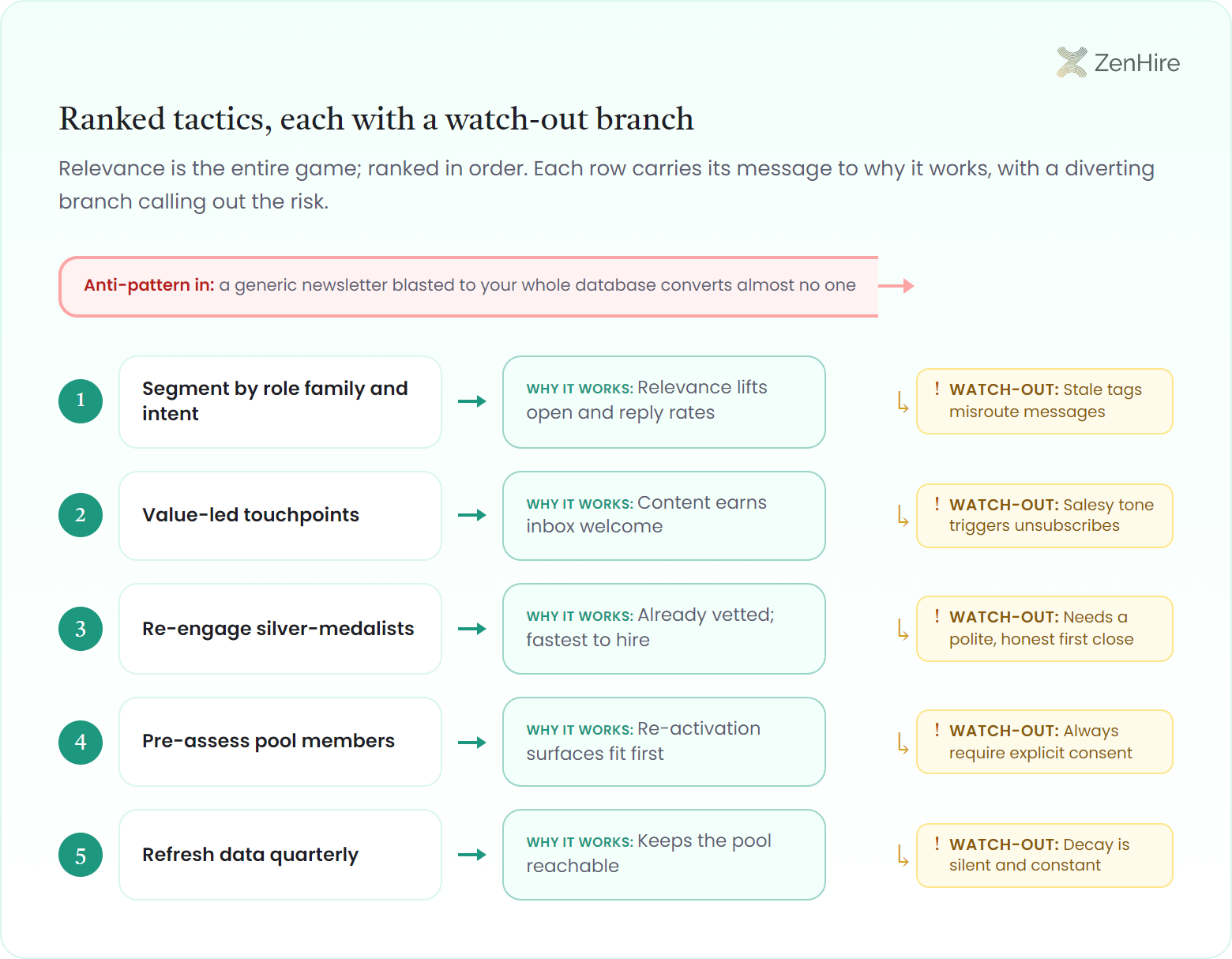
| Tactic | Why it works | Watch-out |
|---|---|---|
| Segment by role family and intent | Relevance lifts open and reply rates | Stale tags misroute messages |
| Value-led touchpoints | Content earns inbox welcome | Salesy tone triggers unsubscribes |
| Re-engage silver-medalists | Already vetted; fastest to hire | Needs a polite, honest first close |
| Pre-assess pool members | Re-activation surfaces fit first | Always require explicit consent |
| Refresh data quarterly | Keeps the pool reachable | Decay is silent and constant |
I am building an AI recruiter, and the lesson that keeps repeating is that candidate relationship management is mostly a memory problem, not a messaging problem. Most in-house teams already met the right person months ago; they just had no system to remember the signal, so they re-source and re-screen the same talent again and again. The job of AI here is not to send more emails; it is to hold an honest, structured read on every candidate you have ever evaluated, so the day a role opens you can ask one question, who have we already met that fits, and trust the answer. Get that right and a CRM stops being a database and starts being institutional memory.
Frequently asked questions
What is the difference between a candidate CRM and an ATS?+
A candidate CRM is proactive and an ATS is reactive. A CRM nurtures relationships with future candidates across every role you will post, including people who have not applied yet, while an ATS tracks active applicants through one open requisition. They are complementary layers, not substitutes.
What is CRM in recruiting?+
CRM in recruiting means candidate relationship management, the systematic nurturing of prospects, past applicants, and silver-medalists over time. It borrows the logic of sales CRM, but the goal is keeping talent warm and reachable rather than closing deals, so your next shortlist is half-built before the role opens.
Does candidate relationship management actually speed up hiring?+
Candidate relationship management speeds up hiring by front-loading the slowest stage, finding and persuading people, before the role opens. A nurtured pool means you launch a search from a warm shortlist instead of a cold market, which is the single biggest lever on time-to-hire for an in-house team.
What is the best candidate relationship management strategy?+
The best candidate relationship management strategy is relevance over volume: segment tightly, send value-led touchpoints on a deliberate cadence, and re-engage silver-medalists first. A generic newsletter to the whole database feels productive but converts almost no one, while a relevant, consent-based message to the right segment performs far better.
How do you keep a talent pool from going stale?+
You keep a talent pool fresh by tending it on a schedule: refreshing contact data quarterly, re-tagging by current intent, and retiring contacts who have disengaged. A recruiting database is a depreciating asset; skills, details, and interest decay silently, so an un-nurtured pool is barely better than no pool at all.
Free for candidate relationship management
The candidate-nurture starter kit
A practical kit for warming a pipeline without spamming it: how to segment your pool, a quarterly touchpoint cadence, and the silver-medalist re-engagement script that turns a near-miss into your next hire.