
Talent Acquisition vs Recruitment: What's the Difference?


· 8 min read
Talent acquisition vs recruitment differs by time horizon: recruitment reactively fills the open requisition in weeks, while talent acquisition proactively builds pipelines and employer brand for roles opening over quarters and years. Recruitment optimizes time-to-fill and cost-per-hire on one role; talent acquisition optimizes pipeline depth, quality-of-hire, and retention as the recruitment market grows from roughly $450B in 2023 to about $870B by 2032 (~7.5% CAGR). Agencies sell recruitment at a 15-25% placement fee of first-year salary, and neither model survives a weak screen: a candidate waved through on a gut-feel interview tracks job performance at only ~0.18, whereas structured, validated evaluation reaches 0.6+, so the pipeline you build is only worth the bar you hold it to.
How is talent acquisition vs recruitment different?
Talent acquisition vs recruitment is different in time horizon and intent: recruitment is the reactive act of filling a specific open role, while talent acquisition is the ongoing, strategic function of anticipating roles and building the relationships and pipeline to fill them before they open. Recruitment starts when a requisition is approved and ends when the offer is signed. Talent acquisition has no clean start or end; it is always sourcing, nurturing, and forecasting, so that when a requisition lands, the shortlist already half exists.
Mechanically, recruitment is a funnel and talent acquisition is a flywheel. The recruiter works a single funnel, applications in and hire out, and optimizes for speed and cost on that one role. The talent acquisition team works the talent pipeline and employer branding so that the next funnel starts warmer than the last. A concrete example: a contact center that needs 40 agents this month is recruiting; the same center building a standing pool of pre-screened, CEFR-rated candidates it can activate the day a new client campaign closes is doing talent acquisition.
The edge case that trips people up is the agency. When you hire an external recruiter or RPO partner, you are buying recruitment-as-a-service, fast and role-specific filling, not a talent acquisition function. The pipeline they build belongs to them, not you, which is exactly why the placement fee is what it is.
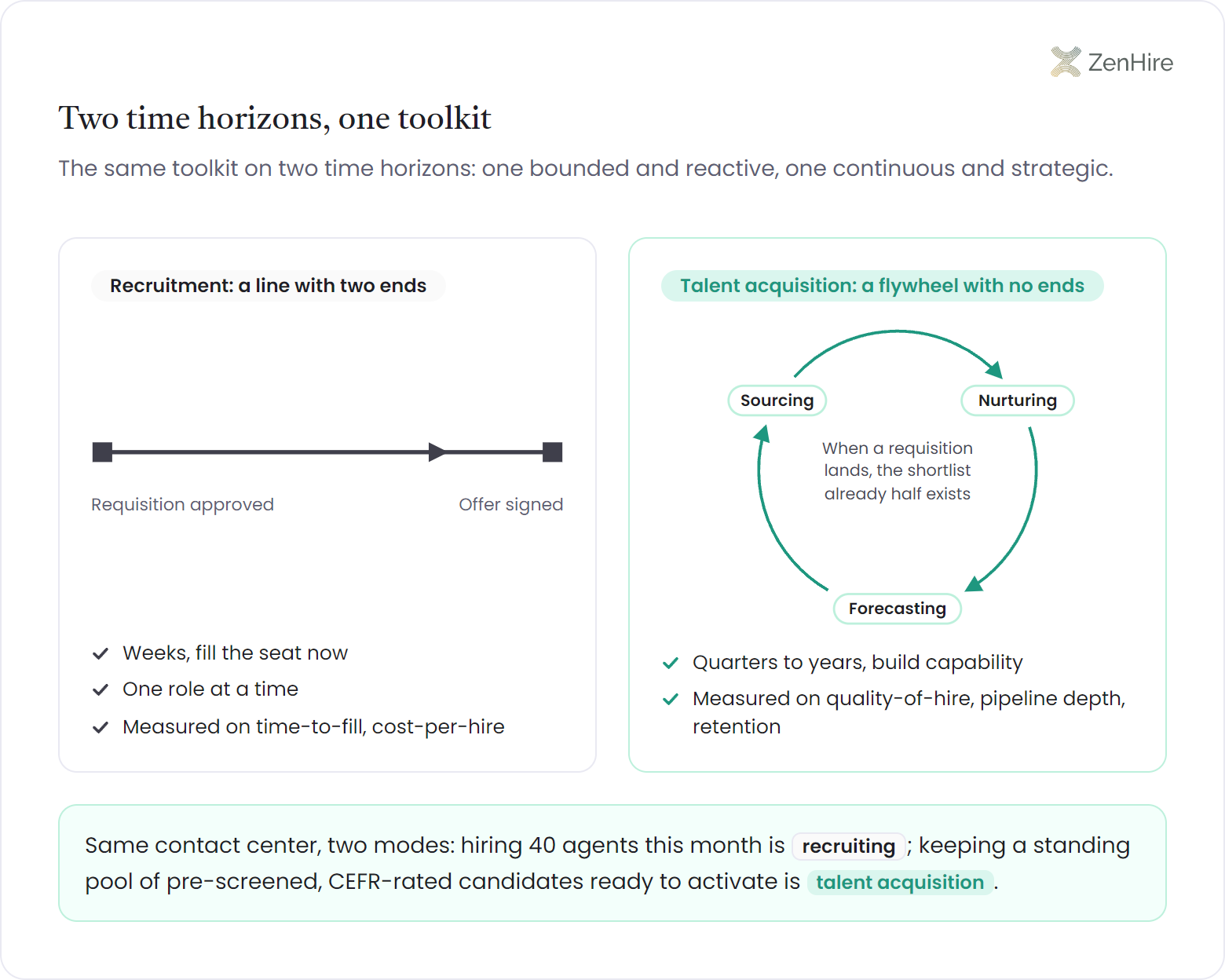
| Dimension | Recruitment | Talent acquisition |
|---|---|---|
| Trigger | An open requisition | A forecasted future need |
| Time horizon | Weeks, fill the seat now | Quarters to years, build capability |
| Unit of work | One role at a time | Pipelines, segments, and the employer brand |
| Success metric | Time-to-fill, cost-per-hire | Quality-of-hire, pipeline depth, retention |
When does talent acquisition vs recruitment matter for strategy?
Talent acquisition vs recruitment matters for strategy whenever the cost of a slow or wrong hire outweighs the cost of building a pipeline in advance. That is the line where a reactive fill stops being good enough. If a role is rare, business-critical, or hired in repeating waves, a standing pipeline pays back. If a role is abundant, interchangeable, and hired one-off, a clean recruitment funnel is the more economical answer.
The mechanism is a market-timing problem. The recruitment market itself is forecast to roughly double from about $450B in 2023 to around $870B by 2032 (a ~7.5% CAGR), which means competition for the same candidates keeps intensifying. A reactive team always shops in a tight market at the worst moment; a talent acquisition team has already met the candidate when the seat opens. The strategic lever is moving high-stakes roles from the first model to the second, and you can measure that shift directly in pipeline depth and time-to-fill.
A concrete example: seasonal and campaign hiring. A retailer that scrambles every November is doing reactive recruitment; one that keeps last year's strong-but-not-hired candidates warm and re-activates them is doing talent acquisition: same people, far lower cost and time-to-productivity. The edge case is the true one-off: a single executive replacement with no successor pattern is pure recruitment, and over-investing in a pipeline for it is wasted motion. Most in-house teams run both models at once, sorted by role.
Demand is not slowing down: the global recruitment market is projected to grow from roughly $450B (2023) to about $870B by 2032, a ~7.5% CAGR (industry estimates). When the market for talent tightens every year, the teams that pre-build pipelines stop competing on the day the seat opens, and that is the whole strategic case for talent acquisition over pure recruitment.
Which roles call for talent acquisition vs recruitment?
Roles call for talent acquisition vs recruitment based on scarcity, criticality, and repeatability: scarce, mission-critical, or wave-hired roles justify a pipeline, while abundant, interchangeable, one-off roles are better served by fast recruitment. The test is simple: if you will hire this profile again within a year, build talent acquisition for it; if you genuinely will not, recruit it and move on.
The mechanism is amortization. A pipeline only pays back when you draw from it more than once, so the math favors talent acquisition exactly where volume or recurrence is high. This is why high-volume hiring and BPO operations are natural talent acquisition territory despite being frontline: the roles are abundant but hired so continuously that a standing, pre-screened pool beats starting cold each cycle. A concrete example: a BPO running campaign hiring keeps a CEFR-rated, fraud-checked candidate pool ready, so a new account win turns into staffed seats in days, not the usual 45-60.
Whichever side a role falls on, the screen underneath is the same, and it is where both models leak. The edge case worth flagging is the niche specialist: low volume but extreme scarcity, which still justifies talent acquisition (long-horizon relationship building) even though it is hired rarely. Use a structured interview and validated assessments on both sides of the line so that whether you pull from a pipeline or a fresh funnel, the bar is identical.
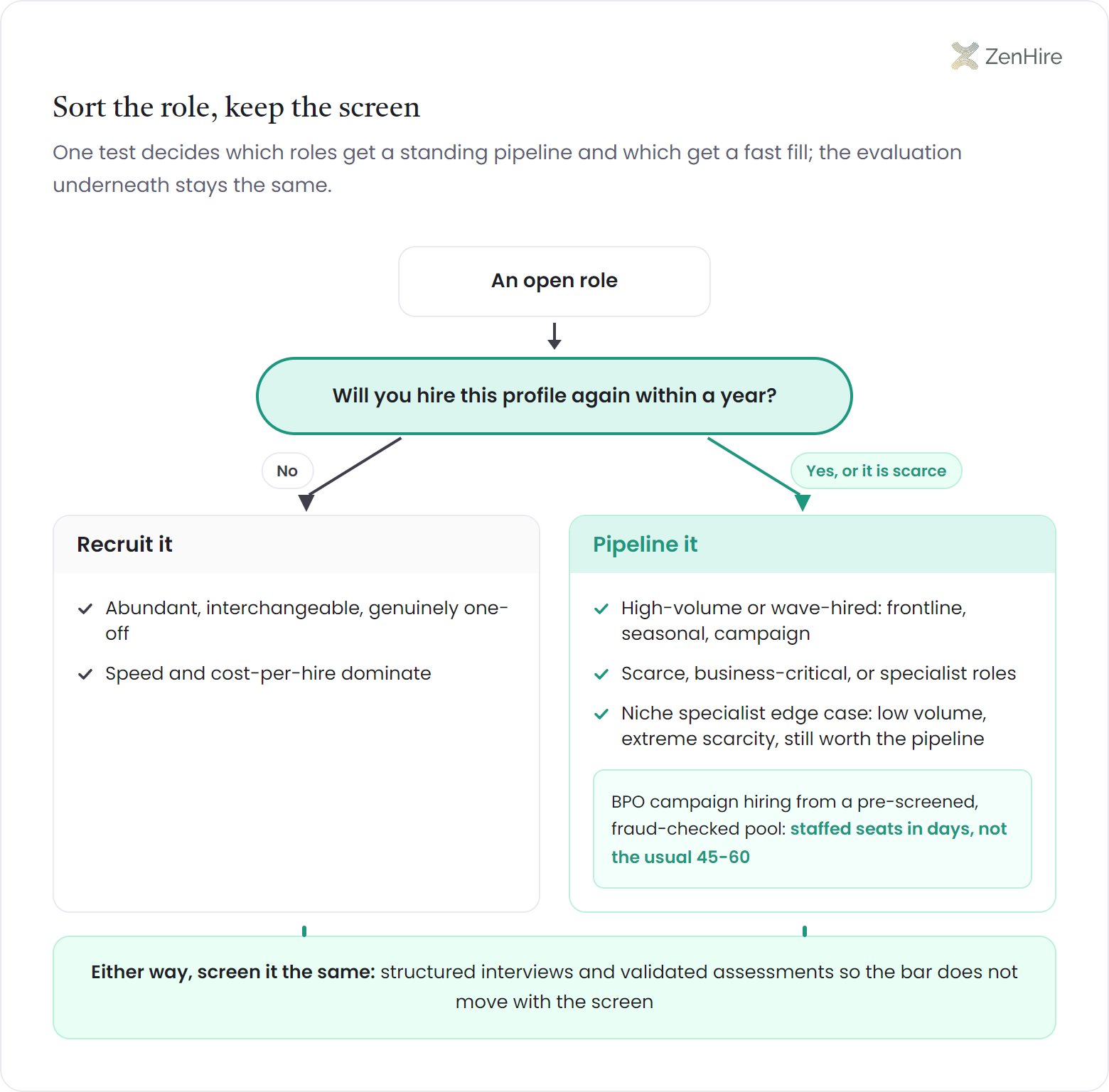
- Recruit it: abundant, interchangeable, genuinely one-off roles where speed and cost-per-hire dominate
- Pipeline it: high-volume or wave-hired roles (frontline, seasonal, campaign) where you draw repeatedly
- Pipeline it: scarce, business-critical, or specialist roles where a wrong or slow hire is expensive
- Either way, screen it the same: consistent, validated evaluation so the bar does not move with the model
In-house TA teams keep getting asked to be strategic while being measured on time-to-fill, two jobs that pull in opposite directions. I think the honest answer is that the distinction between recruitment and talent acquisition only holds if the evaluation underneath is the same on both sides. Building ZenHire, the thing I keep seeing is that teams pour energy into pipelines and employer branding, then screen the candidates they worked so hard to attract with a gut-feel phone call. A consistent, explainable screen is what lets you run both models without the quality drifting; your pipeline is only as strategic as the bar you hold it to.
Frequently asked questions
Is talent acquisition the same as recruitment?+
Talent acquisition is not the same as recruitment, though the terms are often used interchangeably. Recruitment is the reactive act of filling a specific open role, while talent acquisition is the ongoing, strategic function of building pipelines and employer brand for roles you will need later. Recruitment is a subset of activity that lives inside the broader talent acquisition function.
What is the main difference between talent acquisition and recruitment?+
The main difference between talent acquisition and recruitment is time horizon. Recruitment works one open requisition at a time and ends at the offer; talent acquisition is continuous, sourcing, nurturing, and forecasting so the shortlist exists before the seat opens. Recruitment optimizes for speed on a role; talent acquisition optimizes for capability over quarters.
Does a small company need talent acquisition or just recruitment?+
A small company can run pure recruitment and be perfectly well served: talent acquisition pays back when roles recur or are scarce, not by company size. If you hire the same profile repeatedly or compete for rare specialists, build a pipeline even at small scale; if every hire is genuinely one-off, a clean recruitment funnel is the more economical choice.
Do agencies do recruitment or talent acquisition?+
Agencies and RPO providers deliver recruitment-as-a-service, not your talent acquisition function. You are buying fast, role-specific filling, at a placement fee commonly 15-25% of first-year salary, and the pipeline they build belongs to them. Talent acquisition is a standing in-house capability you own, not a per-role service you rent.
Does the difference change how I screen candidates?+
The difference should not change how you screen, only how you source. Whether a candidate comes from a pre-built pipeline or a fresh recruitment funnel, the evaluation bar must be identical, or quality drifts with the model. Use structured interviews and validated assessments on both sides, because a hire nurtured through a pipeline and one pulled from a cold funnel deserve the identical bar: gut-feel screening predicts performance at only about 0.18 against 0.6+ for combined validated methods.
Free for talent acquisition strategy
The recruitment vs talent acquisition decision sheet
A one-page sheet for sorting your open roles into recruit-it-now versus build-a-pipeline, with the scarcity, criticality, and recurrence tests in-house TA teams use to decide.