
How Do You Reduce Restaurant Staff Turnover?


· 7 min read
You reduce restaurant staff turnover by screening servers and cooks for reliability and pace fit before the offer, then tracking 90-day attrition by role, location, and hiring source. Roughly half of frontline leavers quit inside 90 days, frontline attrition runs 30-45% a year, and replacing one restaurant worker costs $5,000-$20,000 in recruiting, training, and uncovered shifts. The problem is that the tool most managers lean on hardest, the resume, barely predicts who lasts a season: it correlates with on-the-job performance at about 0.14, where blending validated methods clears 0.6, so a consistent structured screen is the cheapest retention lever a restaurant has.
What drives restaurant staff turnover?
Restaurant staff turnover is driven mostly by hiring mismatch and a brutal first few shifts: the wrong-fit server or cook, hired fast to fill a hole in the schedule, and then dropped onto a busy floor with no real onboarding. People who cannot carry the pace, the standing, the heat of the line, or the customer pressure leave first, and they leave before the cost of training them is ever recovered.
Pay and scheduling matter, but they explain the slow attrition, not the fast one. The 90-day cliff in restaurants is a screening problem: an applicant who interviewed fine between two seatings could not actually handle a Saturday double. It is most acute in high-volume restaurant hiring, where the pressure to fill a station this weekend invites rushed, inconsistent screening that the kitchen pays for later.
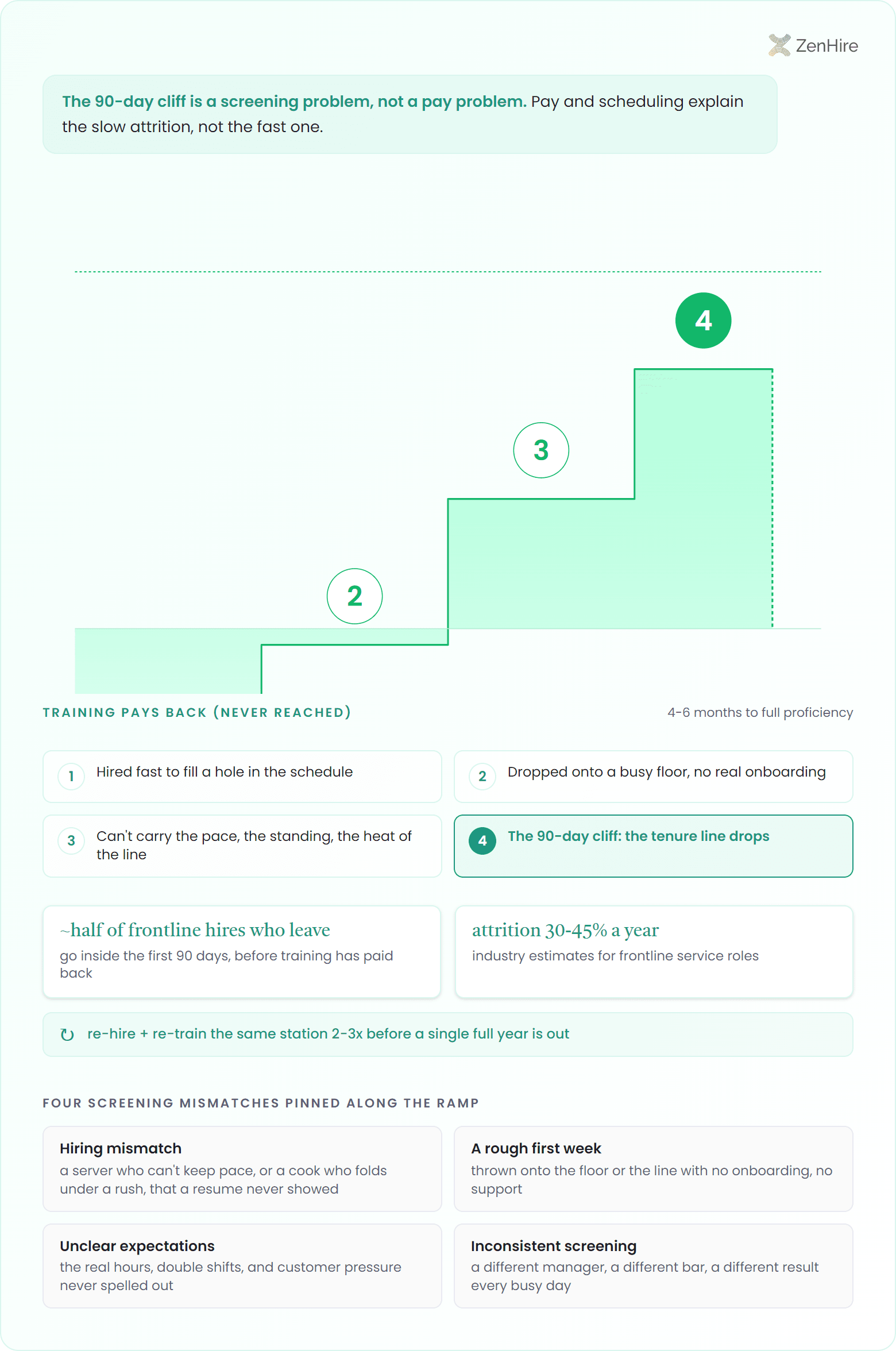
Roughly half of frontline hires who leave do so inside the first 90 days (before training has paid back), and frontline service roles can run attrition of 30-45% a year (industry estimates). In a restaurant that means re-hiring and re-training the same station two or three times before a single full year is out.
- Hiring mismatch: a server who cannot keep pace, or a cook who folds under a rush, that a resume never showed
- A rough first week, thrown onto the floor or the line with no onboarding and no support
- Unclear expectations: the real hours, the double shifts, and the customer pressure were never spelled out
- Inconsistent screening: a different manager, a different bar, and a different result every busy day
How do you hire restaurant staff who show up and stay?
You hire restaurant staff who show up and stay by evaluating reliability and pace fit consistently before the offer, not by trusting a rushed phone screen squeezed between services. The goal is to catch the mismatch in screening, where it costs you nothing, instead of on the floor in week two, where it costs you a shift and a re-hire.
Structured, AI-assisted screening gives a busy general manager two things they cannot manufacture during a rush: consistency and scale. Every applicant for a server or line-cook role clears the same bar, scored the same way, so a strong, reliable candidate is not lost because they applied the night before a holiday weekend. ZenHire's AI interview software reads communication, composure under pressure, and reliability signals in about four minutes, and the same evidence is on file whether you are hiring one host or staffing five new locations. For multi-unit operators, that consistency is exactly what the food and beverage hiring playbook is built around.
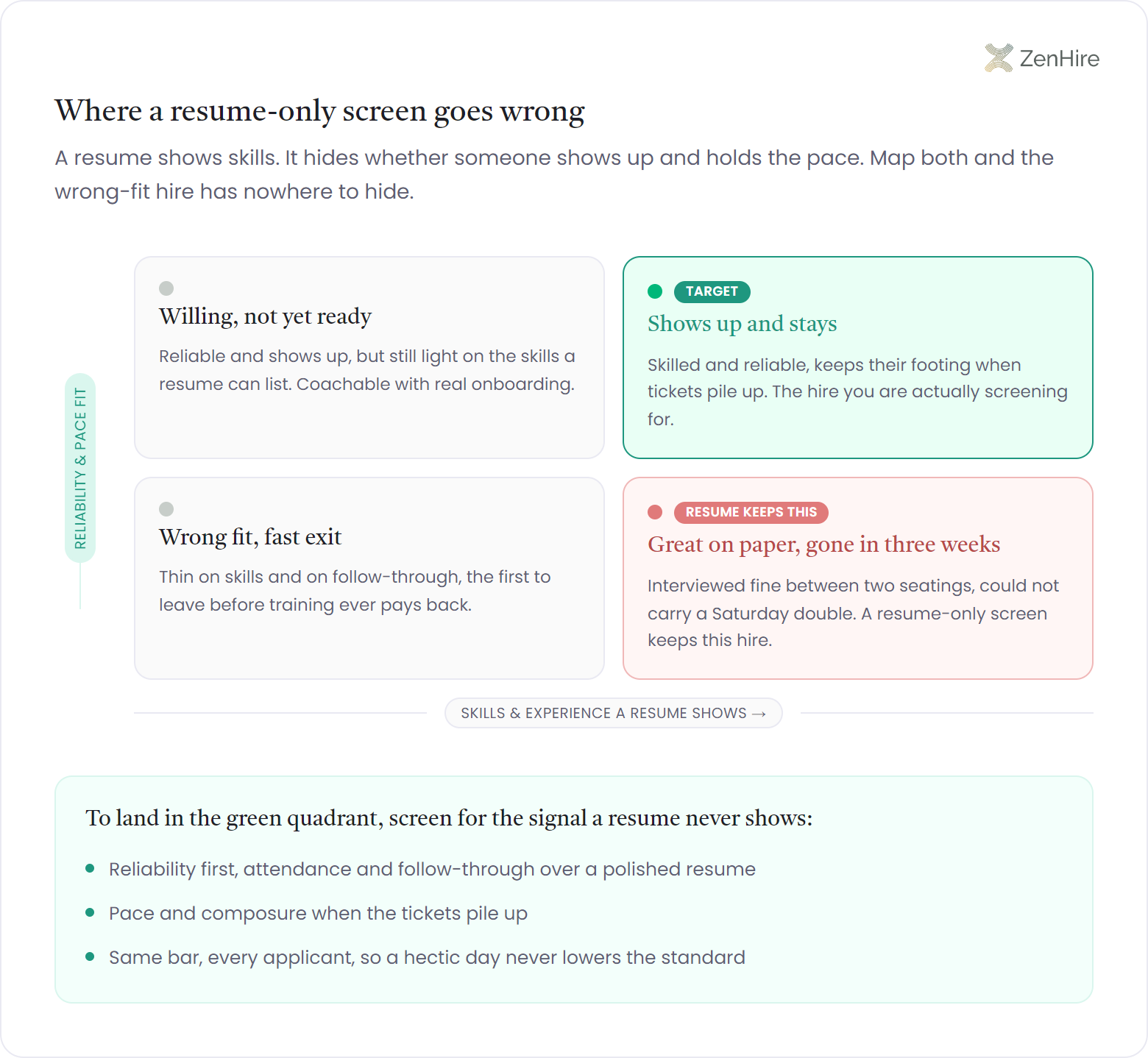
How you screen matters more than how hard you look. Scanning a resume for prior restaurant experience predicts who actually performs at only about r = 0.14, and a quick unstructured chat at ~0.18. Layer a structured interview onto skills tests (0.45+) and a cognitive measure (0.5+), though, and the combined signal climbs past 0.6, better than four times what a resume alone tells you about a line cook.
- Reliability first: weight attendance and follow-through signals over a polished resume
- Pace and composure: screen for whether someone keeps their footing when tickets pile up
- Same bar, every applicant: a structured interview so a hectic day does not lower the standard
- Set expectations honestly: name the real shifts and pressure so the wrong fit self-selects out before day one
How do you predict 90-day quits in restaurants?
You predict 90-day quits in restaurants by tracking early attrition as a leading indicator, segmented by role, location, and hiring source, so you can see which station, which shift pattern, and which sourcing channel is bleeding people before the annual turnover number ever catches up. The 90-day quit rate is a screening-quality signal: when it climbs, your front door is letting in people who cannot carry the work.
Watch the leading indicator (90-day attrition) alongside the lagging one (annual turnover), and break both down by where the hire came from and which role they filled. If a sourcing channel or a screening change cuts early server churn, you will see it months before the yearly rate moves. Pair it with quality-of-hire so retention is read against performance, and lean on a faster, more consistent screen to reduce time-to-hire without lowering the bar, because the rushed hire is the one most likely to quit by week eight.
| Signal | What it tells a restaurant operator |
|---|---|
| 90-day attrition by role | Screening quality: are your servers and cooks built for the pace, or just available? |
| Turnover by hiring source | Which channels send people who stay past the training cliff |
| No-show / early-absence rate | An early reliability tell that often precedes a 90-day quit |
| Time to full proficiency | Industry studies cite 4-6 months to fully ramp a frontline hire, and every early quit resets that clock |
Restaurant owners talk about turnover like it is weather, something that just happens to you every season. It is not. I have watched the leak sit at the front door: a manager fills a station fast on a Thursday, hopes it works out, and by the second Saturday the new server has already stopped showing up. The cheapest retention program a restaurant has is an honest, consistent screen that takes a few minutes and treats every applicant the same. Catch the mismatch before the offer and most of your 90-day churn simply never reaches the schedule.
Frequently asked questions
What is the biggest cause of restaurant staff turnover?+
The biggest cause of early restaurant turnover is hiring mismatch: a server or cook who looked fine in a rushed interview but could not carry the pace, the hours, or the customer pressure. It shows up as the 90-day cliff, where industry studies put roughly half of frontline leavers gone before training pays back.
How do you reduce server churn specifically?+
You reduce server churn by screening for reliability and composure under pressure before the offer, then setting honest expectations about shifts and pace so the wrong fit opts out early. Consistent, structured evaluation catches the mismatch in screening, where it is cheap, instead of on the floor during a Saturday rush.
Can better hiring really lower restaurant turnover?+
Better hiring is the most direct lever on early restaurant turnover, because most early exits are screening failures, not pay problems. A snap read between services behaves like an unstructured interview and predicts performance at only ~0.18, while combined validated methods clear 0.6, so a consistent screen more than triples your odds of hiring a server who stays.
How much does restaurant turnover cost?+
Replacing one frontline restaurant worker costs about $5,000-$20,000 (industry estimates) once you count recruiting, training, and the shifts a short-staffed line cannot cover, and SHRM puts skilled-role replacement at 50-200% of annual salary.
What is a healthy turnover rate for a restaurant?+
A healthy restaurant turnover rate depends on the role and market, but frontline service runs far higher than office work, with 30-45% a year common for similar high-volume roles. The more useful target is your own 90-day attrition trend, segmented by station, shift pattern, and hiring source.
Free for reducing restaurant turnover
The restaurant 90-day retention checklist
A one-page checklist for cutting early restaurant turnover at the hire: the reliability and pace signals to screen for, the first-week support that keeps new servers and cooks, and the early-quit metrics worth watching.