
What Are the Challenges of Public Sector Hiring?


· 9 min read
The challenges of public sector hiring are speed, fairness, and defensibility at once: government agencies must fill seats fast, treat every applicant equally, and document each decision well enough to survive an audit or appeal. Accountability safeguards stretch a two-week private hire into a two-to-four-month government one, and a single public posting can draw 600 applicants, roughly 60 hours of manual resume screening before the first interview. Structured, explainable screening resolves the trade-off, and for a public employer the deciding factor is auditability: an off-the-cuff interview forecasts on-the-job performance at only ~0.18, barely better than chance, while a validated method mix clears 0.6+, and only the structured version leaves a record an auditor can actually read back.
Why is public sector hiring so slow?
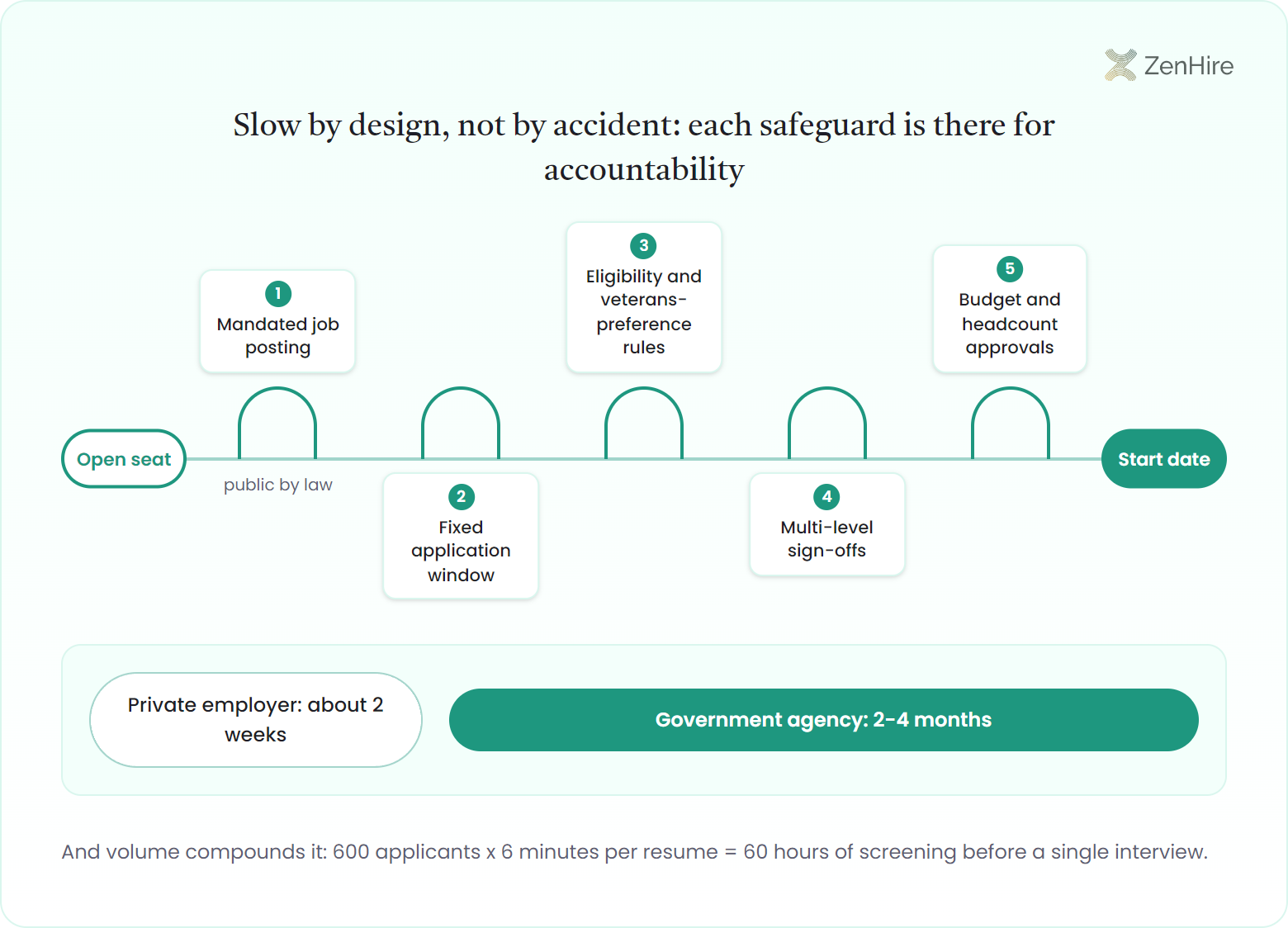
Public sector hiring is slow because the process is built for accountability, not speed. Mandated job postings, fixed application windows, eligibility and veterans-preference rules, multi-level sign-offs, and budget or headcount approvals all sit between an open seat and a start date. Each safeguard is there for a good reason, but stacked together they stretch a hire that takes a private employer two weeks into one that takes a government agency two to four months.
The slowdown compounds under volume. A government posting is public by law, so it often draws hundreds of applicants, and a small HR team then has to screen every one consistently to defend the shortlist. When screening is manual, the realistic options are to slow down further or to cut corners, and cutting corners in public hiring is exactly what triggers an appeal. This is the same bottleneck private high-volume employers face, just with a legal duty attached. The reduce time-to-hire playbook applies, but only when the speed-up is also fully documented.
Consider a city agency posting 40 entry-level roles. If 600 people apply and a recruiter spends even six minutes per resume, that is 60 hours of screening before a single interview, and any inconsistency across those 60 hours becomes grounds for a challenge. The edge case is the niche specialist role, say a wastewater engineer or a court interpreter, where the applicant pool is tiny but the eligibility and certification checks are heavy. Here the delay is not volume but verification, and rushing it risks hiring someone who cannot legally hold the post.
In public hiring the choice of method is itself an audit exposure: reading a resume tracks eventual performance at roughly r = 0.14 and an informal interview at ~0.18, so screening built on either is hard to defend when it is challenged. Fold structured interviews together with cognitive and skills assessments and the combined signal climbs past 0.6, more than four times the predictive power, and that structured version is the only one that comes with a rationale you can put in writing.
How do you run fair, compliant public sector hiring?
You run fair, compliant public sector hiring by making every step structured, consistent, and documented: the same questions, the same scoring rubric, and the same evidence for every applicant, so the shortlist can be explained to any candidate or auditor who asks. Fairness in government hiring is not a sentiment; it is a procedural standard you have to prove, which means the screen has to exclude demographic factors, apply one bar to everyone, and leave an audit trail behind it.
The most reliable way to hold that standard at volume is a structured interview with a fixed scorecard, paired with job-relevant assessments rather than gut-feel phone screens. Structure is what makes evaluation both fairer and more defensible: when every applicant answers the same prompts and is scored on the same criteria, a strong candidate is not lost because they applied late in a busy week, and a rejection comes with a reason on the record. Designing the screen to actively reduce bias, using neutral, job-related features instead of proxies that leak gender, age, or ethnicity, is what turns 'we tried to be fair' into 'here is how we were fair.'
Take a state agency hiring 200 seasonal field staff: a fixed rubric scoring communication, reliability, and role-specific competencies gives every applicant an identical, logged evaluation that withstands a freedom-of-information request. The edge case is the accommodation: a candidate who needs an alternative format, extra time, or an audio-only path. A compliant process plans for that up front: a low-bandwidth, audio-only assessment option, for instance, keeps the screen accessible without creating a separate, undocumented track that itself becomes a fairness risk.
- One rubric for everyone: identical questions and scoring criteria, applied to every applicant in the pool
- Demographic factors excluded: score job-relevant signal, not proxies for age, gender, or ethnicity
- Every decision logged: an auditable record behind each advance-or-reject, ready for appeal or FOIA
- Accessible by design: alternative and audio-only formats built in, not bolted on as an exception
How does explainable AI speed public sector hiring decisions?
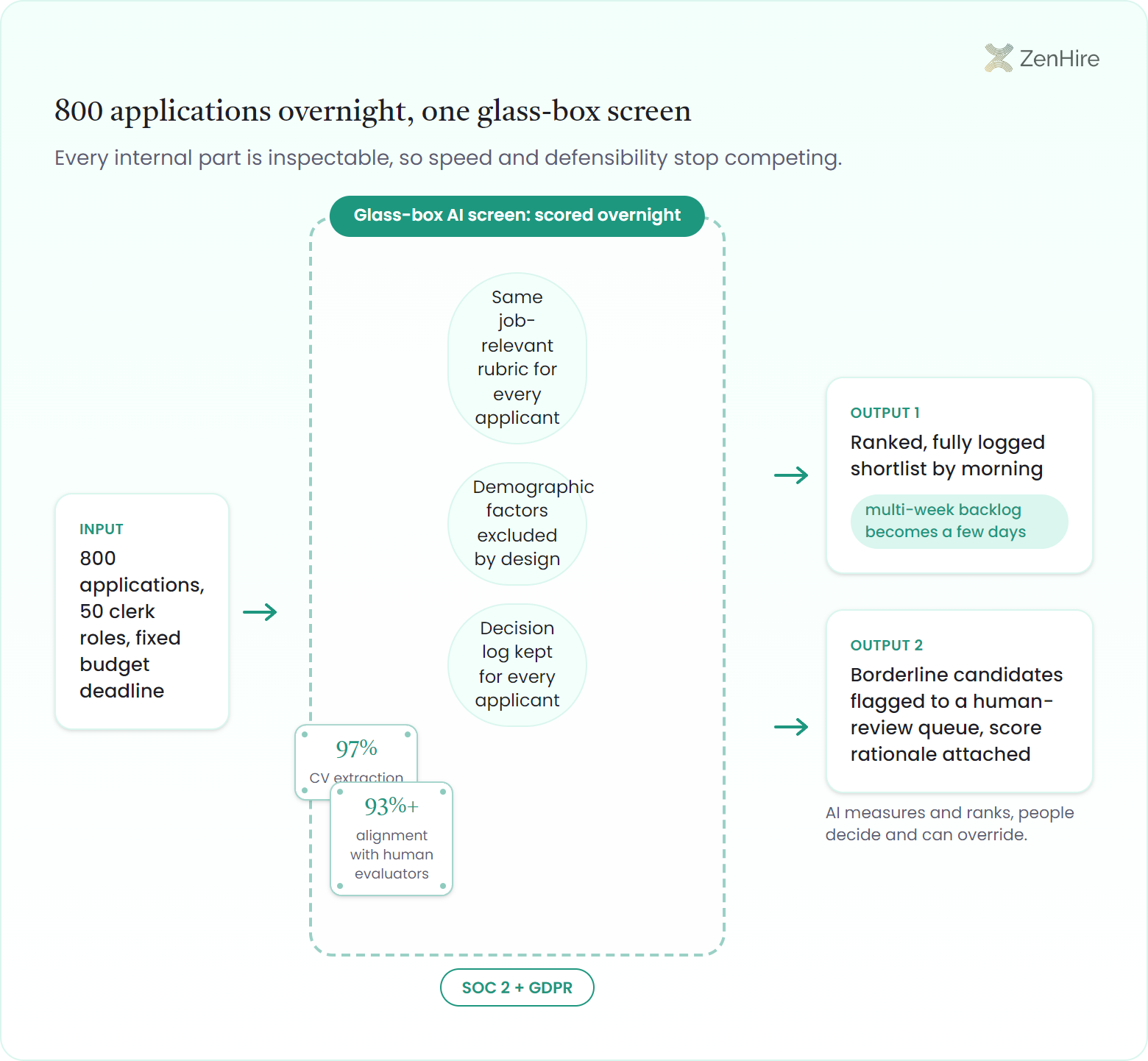
Explainable AI speeds public sector hiring decisions by doing the consistent, high-volume screening in minutes while producing the audit trail compliance already demands, so speed and defensibility stop competing. A glass-box system scores every applicant against the same job-relevant rubric, ranks them, and shows the reasoning behind each score, which collapses the 60-hour manual screen into a same-day shortlist that any reviewer can inspect.
The key word is explainable. Public hiring cannot use a black box that returns a number with no reason, because an unexplained rejection is an indefensible one. ZenHire prefers safe, auditable machine learning over opaque deep learning, excludes demographic factors by design, and keeps a decision log for every applicant, the same glass-box, SOC 2 and GDPR posture that lets a public employer answer an appeal with evidence instead of a shrug. The human stays accountable: AI measures and ranks, people decide and can override, which is exactly the division of labor public hiring rules expect.
Picture a county processing 800 applications for 50 clerk roles before a fixed budget deadline. An AI screen scores all 800 on the same criteria overnight, surfaces a ranked, fully logged shortlist by morning, and frees the HR team for structured interviews instead of resume triage, turning a multi-week backlog into a few days. The edge case is the borderline or contested candidate: rather than auto-rejecting, the system flags them into a human-review queue with the score rationale attached, so a person makes the final call on the record. That same accuracy backbone, 97% CV extraction and 93%+ alignment with human evaluators on matching, is what makes the fast shortlist trustworthy enough to act on. For fully manual workflows, see how to lower recruitment costs by removing the repetitive triage entirely.
| Capability | What it does for public hiring |
|---|---|
| 97% CV extraction | Reads every application the same way, so the shortlist is built on complete data |
| 93%+ human alignment | AI ranking tracks expert reviewers, making the fast screen trustworthy |
| Glass-box scoring | Every score comes with a reason on the record for appeal or audit |
| Audio-only option | Keeps the screen accessible for low-bandwidth or accommodation needs |
| SOC 2 + GDPR | Meets the data-handling bar public employers must clear |
People assume public sector hiring is slow because of bureaucracy, and they are half right. The rules are not the enemy. Accountability, equal treatment, an audit trail: those are exactly what good hiring should have. The real problem is that we have only ever enforced those rules with slow, manual work, so fairness and speed feel like a choice. They are not. The most defensible screen is also the most structured one, and a structured screen is precisely what a glass-box system runs in minutes. Done honestly, AI does not let public agencies skip the safeguards; it lets them prove they followed every single one.
Frequently asked questions
Why is government recruitment so much slower than private hiring?+
Government recruitment is slower because the process is built for accountability, not speed. Mandated postings, fixed application windows, eligibility and preference rules, and multi-level approvals add weeks. Each safeguard is justified, but stacked together they turn a two-week private hire into a two-to-four-month public one.
What are the main public sector hiring barriers?+
The main public sector hiring barriers are high application volume, the duty of equal treatment, and the need to document every decision. A single public posting can draw hundreds of applicants, and screening them consistently enough to defend the shortlist is where manual processes either slow down or risk an appeal.
Can AI be used fairly and legally in public sector hiring?+
AI can be used fairly in public hiring when it is explainable rather than a black box. A glass-box system that excludes demographic factors, scores every applicant on the same job-relevant rubric, and logs a reason for each decision can reduce bias and legal exposure compared with informal manual screening, provided a human stays accountable for the final call.
How does structured screening improve fairness?+
Structured screening improves fairness by applying one identical bar to every applicant. The same questions and the same scoring rubric mean a strong candidate is not lost to timing or interviewer mood, and every rejection comes with a recorded reason. The same discipline is why a structured screen forecasts performance so much more reliably than a loose one, giving a government agency both a fairer decision and a more defensible one.
Does speeding up public sector hiring mean cutting corners on compliance?+
No, the right speed-up comes from automating the consistent screening, not skipping the safeguards. Explainable AI does the high-volume triage in minutes and produces the audit trail compliance already requires, so the shortlist is both faster and more defensible, with borderline cases routed to human review.
Free for public sector hiring
The compliant public sector hiring checklist
A one-page checklist for screening at volume without losing fairness: the rubric to standardize on, the factors to exclude, and the audit trail to keep for every decision.