
Recruiter vs Done-for-You Hiring: Which Costs Less?


· 12 min read
In a recruiter vs done-for-you hiring cost comparison, done-for-you costs less for occasional or moderate volume: a flat per-hire fee replaces the 15-25% agency contingency fee and the recruiter's loaded salary. On three comparable roles, a 20% contingency totals 0.60 salary-units and rises with every richer offer, while an in-house recruiter's loaded cost runs 1.0-1.5 salary-units a year whether or not roles are open. True cost to hire adds your hours plus mis-hire risk, which SHRM puts at 50-200% of salary, so screening rigor, not the sticker fee, moves the largest line.
Hiring-cost comparator
Agency vs in-house vs done-for-you
Compare the annual and per-hire cost of each hiring model at your volume, and find the break-even point where in-house starts to win.
Contingency agencies typically charge 15-25% of first-year salary.
Base + benefits + tools + overhead. Paid whether you hire 1 or 50.
A flat per-role fee, independent of salary.
Your result
At 3 hires/year on $75k salaries, Agency is cheapest at $45k/yr ($15k/hire). In-house breaks even around 7 hires/year. True cost also includes your team's interview hours and mis-hire risk (SHRM: 50-200% of salary), where screening rigor, not the fee, decides.
How each model is costed+
- 1.Agency = hires x salary x contingency %. At 20% on $75k: 3 x $75k x 0.20 = $45k. Per-hire cost rises with every raise in the offer.
- 2.In-house = the recruiter's loaded annual cost, paid whether you have one open role or five. Per-hire cost falls as volume rises.
- 3.Done-for-you = a flat fee per filled role: hires x fee. Per-hire cost stays the same across salary bands, predictable at any volume.
- 4.In-house break-even = loaded cost / (salary x contingency %). Below it the percentage model is cheaper; above it the fixed salary wins.
- 5.True cost adds two lines the fee hides: your team's interview hours and the cost of a mis-hire (SHRM: 50-200% of salary), driven by screening rigor, not price.
What does a recruiter or agency cost versus done-for-you hiring?
A recruiter or agency costs a percentage of salary or a loaded wage, while done-for-you hiring costs a flat fee for each role it fills: three pricing shapes that drive almost every number that follows.
An external staffing agency commonly bills a contingency fee of 15-25% of the new hire's first-year salary, charged only when a candidate accepts. An in-house recruiter instead carries a loaded annual cost (base pay plus benefits, tooling, and overhead) that you pay every month regardless of how many requisitions are open. Done-for-you hiring sits between the two: an outside team or platform runs sourcing, screening, and shortlisting and charges a defined amount per hire, so cost scales with output rather than with salary or headcount. The pattern matters more than any single quote, which is why it helps to understand what a done-for-you hiring service does before comparing line items.
Concrete example: a 12-person company needs to fill three roles this year. At a 20% contingency on three comparable salaries, the agency fee is roughly six-tenths of one full salary in fees alone. A full-time recruiter would cost more than that in loaded pay and sit idle most quarters. Done-for-you hiring prices those same three placements as three predictable fees, with no standing payroll line between them.
The edge case is salary inflation under contingency pricing. Because the agency fee is a percentage of pay, a higher offer mechanically raises the fee, quietly rewarding the agency for a more expensive hire. The in-house and done-for-you models do not move with the offer the same way, so they avoid that built-in incentive. If you would rather skip the third party entirely, the trade-offs of hiring without a recruiter are a separate question worth weighing.
Industry benchmarks anchor the comparison: agency contingency fees run 15-25% of first-year salary, while replacing a hire that does not work out costs 50-200% of salary (SHRM). The fee you negotiate is rarely the largest number in the equation; the cost of getting the wrong person usually is.
| Cost driver | Recruiter / agency | Done-for-you hiring |
|---|---|---|
| Pricing shape | Agency: 15-25% of first-year salary per placement. In-house: loaded annual salary | Defined fee per filled role |
| Scales with | Salary level and headcount | Hires you actually make |
| Cost when no roles are open | In-house salary continues; agency pays nothing | Nothing until you start a hire |
| Your time per hire | Briefing, reviewing forwarded resumes, scheduling | Reviewing a ranked, evidence-backed shortlist |
| Mis-hire exposure | Replacement runs 50-200% of salary if it fails | Same exposure, lowered by structured, consistent screening |
What does each hiring model cost on a worked example?
On the same three roles, an agency typically costs the most, an under-used in-house recruiter the second most, and done-for-you hiring the least, and the cheapest line stays flat instead of scaling with salary. The table below works the numbers in salary-multiples so you can drop in your own pay bands.
To keep it honest and dollar-free, the example expresses every cost as a fraction of one annual salary (write it as 1.0 salary-unit). Assume a lean team filling three comparable roles in a year. For the agency line, third-party data puts contingency fees at 15-25% of first-year salary; this example uses the 20% midpoint, so three placements cost 0.60 salary-units in fees, and that number rises automatically if any offer goes up. For the in-house line, a recruiter's loaded annual cost (base, benefits, tooling, overhead) commonly lands near 1.0-1.5 salary-units and runs every month whether or not a role is open, and across just three hires that is roughly 0.33-0.50 salary-units per placement. For done-for-you hiring, the cost is a defined per-hire fee that does not move with salary, so the comparison holds across pay bands.
Two findings fall out of the math. First, the agency line is the only one that grows with the offer: push the salaries up and the 0.60 figure climbs in lockstep, while the per-hire fee does not. Second, the in-house line only looks expensive because the example assumes low volume; raise it to ten or fifteen hires a year and that same loaded salary divides down fast, which is exactly the in-house recruiter break-even point worth finding before you commit to payroll.
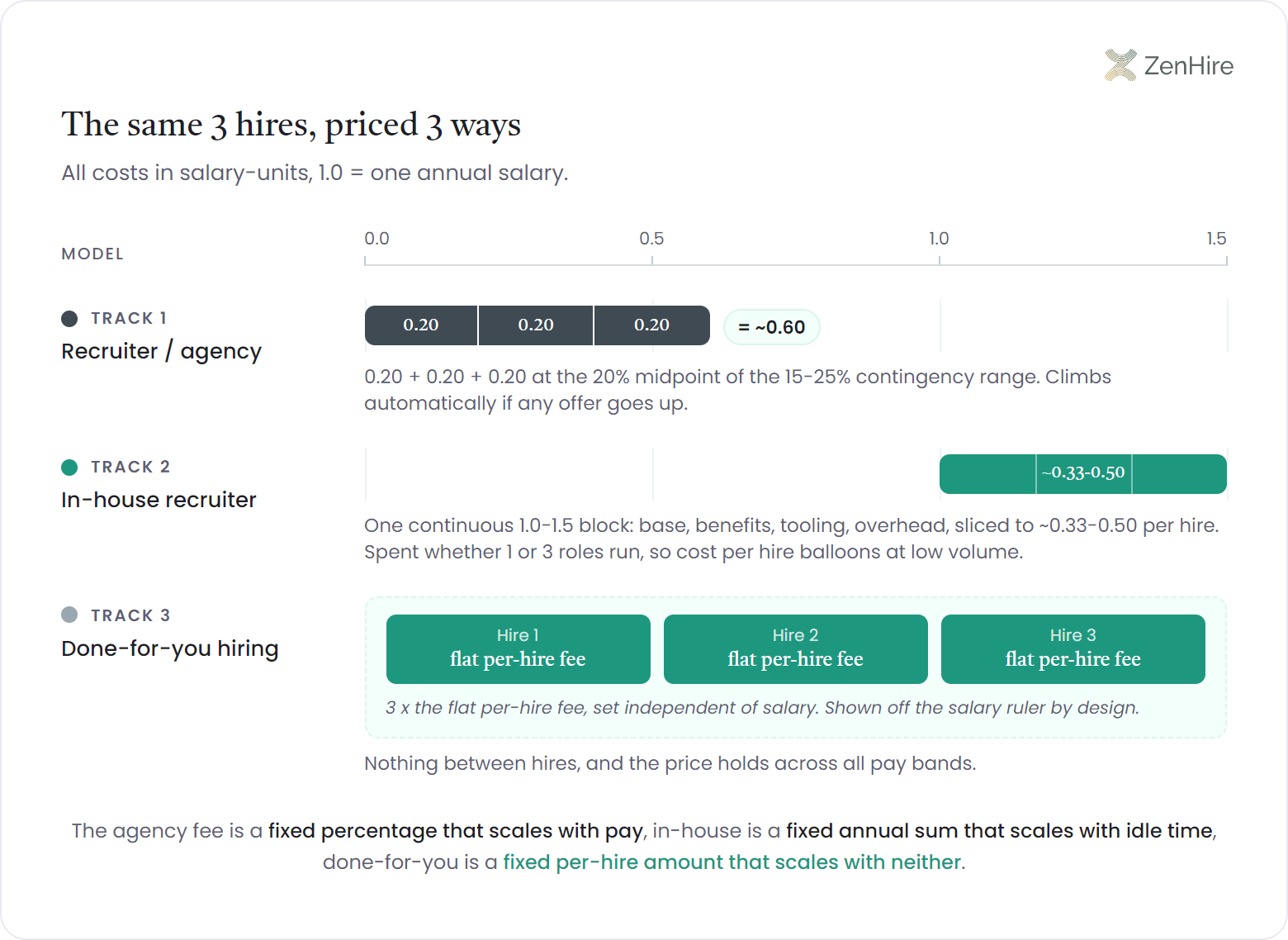
Read the table as ratios, not prices. Because no dollars are involved, the relationships hold at any salary band: the agency fee is a fixed percentage that scales with pay, the in-house cost is a fixed annual sum that scales with idle time, and the done-for-you fee is a fixed per-hire amount that scales with neither. The model that wins is the one whose scaling factor you can keep small.
| Cost element | Recruiter / agency | In-house recruiter | Done-for-you hiring |
|---|---|---|---|
| How the fee is set | 15-25% of first-year salary per placement (industry range) | Loaded annual salary (~1.0-1.5 salary-units), paid monthly | Defined fee per filled role, set independent of salary |
| Cost of 3 example hires | ~0.60 salary-units at a 20% midpoint | ~1.0-1.5 salary-units total (~0.33-0.50 per hire), spent whether 1 or 3 roles run | 3 x the flat per-hire fee, and nothing between hires |
| What it scales with | Salary level, fee climbs with every richer offer | Idle time, cost per hire balloons at low volume | Hires made, flat per seat across all pay bands |
| Best fit | Rare, senior, or fiercely contested searches | High, steady volume that keeps the recruiter fully used | Occasional or repeatable mid-volume hiring on a known number |
| Mis-hire exposure (all models) | Replacement runs 50-200% of salary (SHRM) | Same exposure; depends on screening rigor, not headcount | Same exposure, trimmed by structured, consistent screening |
When is done-for-you hiring cheaper than a recruiter?
Done-for-you hiring beats a recruiter on price whenever your hiring is occasional or uneven: you pay only for the seats you fill and carry no salary between them. Predictable per-hire pricing is the lever.
The mechanism is straightforward. A full-time recruiter only pays off once volume is steady and high enough to keep them busy; below that line, their loaded salary is spread across very few hires, so the [cost per placement](/metrics/cost-per-hire) balloons. Agency contingency fees stay variable, but at 15-25% of salary they climb fast on senior or well-paid roles. A flat done-for-you fee does neither; it holds a known number per hire. This is exactly where the agency-fees-vs-done-for-you comparison is starkest: the agency fee rises with the salary, the done-for-you fee does not.
When the comparison tips toward done-for-you, the deciding factors are usually:
- Low or seasonal volume, where an in-house recruiter would sit underused for months while their salary keeps running.
- Higher salary bands, where a percentage fee balloons with the offer, while a flat per-hire fee stays put.
- Predictable budgeting, because finance wants a known number per seat, not a fee that moves with every counter-offer.
- Lean teams, with no spare hours to run sourcing, screening, and scheduling in-house, so the work has to go somewhere.
- Tooling economics shift, as third-party research sizes the overall recruitment market at roughly $450B in 2023, growing toward about $870B by 2032 at a ~7.5% CAGR, and that scale steadily lowers the cost of running structured screening at a flat per-hire price.
The counter-argument for keeping a recruiter
Some leaders argue a dedicated recruiter is cheaper because there is no per-hire fee at all once they are on payroll, and they build market relationships and a talent pipeline that outside help never will. That is a fair point, at the right scale.
It holds only above a clear volume threshold. A recruiter who fills two roles a year is far more expensive per hire than any per-placement model, and the relationship advantage matters most for rare, senior, or fiercely contested searches. For the steady stream of mid-level and high-volume roles, structured screening run through an AI recruiter that screens and ranks candidates delivers the consistency a single busy recruiter struggles to maintain, at a lower and more predictable cost. The honest rule: recruiter for constant or specialized hiring, done-for-you for occasional or repeatable hiring.
How do you calculate true cost to hire with done-for-you hiring?
You calculate the real cost to hire by adding three lines (the fee, the value of your team's hours, and the expected price of getting it wrong), because the sticker price hides the last two.
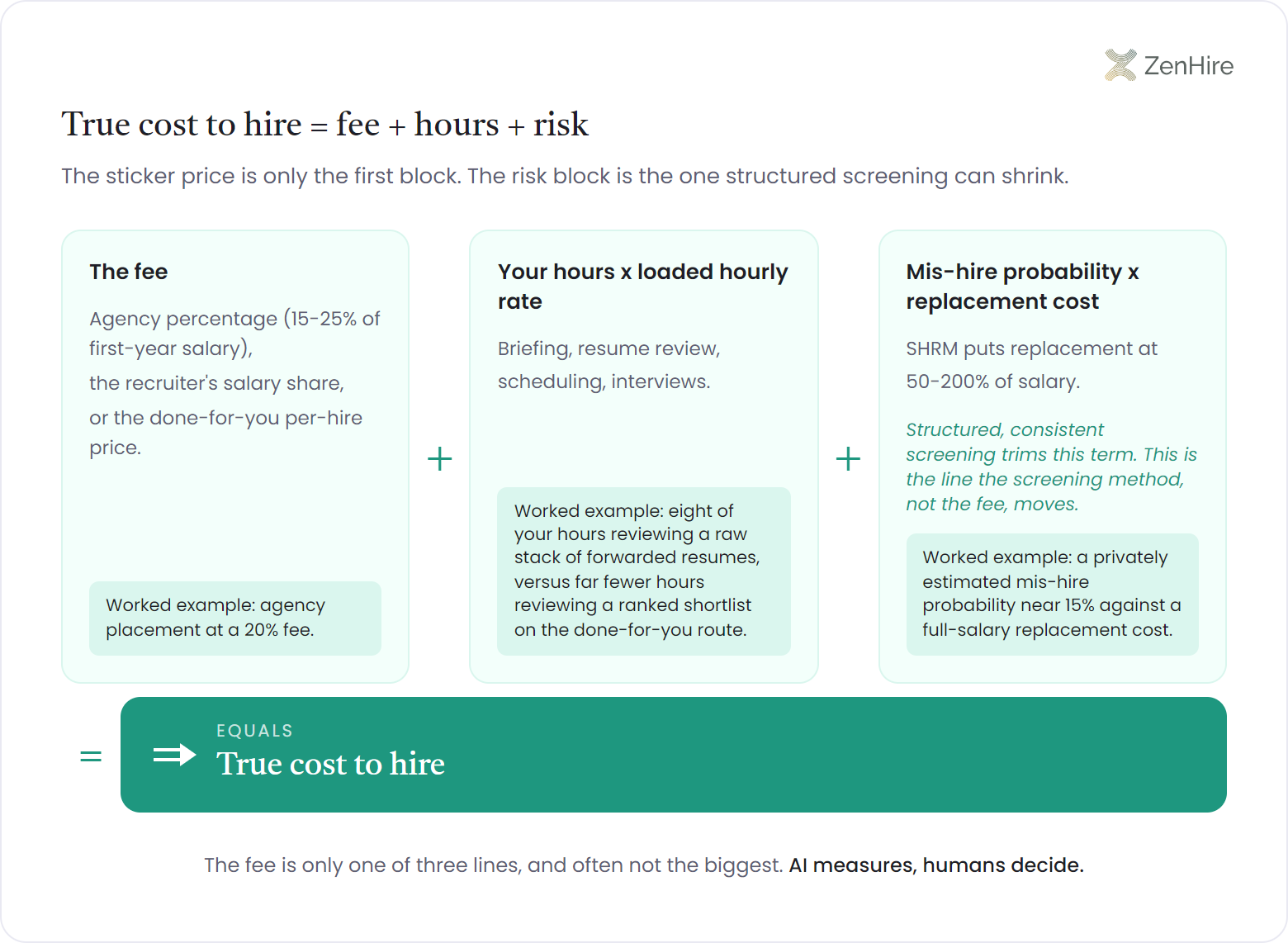
Use a simple formula: true cost to hire = fee + (your hours x loaded hourly rate) + (mis-hire probability x replacement cost). The fee line is the agency percentage, the recruiter's salary share, or the done-for-you per-hire price. The hours line captures briefing, resume review, scheduling, and interviews at your team's loaded rate. The risk line uses an industry anchor: SHRM puts replacement at 50-200% of salary, so even a modest chance of a mis-hire carries real expected cost. This is where any recruiter cost comparison gets honest, because the screening method, not just the fee, moves the risk term.
Worked example, no dollars needed: picture an agency placement at a 20% fee, plus eight of your hours spent reviewing a raw stack of forwarded resumes, plus a mis-hire probability you privately estimate near 15% against a full-salary replacement cost. A done-for-you route typically carries a flatter fee and far fewer of your hours (you review a ranked shortlist instead of a raw pile), and stronger, structured screening trims the risk term. The fee is only one of three lines, and often not the biggest.
The edge case is the rare, business-critical senior hire. There the value of finding the right person dwarfs every fee, so you optimize for quality of match and depth of search, not the lowest cost line. This is also where the fee and the risk line pull in opposite directions: the sticker price you pay to fill the seat says nothing about the odds it holds, and those odds live entirely in how the candidate was screened. A resume read alone forecasts on-the-job performance at roughly 0.14; stack structured, validated methods together and the combined signal clears 0.6, better than four-to-one on the same money spent. Whichever model you pick, a glass-box, bias-excluded process that stays explainable and auditable is how you keep the mis-hire term small without handing the final call to the machine. AI measures, humans decide.
Where the risk hides in the fee: a placement quote tells you what the seat costs to fill, not what it costs when it fails, and the second number tracks the screening method rather than the price tag. On the predictive-validity ledger, a plain resume review sits near r = 0.14, an unstructured interview around 0.18, and a structured interview about 0.28; adding cognitive and skills assessments carries the combined signal past 0.6. Roughly 70% of hiring teams now run AI in the loop by 2025, and AI-enabled hiring is cited near 62% lower cost, yet a bargain hire that washes out still forecasts worse than a slightly dearer one that stays.
Founders ask me whether to hire a recruiter or pay per hire, and I tell them the question is wrong. The expensive line is never the fee; it is the wrong person you keep for nine months because the cheap process could not tell you they would fail. I would rather a team spend a little more on screening that actually predicts performance and a little less on a sticker price, because the mis-hire is the only cost that compounds. Pick the model that makes your true cost to hire honest, then keep yourself on the final decision.
Frequently asked questions
What is the cost of a recruiter vs done for you hiring?+
The cost of a recruiter vs done-for-you hiring comes down to the pricing shape, not a single number. A recruiter is either an agency fee of 15-25% of first-year salary per placement or a loaded in-house salary, while done-for-you hiring charges a predictable fee per filled role. For occasional or moderate volume, the per-hire model is usually the lower total cost.
How do agency fees vs done for you compare on a senior role?+
Agency fees vs done-for-you diverge most sharply on senior roles. A 20% contingency fee is a fifth of a first-year salary and climbs further with every raise in the offer, whereas a flat done-for-you fee does not scale with salary at all. On well-paid seats, the percentage model is typically the more expensive choice.
What should a recruiter cost comparison actually include?+
A recruiter cost comparison has to include more than the placement fee. Add the value of your team's hours and the expected cost of a mis-hire, which SHRM puts at 50-200% of salary. Comparing only the headline fee makes the most accurate screening method look identical to the riskiest, which it is not.
When is keeping an in-house recruiter the cheaper option?+
Keeping an in-house recruiter is cheaper once hiring volume is high and steady enough to keep them fully utilized. Their loaded salary divided across many placements beats per-hire fees, and they build pipeline and market relationships. Below that volume threshold, a per-hire or done-for-you hiring model almost always costs less.
Does done-for-you hiring lower the risk of a bad hire?+
Done-for-you hiring lowers bad-hire risk when it applies structured, consistent screening rather than informal review. That is the line that actually moves your true cost to hire: structured, validated methods forecast performance at 0.6 or better against roughly 0.14 for a resume read alone, so the mis-hire probability drops even when the fee does not. The screening should stay explainable and bias-excluded so a person, not the system, owns the final decision.
Free for cost-to-hire comparison
The true cost-to-hire calculator
A one-page worksheet that adds the three lines most comparisons hide (placement fee, your team's hours, and mis-hire risk), so you can price a recruiter against done-for-you hiring on the real number, not the sticker.