
How Do You Hire Without Hiring a Recruiter?


· 14 min read
You hire without a recruiter by keeping the structure a good recruiter would impose: a one-page scorecard, the same structured questions for every candidate, and AI running sourcing, screening, and first-round interviews. That swap cuts manual screening by 87% and time-to-hire by 36%, while structured evaluation lifts predictive validity from roughly 0.14 for a resume scan to past 0.6 for combined methods. Reserve paid search, at 15-25% of salary in agency fees, for senior, niche, or high-stakes negotiation hires.
Can you hire well without a recruiter?
You can hire well without a recruiter in almost every case, as long as you replace the discipline a good intermediary brings with structure of your own. The trap is never the missing person; it is the missing process. Swap an inconsistent middleman for a fixed rubric and you actually gain consistency, because software applies the same standard to every applicant instead of drifting with mood and fatigue.
The mechanism is straightforward. Decide what the role truly requires, turn that into a scorecard, and ask every candidate the same questions in the same order. That single move, structuring the evaluation, carries most of the predictive power. Rank the hiring signals a solo hirer can actually use and the gap is stark: the resume you would normally skim predicts on-the-job performance at roughly 0.14, the off-the-cuff chat you would normally run lands near 0.18, a structured interview climbs to 0.28, and stacking validated methods pushes the figure past 0.6. The resume is the weakest signal you own, yet it is the one a rushed manual process leans on hardest.
Picture a founder hiring a third support agent. Instead of forwarding resumes to an agency, they write a five-line scorecard, post the role, and let a recruitment operating system source applicants, parse each CV at 97% field-extraction accuracy, run a short structured interview, and return ranked candidates with the evidence behind every score. The founder reads four decision-ready summaries instead of two hundred resumes and meets the top two the same week, closer to how an AI recruiter that screens for you works than to a manual triage.
Where this breaks down is when you skip the scorecard and treat the tools as a search box. Without a defined target, AI ranks candidates against a vague prompt and you inherit the very inconsistency you set out to escape. The structure is not optional overhead; it is the part that makes hiring without a recruiter actually work.
Structure is the multiplier, not the recruiter. A plain resume review predicts performance at about r = 0.14; layer a structured interview and cognitive or skills tests on top and the combined signal clears 0.6, more than four times what a CV alone tells you. That multiplier is something you build with a rubric, not something you buy with an agency retainer, and a disciplined self-run process captures it where an ad-hoc handoff often loses it.
- Write a one-page scorecard before you post: must-have skills, the signal that proves each, and a clear bar to clear.
- Ask every candidate the same structured questions so answers are comparable, not anecdotal.
- Score against evidence, never gut feel, and keep the record of why each candidate ranked where they did.
- Decide from a shortlist of three to five, not from whoever happened to apply first.
- Running this yourself is no longer the odd path out: roughly 70% of hiring teams use AI by 2025, and AI-enabled hiring is cited at about 62% lower cost, so a founder screening without a recruiter is following the mainstream, not improvising around it.
What does AI replace when you hire without a recruiter?
AI replaces the repetitive, high-volume labor of hiring, never the final call. Four jobs that once demanded a person now run on software: triaging the inbound pile, screening resumes for real fit, conducting the first round, and scoring everyone on one scale. What stays human is the decision and the relationship.
Each replaced stage has a concrete substitute. Sourcing triage becomes semantic CV-to-role matching that reads whether a candidate used a skill or merely listed it, so transferable experience surfaces instead of getting keyword-filtered out. Screening becomes a ranked pass over the whole pile rather than a tired skim of the first thirty, the difference behind 87% less manual screening and a 36% lower [time-to-hire](/metrics/time-to-hire). The first round becomes a structured AI interview that scores spoken answers in about four minutes, judging communication and, where the role needs it, spoken language graded on the CEFR scale from A1 to C2 from the audio itself. Scoring becomes a glass-box scorecard you can audit, with sensitive attributes excluded by design and a GDPR and SOC 2 posture behind it.
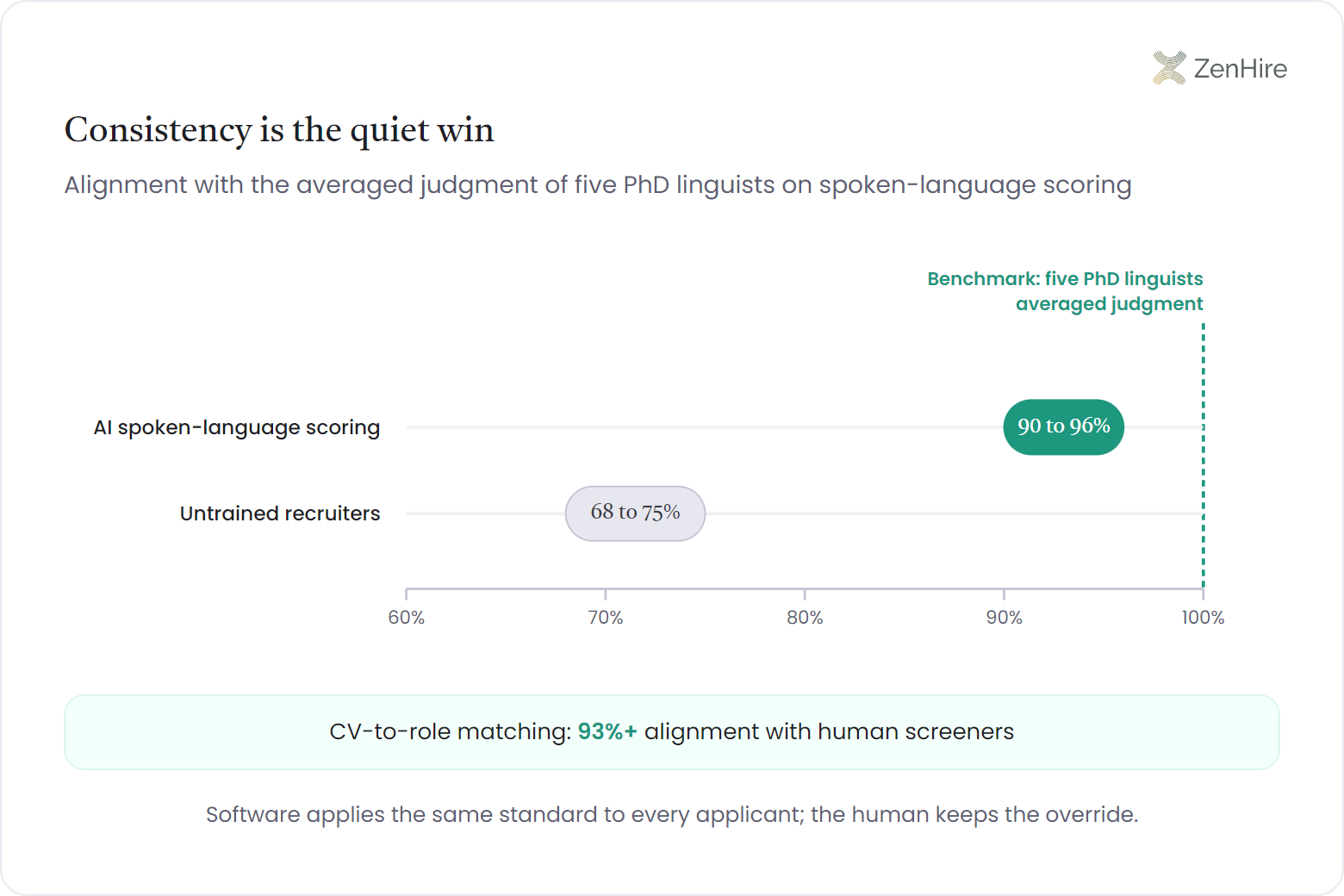
Consistency is the quiet win, and it is exactly what a lone hirer cannot hold across a hundred applicants. On spoken-language grading, the platform lands within 90 to 96% of the averaged verdict of five PhD linguists, while untrained recruiters manage only 68 to 75%, and CV-to-role matching hits 93%+ alignment with human screeners. Take a seasonal support push: manually, two people would burn a week reading resumes and booking phone screens; with AI running triage, screening, and the first round, the same team reviews a shortlist on day two, a transparent score and a clip behind each name, and spends its scarce hours only on candidates worth a real conversation.
The edge case is the unusual signal a rubric was never told to look for: the candidate whose value is a story rather than a score. AI ranks that person on what it was asked to measure and may underweight the rest, which is exactly why the human keeps the override. Treat a low AI score on an intriguing candidate as a prompt to look closer, not a verdict.
The four jobs AI takes over
Sourcing triage, resume screening, the first-round interview, and consistent scoring are the four tasks AI takes over first. Together they consume most of a manual hiring week, and handing them to software is what frees a non-recruiter to run a real process in the time they actually have; judgment, relationships, and the close stay with you.
What is the step-by-step playbook to run a fair hire solo?
Run the hire as a fixed seven-step sequence, and automate the high-volume middle while you keep the bookends, defining the role and making the call, for yourself. The point of a playbook is that fairness comes from doing the same thing in the same order for everyone, not from how much time you have. Below is the exact sequence, with what a non-recruiter does by hand and what to hand to software at each step, so a structured solo hire takes hours of judgment instead of weeks of reading.
The discipline is front-loaded on purpose. Steps 1 and 2 are where you spend your thinking; steps 3 through 5 are where automation earns its keep at volume. This is the stretch behind roughly 87% less manual screening and a 36% lower time-to-hire in practice. Steps 6 and 7 return the decision and the close to you, because that is the part no rubric should own.
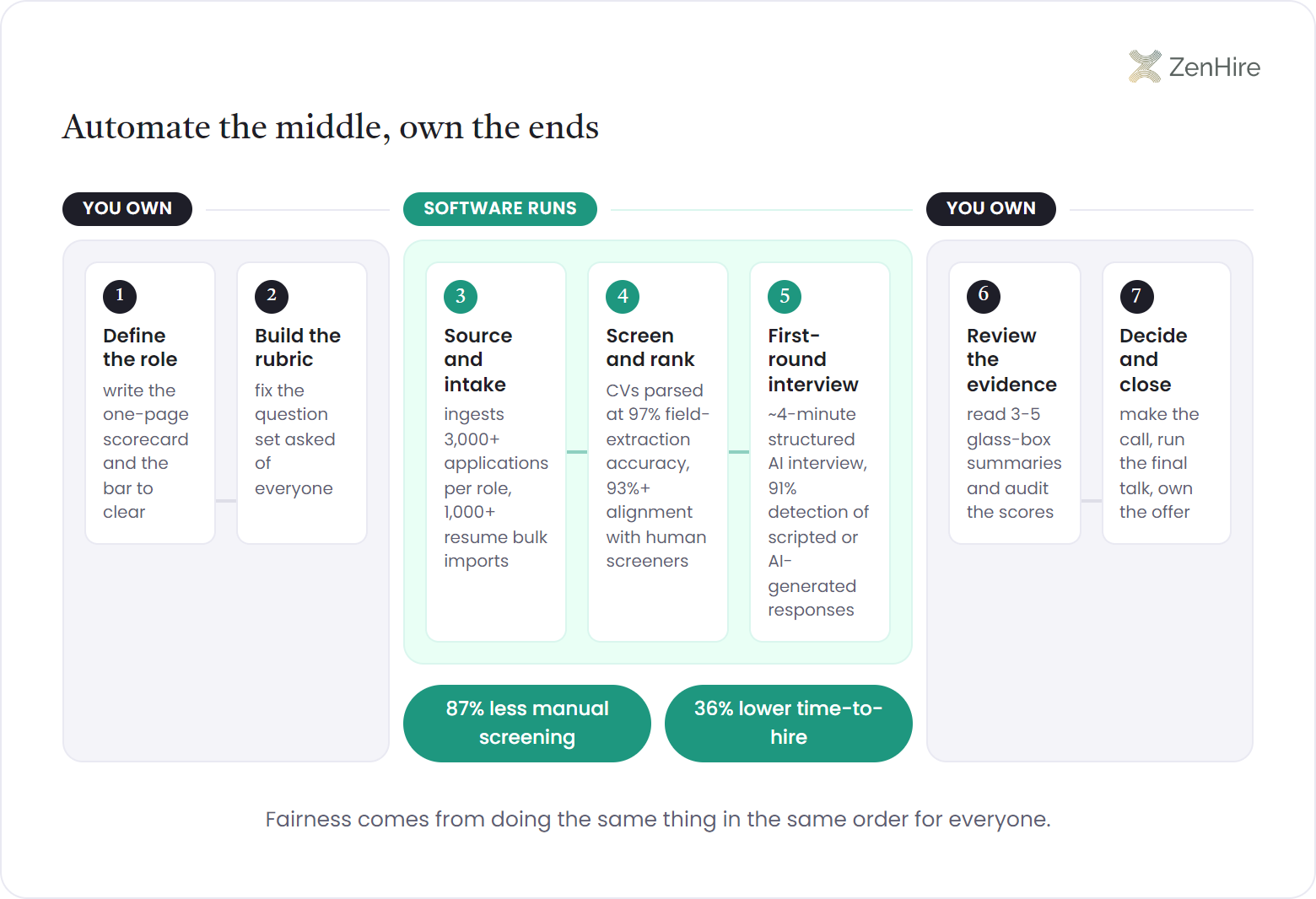
The rule of thumb: automate the middle, own the ends. Steps 1-2 (define and build) and steps 6-7 (decide and close) are where your judgment lives; steps 3-5 (source, screen, interview) are pure repeatable labor that software runs the same way for every applicant, which is exactly what makes a solo hire both fast and fair.
| Step | What you do by hand | What to automate |
|---|---|---|
| 1. Define the role | Write the one-page scorecard and the bar to clear | Draft a scorecard from the role description |
| 2. Build the rubric | Fix the question set asked of everyone | Generate a structured question bank |
| 3. Source and intake | Approve the posting and channels | Ingest 3,000+ applications and bulk resume imports |
| 4. Screen and rank | Spot-check the top and bottom of the list | Parse CVs at 97% accuracy and rank against the rubric |
| 5. First-round interview | Set the questions and the bar | Run a ~4-minute structured AI interview, scored consistently |
| 6. Review the evidence | Read 3-5 glass-box summaries and audit the scores | Surface ranked, evidence-backed shortlist |
| 7. Decide and close | Make the call, run the final talk, own the offer | Nothing: judgment and the close stay human |
Steps 1-2: Define the role, then build the rubric
Start by writing what "good" means before you look at a single applicant. This is the step that makes everything after it fair. Step 1 is a one-page scorecard: the three to five must-have skills, the observable evidence that proves each, and the bar a candidate has to clear. Step 2 turns that scorecard into a fixed question set asked of everyone in the same order. Automate the scaffolding here, generating a first-draft scorecard and a structured question bank from the role description, but you own the final cut, because a rubric built on the wrong target automates the wrong hire.
Steps 3-5: Source, screen, and run the first round
This is the high-volume middle, and almost all of it should be automated. Step 3 is sourcing and intake: post the role and let a recruitment operating system ingest applicants, up to 3,000+ per role and 1,000+ in a single bulk resume import, without a person touching the pile. Step 4 is screening: each CV is parsed at 97% field-extraction accuracy and scored against your rubric at 93%+ alignment with human screeners, so the ranking reflects the whole pile rather than the first thirty resumes you had energy for. Step 5 is the first round, and it is the piece a solo hirer usually cannot scale: a structured async AI interview that scores spoken answers in about four minutes, rating communication and, where the role calls for it, spoken language across the CEFR band from A1 to C2 at 90 to 96% agreement with five PhD linguists against just 68 to 75% for untrained recruiters, with 91% detection of scripted or AI-generated answers so nobody games the screen.
Steps 6-7: Review the evidence, then decide and close
The last two steps come back to you; automation prepares the decision, it does not make it. Step 6 is review: read three to five glass-box summaries instead of two hundred resumes, each with an auditable score, the evidence behind it, and sensitive attributes excluded by design, so you can defend every ranking under a GDPR and SOC 2 posture. Step 7 is decide and close: pick from the shortlist, run the final human conversation, and own the offer. Treat a low score on a candidate whose value is a story rather than a number as a prompt to look closer, not a verdict; the override is yours to keep.
When should you still use a human instead of hiring without a recruiter?
You should still use a human recruiter when the hire turns on relationships, scarcity, or persuasion rather than throughput. Senior and executive searches, genuinely niche skill sets, and sensitive negotiations are the cases where a skilled person earns their fee, because the value sits in access and trust that no scorecard captures.
The reasoning is about where leverage lives. For a frontline or high-volume role, the bottleneck is volume, and structured automation wins on speed and consistency. For an executive or a rare specialist, the bottleneck is a tiny passive market: the best candidate is not applying, the shortlist may be five people on earth, and closing them is a months-long courtship. A recruiter who owns that network and can sell the vision is doing work AI does not do.
Some argue this proves you should keep a recruiter on everything, because hiring is too important to automate. The evidence does not support that blanket conclusion. For the bulk of roles an ad-hoc agency process is less structured than a disciplined AI one, and structure is what predicts performance. The honest split is by role: let software run the repeatable, high-volume hiring where consistency wins, and reserve human-led search where a recruiter still beats AI for the senior, niche, and sensitive few where access and negotiation win. This is the core thesis in practice: AI measures, humans decide.
A concrete line: hiring ten contact-center agents is a structure-and-volume problem AI handles well, given that replacing one frontline hire runs roughly $5,000 to $20,000 and a consistent process cuts mis-hires. Hiring one VP of Engineering is a relationship problem where a specialist is usually worth it, and agency placement fees commonly run 15 to 25% of salary, so one great hire from a tiny passive market has to justify the bill. The edge case that blurs the line is the senior role with a large, active applicant pool, where you can run the structured screen yourself and bring a human in only to close.
The cost math splits cleanly by role. Replacing a single frontline or agent hire runs about $5,000 to $20,000, and SHRM puts full replacement at 50 to 200% of salary, so at volume, a consistent, structured screen pays for itself by cutting mis-hires. An agency fee of 15 to 25% of salary only earns out when one hard-to-reach senior hire would otherwise stay unfilled.
| Hiring situation | Lead with AI (no recruiter) | Keep a human in the lead |
|---|---|---|
| Volume | High-volume, repeatable roles | One-off senior or executive seats |
| Talent market | Active applicants you can screen | Passive, must be courted |
| What decides it | Consistent, structured evaluation | Relationships and persuasion |
| Negotiation | Standard, low-sensitivity offers | Complex, high-stakes deals |
| Cost logic | Per-hire cost must stay low | One great hire justifies a fee |
The first time I hired without a recruiter, I made every mistake in the book. I read resumes for two weeks, trusted my gut in interviews, and still got it wrong. What fixed it was not finding a better recruiter. It was writing down what "good" meant before I looked at a single CV. That is the whole trick. A recruiter sells you their discipline; I would rather you own that discipline yourself, run it consistently on every applicant, and keep the final call where it belongs, with the person who has to live with the hire.
Frequently asked questions
How do you hire without a recruiter in practice?+
Hiring without a recruiter in practice means trading the recruiter's discipline for your own structure. Write a scorecard, post the role, and let a Recruitment OS source, screen, run a short structured interview, and score candidates, then decide from a ranked shortlist with the evidence attached. The work shifts from reading every resume to choosing among three or four decision-ready summaries, which is where the 87% reduction in manual screening comes from.
Can you hire without an agency and still get quality candidates?+
You can hire without an agency and still get quality candidates, because quality comes from structured evaluation rather than from a middleman. A fixed rubric plus AI screening and a structured interview holds every applicant to the same bar, and that stacked approach predicts performance past 0.6, four-plus times the roughly 0.14 you get from the resume scan an agency would forward you anyway.
Is it realistic to self hire without a recruiter as a small team?+
Self hire without a recruiter is most realistic for small teams, precisely because they are the ones with no spare hours to read every application. AI runs sourcing triage, screening, and a first-round interview of about four minutes, so a founder or manager touches only the shortlist. Small teams also feel each hire more, which is exactly where consistent evaluation earns its keep. See how to hire your first employee for the step-by-step.
Is hiring without a recruiter biased or unfair?+
Hiring without a recruiter is not inherently biased, and a transparent system is often fairer than informal manual screening. The real risk is opacity, not automation. A glass-box approach excludes sensitive attributes from scoring, keeps an auditable record of every decision, and maintains a GDPR and SOC 2 posture, which can reduce exposure compared with undocumented gut-feel choices.
When is a recruiter still worth the cost?+
A recruiter is still worth the cost when the role hinges on access and persuasion rather than volume: senior and executive searches, genuinely niche skills, and sensitive negotiations. Agency placement fees commonly run 15 to 25% of salary, so the math favors a human only when one great hire from a tiny passive market justifies it.
Free for self-run hiring
The no-recruiter hiring scorecard
A one-page scorecard template plus the structured interview questions to ask every candidate, so you replace a recruiter's discipline with your own, not with guesswork.