
What Is the 80/20 Rule in Recruiting?


· 8 min read
The 80/20 rule in recruiting is the Pareto principle applied to hiring: roughly 20% of your channels and screening decisions produce about 80% of your good hires. Nowhere is that imbalance sharper than in how well each step predicts performance: reading a resume earns a correlation of just r = 0.14, a structured interview roughly quadruples it to ~0.28, and stacking validated methods pushes past 0.6. Yet the least-predictive step usually eats the most calendar time, so the leverage move is to drain hours out of manual resume triage and into the consistent screen that keeps a $5,000-$20,000 frontline mis-hire from slipping through.
What is the 80/20 rule in recruiting?
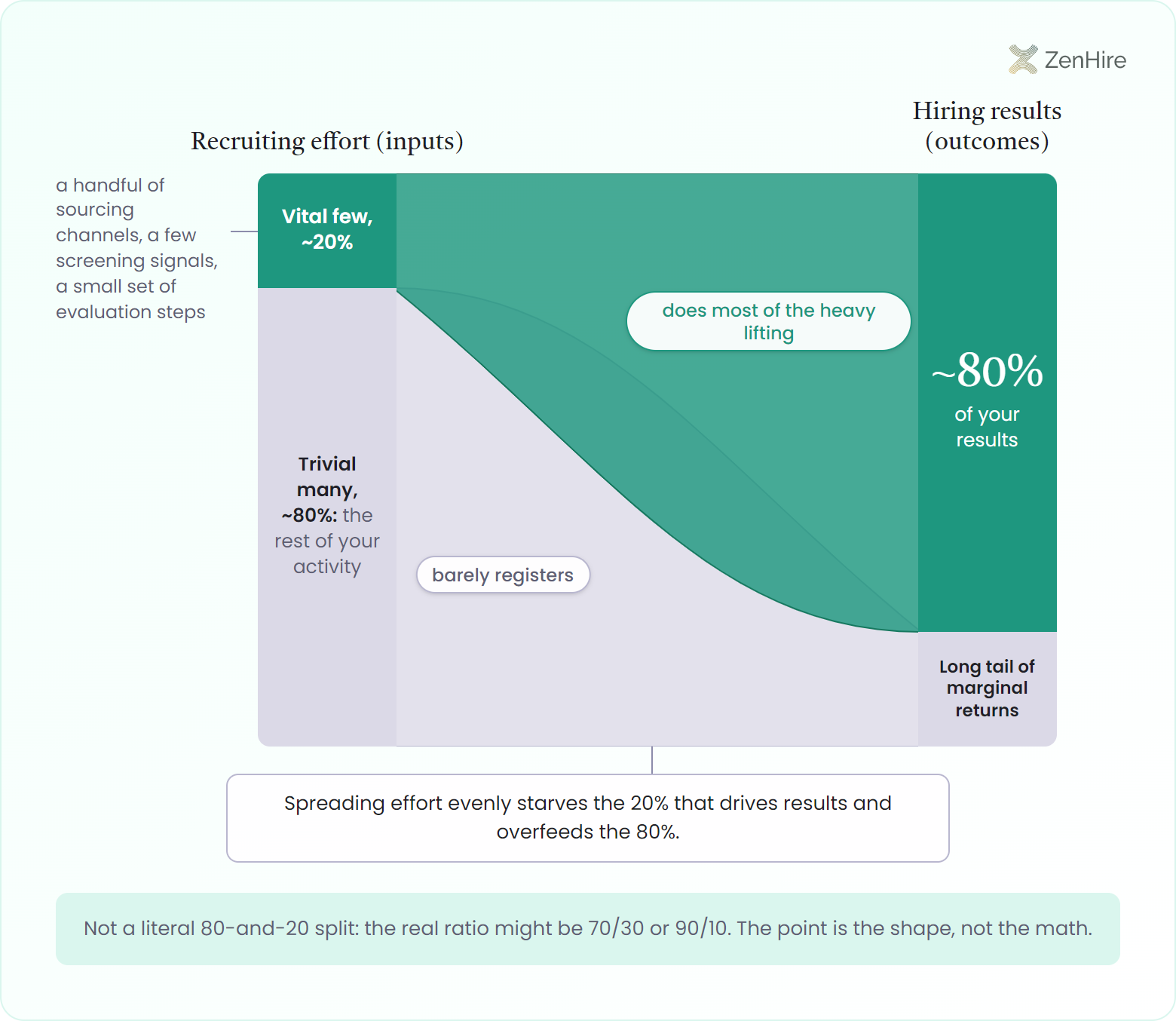
The 80/20 rule in recruiting is the Pareto principle applied to hiring: the observation that outcomes are not evenly distributed, so roughly 20% of your inputs account for around 80% of your results. In hiring terms, a handful of sourcing channels, a few screening signals, and a small set of evaluation steps do most of the heavy lifting, while the rest of your activity produces a long tail of marginal returns.
The pareto principle in recruiting is not a literal 80-and-20 split; the real ratio might be 70/30 or 90/10. The point is the shape, not the math: effort and outcomes are lopsided. Treat the rule as a lens for asking which fraction of your work actually moves the metrics that matter, like quality of hire and time to hire, and which fraction just feels like progress.
Where teams go wrong is assuming every resume, every channel, and every interview round deserves equal attention. That instinct is fair but expensive. When you spread effort evenly, you starve the 20% that drives results and overfeed the 80% that barely registers, the opposite of what the rule prescribes.
Line the funnel up by predictive validity and the lopsidedness is obvious: a plain resume review sits at r = 0.14, an unstructured interview inches up to ~0.18, and a structured interview reaches ~0.28, yet the first two soak up the bulk of recruiting hours. The steps in the vital 20% (structured, validated evaluation) are precisely the ones starved of time.
- Pareto principle: a small share of inputs produces most of the outputs; outcomes are lopsided, not even
- Vital few vs. trivial many: a few channels and signals carry the result; the rest is a long, flat tail
- The ratio is directional: 80/20 is shorthand, not a precise measurement of your funnel
- The lesson is allocation: find the high-yield fraction and protect it from being diluted
Which 20% of effort drives 80% of hires under the 80/20 rule?
Under the 80/20 rule, the 20% of effort that drives 80% of hires is almost always your evaluation step and your top one or two sources, not the raw volume of applications you process. Sourcing gets the credit because it is visible and busy, but the decision that actually predicts a good hire happens when you evaluate fit, reliability, and skill consistently. That is the vital few.
Concretely, the high-yield 20% tends to be: the two channels that produce candidates who pass and stay; the structured evaluation that separates real ability from resume polish; and the early reliability and communication signals that predict tenure. The low-yield 80% is manual resume triage, chasing every job board, and unstructured chats where each interviewer applies a different bar. Consistent, scaled evaluation is exactly what an AI interview and a structured interview process deliver: every candidate clears the same bar, scored the same way.
A concrete example: a contact-center team posting to six boards found that two sources produced nearly all the candidates who cleared screening and passed 90 days, while the other four generated volume and noise. Reallocating spend and recruiter time toward those two, and standardizing the screen, lifted yield without adding headcount. The edge case to watch: 80/20 is descriptive of the past, not a promise about the future. A channel that was vital can decay, and over-concentrating on one source creates fragility, so re-measure each quarter and keep a credible backup before you cut the tail entirely.
| Hiring method | Predictive validity (r) | 80/20 verdict |
|---|---|---|
| Resume / CV review | ~0.14 | High effort, low yield: the 80% to trim |
| Unstructured interview | ~0.18 | Feels productive, predicts little |
| Structured interview | ~0.28 | Part of the vital 20% |
| Cognitive + skills tests | 0.45-0.5+ | High signal per hour invested |
| Combined validated methods | 0.6+ | The 20% that drives most good hires |
How do you apply the 80/20 rule to your funnel?
You apply the 80/20 rule to your funnel by measuring where hires actually come from, then reallocating effort from the low-yield 80% to the high-yield 20%, first by source, then by stage, then by signal. The work is unglamorous: tag every hire with its origin, attach a quality and retention outcome, and let the distribution tell you which fraction earns its keep.
Start at the source. Pull hires by channel and segment them by who passed screening and who survived 90 days, not who applied. Two or three channels usually dominate, so tightening your sourcing strategy means doubling down there and pruning the rest. Then move to the stage: time the work in each step against the hires it produces, and you will typically find manual resume triage eating the most hours while predicting the least. That is the classic 80/20 inversion to fix, and it is where lowering your cost per hire and time to hire usually starts.
A concrete example: a team spending three recruiter-days a week manually triaging resumes shifted that triage to automated screening, freeing those days for structured evaluation and candidate experience, the steps that actually predict tenure. The edge case: in genuinely low-volume or highly specialized hiring, the distribution flattens. When every hire is critical and you make only a handful a year, there is no trivial 80% to cut, and the rule inverts: each candidate warrants the full, consistent evaluation rather than triage. Apply the lens, but verify the distribution before you act on it.
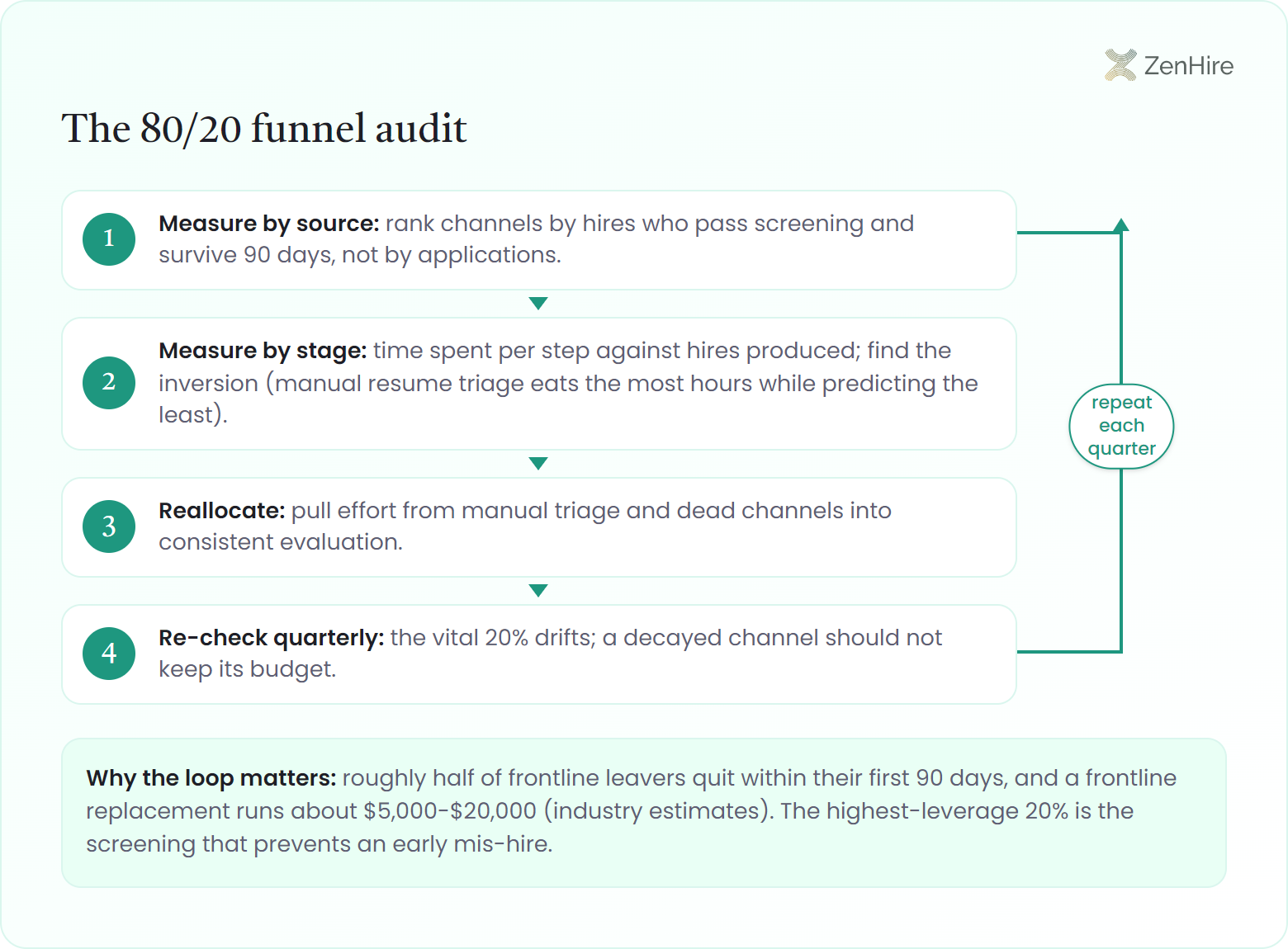
The reallocation has a hard ceiling worth respecting: in high-volume hiring, roughly half of frontline leavers quit within their first 90 days and a frontline replacement runs about $5,000-$20,000 (industry estimates). That means the highest-leverage 20% is the screening that prevents an early mis-hire, the single most expensive thing a thin, evenly-spread funnel lets slip through.
- Measure by source: rank channels by hires who pass and stay, not by applications
- Measure by stage: time spent per step against hires produced; find the inversion
- Reallocate: pull effort from manual triage and dead channels into consistent evaluation
- Re-check quarterly: the vital 20% drifts; a decayed channel should not keep its budget
I am suspicious of 80/20 when people use it to justify doing less. The honest version is harder: it tells you that most of your hiring time is going to the step that predicts the least, reading resumes, and almost none is going to the step that predicts the most. We did not build ZenHire to help teams skim faster. We built it so the high-yield 20% (consistent, evidence-based evaluation) is the part that scales, and the resume-shuffling 80% is the part the machine quietly absorbs. Find your vital 20%, protect it, and let everything else get smaller.
Frequently asked questions
What is the 80/20 rule in recruiting in simple terms?+
The 80/20 rule in recruiting means roughly 20% of your effort produces about 80% of your good hires: a small set of channels and screening decisions does most of the work. It is the Pareto principle applied to hiring, and the practical takeaway is to find that vital 20% and stop spreading attention evenly across everything.
Is the 80/20 split in recruiting exact?+
No, 80/20 is a directional ratio, not a precise measurement. Your real distribution might be 70/30 or 90/10. What matters is the shape: effort and outcomes are lopsided, so the lens is for finding the high-yield fraction, not for hitting an exact number.
Which part of recruiting is the high-leverage 20%?+
The high-leverage 20% is almost always consistent evaluation and your top one or two sources, not raw application volume. The validity numbers make the case: a resume scan barely registers at ~0.14, while a structured interview jumps to ~0.28 and combined validated methods clear 0.6, so the step carrying the most signal is the one you should protect from being crowded out.
Does the 80/20 rule mean I should ignore the other 80%?+
Not ignore; shrink and automate. The trivial many (manual resume triage, low-yield channels) should consume less of your time, often by handing repetitive screening to automation, so the freed hours flow into the vital 20% that predicts tenure.
When does the 80/20 rule break down in hiring?+
The 80/20 rule breaks down in low-volume or highly specialized hiring, where the distribution flattens and there is no trivial 80% to cut. When you make only a few critical hires a year, every candidate warrants full, consistent evaluation rather than triage.
Free for 80/20 rule in recruiting
The 80/20 recruiting audit
A one-page worksheet to find your vital 20%: how to rank channels by hires who stay, time each funnel stage against its yield, and spot the effort inversion most teams miss.