
What Is an Employer of Record (EOR)?


· 10 min read
An employer of record (EOR) is the third party that legally employs your worker, running payroll, tax withholding, benefits, and statutory compliance, while you direct the day-to-day job. It lets you hire in a country or state where you have no legal entity, compressing a months-long incorporation into days-long onboarding for a per-worker monthly fee. An EOR handles employment, not selection: it never screens candidates, and a mis-hire still costs $5,000-$20,000 for frontline roles or 50-200% of annual salary for skilled ones (SHRM).
What does an employer of record do?
An employer of record does everything that makes someone legally employed, except the work itself. It signs the employment contract, runs payroll, withholds and remits taxes, administers benefits, files statutory paperwork, and absorbs the compliance liability that comes with being an employer in a given jurisdiction. You still choose the person, set their tasks, manage their performance, and decide when the engagement ends; the EOR simply becomes the named legal employer so all of that can happen lawfully in a place where you have no entity.
The mechanism is a split of roles. On paper, the worker is employed by the EOR; in practice, they work for you. The EOR is the registered employer in the relevant country or state, which means it carries the local registrations, the payroll tax accounts, and the obligations around leave, termination notice, and mandatory benefits. This is what separates an EOR from a staffing agency: a staffing agency typically sources and supplies candidates, whereas an EOR formalizes the employment of a worker you have already selected.
As a concrete example, picture a company headquartered in one country that wants to hire a single support specialist in another where it has no subsidiary. Registering an entity there could take months and ongoing accounting overhead for one hire. Instead, the company engages an EOR already established in that market; the EOR puts the specialist on its own payroll, handles local tax and social contributions, and invoices the company a fee. The specialist reports to the company day to day but is, legally, the EOR's employee.
The edge case to watch is misclassification and permanent-establishment risk. An EOR keeps a worker correctly classified as an employee, which is exactly the protection contractors lack, but if you start treating the arrangement like a long-term, independent operation (signing local contracts, generating in-country revenue through that person), tax authorities may decide you have a taxable presence anyway. An EOR removes the employment-law risk; it does not, on its own, remove every tax consequence of operating in a market.
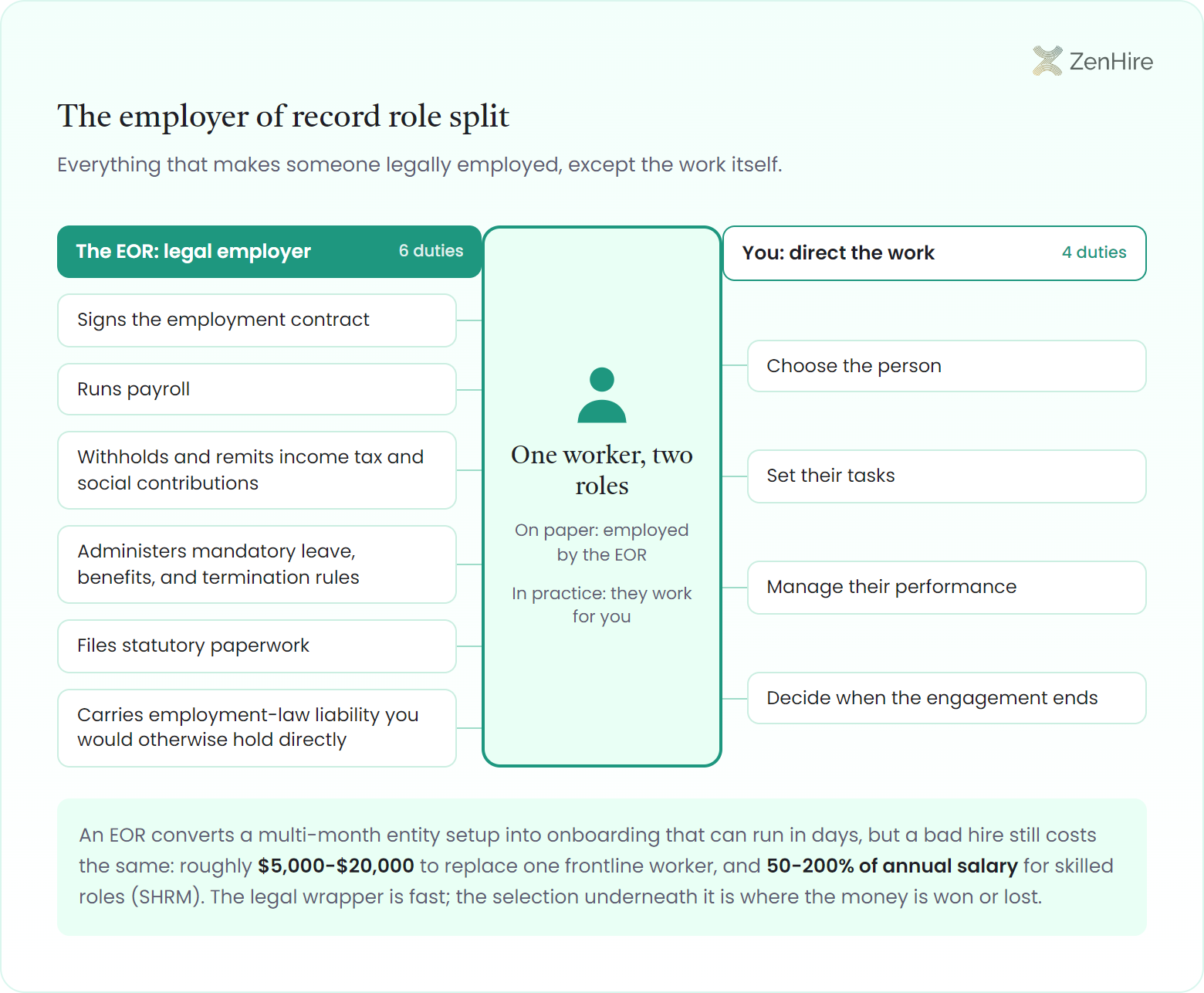
An EOR converts a multi-month entity setup into onboarding that can run in days, but it does not change what a bad hire costs. Industry estimates still put the cost of replacing one frontline worker at roughly $5,000-$20,000, and SHRM puts skilled-role replacement at 50-200% of annual salary. The legal wrapper is fast; the selection underneath it is where the money is won or lost.
- Legal employment: owns the contract and is the named employer in the jurisdiction
- Payroll and tax: pays the worker, withholds and remits income tax and social contributions
- Benefits and statutory compliance: administers mandatory leave, benefits, and termination rules
- Risk transfer: carries employment-law liability that you would otherwise hold directly
When do you use an employer of record instead of hiring directly?
You use an employer of record instead of hiring directly when you need a legal employee in a place where you have no entity, or where standing one up is not worth it for the headcount involved. The deciding factor is rarely the person and almost always the geography: if you already have a registered company in the worker's country or state, you can usually hire them directly and skip the EOR fee. The EOR earns its keep precisely when direct employment is blocked by the absence of a local entity.
The mechanism is a cost-and-speed trade. Opening an entity means incorporation, local bank accounts, payroll registration, and ongoing accounting and filing obligations, sensible if you are committing to a market with many hires, wasteful if you want one or two people there now. An EOR collapses that overhead into a per-worker monthly fee, so the math favors an EOR for small or exploratory headcount and tips back toward your own entity as the team in that market grows. Either way, the fee only pays off if you keep recruitment costs disciplined on the selection side.
As a concrete example, a company expanding into a new region might place its first three hires through an EOR to test demand without committing to incorporation. If the region works and headcount climbs past a dozen, the recurring EOR fees start to exceed the cost of running an entity, and the company migrates those employees onto its own payroll. The EOR was the right tool for the entry phase and the wrong one for the scale phase.
The edge case is highly regulated or security-sensitive work. Some roles (certain public-sector, defense, or licensed positions) require the worker to be directly employed by the contracting organization, or restrict who can legally employ them. In those situations an EOR is not an option regardless of geography, and the choice collapses back to direct hiring with full local setup. Always confirm the role itself permits an EOR before assuming geography is the only constraint; for high-volume entries, our guidance on reducing time to hire and seasonal hiring covers the speed levers an EOR does not touch.
| Situation | Direct hire or EOR? |
|---|---|
| You have a registered entity in the worker's location | Direct hire, no EOR fee needed |
| No entity, one to a few hires in a new market | EOR, the fastest, lowest-overhead path |
| No entity, but scaling to a large local team | Start EOR, migrate to your own entity as headcount grows |
| Regulated, licensed, or security-cleared role | Direct hire, an EOR is often not legally permitted |
How does an employer of record fit your hiring stack?
An employer of record fits at the very end of your hiring stack: it formalizes the employment after the selection decision is already made, not before. An EOR is an employment-and-compliance layer, not a sourcing, screening, or assessment layer. It answers the question "how do we legally employ this person here?" and is silent on the question that actually drives quality: "is this the right person to employ at all?" That earlier question is where mis-hires are prevented or created, and the EOR inherits whatever decision you feed it.
The mechanism is sequential. Sourcing finds candidates, structured screening and assessment decide who is worth an offer, and only then does the EOR convert your chosen candidate into a compliant employee. Because the EOR is downstream, the predictive power of your pipeline is entirely set upstream, and the evidence gap between methods is stark. Handing the EOR a candidate picked from a resume scan is handing it a decision that predicts eventual performance at only about r = 0.14; an unstructured interview barely improves on that at roughly 0.18. A structured interview lifts the signal to about 0.28, and layering cognitive and skills assessments on top pushes the combined figure past 0.6. The EOR contract reads identically whether the person behind it was chosen on a 0.14 hunch or a 0.6 measurement; the gap only surfaces months later, in who is still on that compliant payroll.
As a concrete example, a team hiring offshore support staff might run every candidate through a consistent, AI-assisted screen for communication, reliability signals, and a CEFR-aligned English assessment that grades spoken fluency rather than a resume claim, and only then hand the chosen hire to an EOR to put on a compliant local contract. The EOR makes the employment legal; the screen makes the hire good. Skipping the screen because the EOR makes onboarding fast is how fast hiring becomes expensive hiring.
The edge case is the cross-border English-screening trap. Teams using an EOR to hire in offshore markets often assume the EOR vets language ability, but it does not. EORs handle contracts and payroll, not capability, so spoken-English quality has to be measured before the EOR ever sees the candidate. Industry research from PhD-linguist comparisons finds untrained human recruiters align with expert language ratings only about 68-75% of the time, which is why front-loading a structured, audio-only assessment matters more, not less, when an EOR is removing all the other friction. To keep the whole pipeline honest before the EOR step, pair this with outstaffing and your broader recruitment strategy.
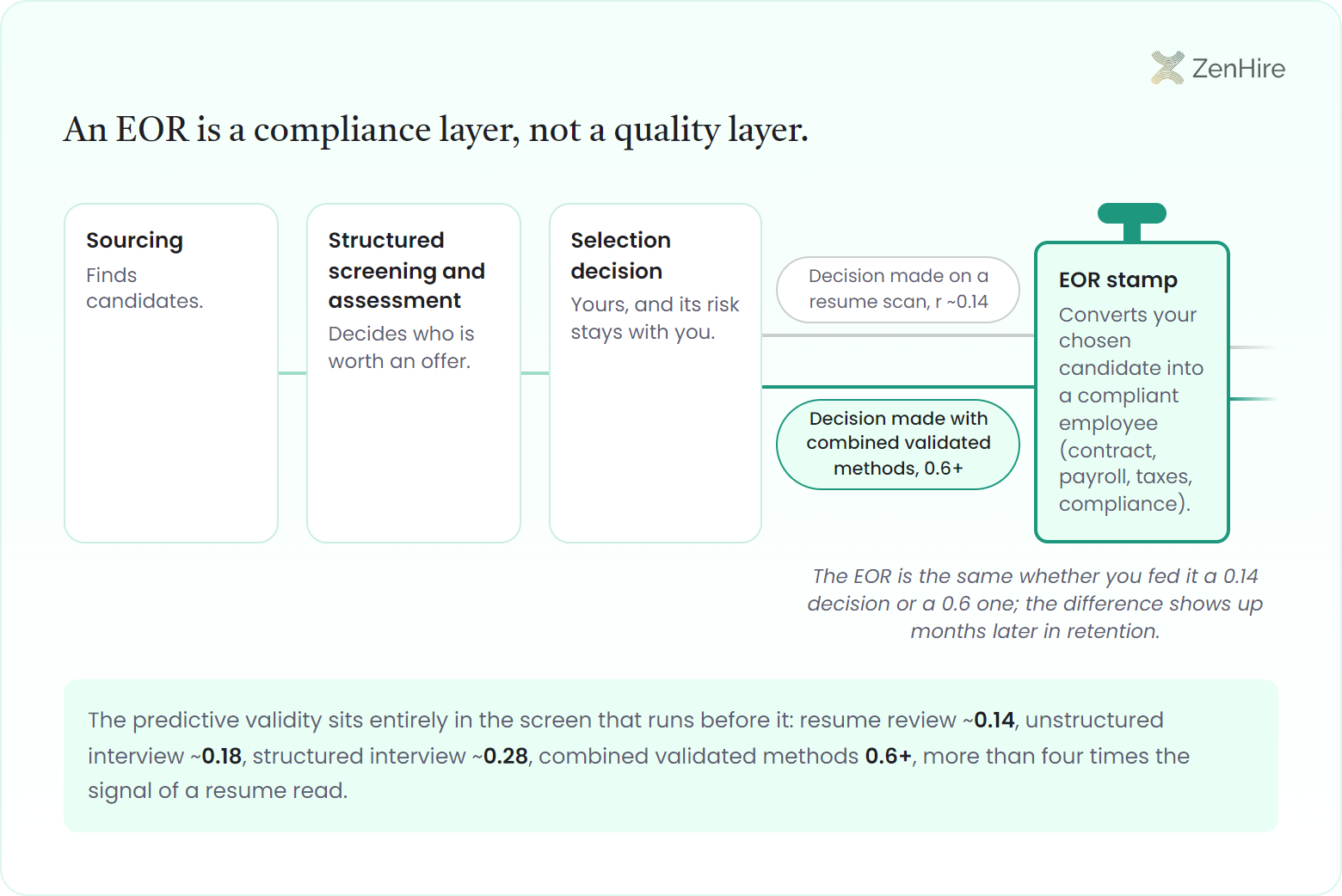
An EOR is a compliance layer, not a quality layer. All of the predictive validity is spent before the contract exists, in the screen that ranks your candidates: a resume review lands at only ~0.14, an unstructured interview ~0.18, a structured interview ~0.28, and combined validated methods 0.6+, over four times the signal of reading a CV. Because the EOR simply formalizes whichever candidate you hand it, the market you are entering does not lower that bar; it raises it.
People come to an EOR for speed, and that is exactly where the danger hides. When you can put someone on a compliant payroll in a new country in days, it is tempting to treat the hire as solved: the paperwork is done, so the decision must be done too. But the EOR never looked at whether the person can actually do the job; it only made the employment legal. I have seen teams move fast on the contract and slow on the screen, then wonder why a clean, compliant hire still washed out at 90 days. An EOR is a brilliant way to employ the right person anywhere. It is a very expensive way to employ the wrong one. Get the screen right first, and let the EOR do what it is good at.
Frequently asked questions
What is the difference between an EOR and a staffing agency?+
The difference is who picks the worker. A staffing agency sources and supplies candidates for you to choose from, while an employer of record formalizes the employment of a worker you have already selected. An EOR is an employment-and-compliance layer; it does not source, screen, or decide who is a good hire.
Does an employer of record screen or vet candidates?+
No, an employer of record does not screen, assess, or vet candidates. It handles contracts, payroll, taxes, and compliance after you have chosen who to hire. Screening, including spoken-English and reliability assessment, has to happen upstream, before the EOR ever sees the person, because the EOR inherits whatever hiring decision you hand it.
When should I use an EOR instead of opening my own entity?+
Use an EOR when you have no legal entity in the worker's location and the headcount does not justify creating one. For one to a few hires in a new market, an EOR is faster and cheaper than incorporation. Once a local team scales into double digits, recurring EOR fees often exceed the cost of running your own entity, and migrating off the EOR becomes the better choice.
Is an employer of record legal everywhere?+
An EOR is legal in most markets but not for every role. Highly regulated, licensed, or security-cleared positions sometimes require direct employment by the contracting organization, which rules out an EOR regardless of geography. Always confirm the specific role permits an EOR before assuming the absence of a local entity is the only constraint.
How much does a bad EOR hire cost?+
A bad EOR hire costs the same as any other bad hire. Industry estimates put frontline replacement at roughly $5,000-$20,000, and SHRM puts skilled-role replacement at 50-200% of annual salary. The EOR makes onboarding fast, but it does nothing to make the underlying selection correct, so the quality of hire is unchanged.
Free for employer of record hiring
The cross-border hiring screen checklist
A one-page checklist for screening before the EOR step: the reliability and communication signals to weight, how to grade spoken English fairly, and where compliance ends and capability begins.